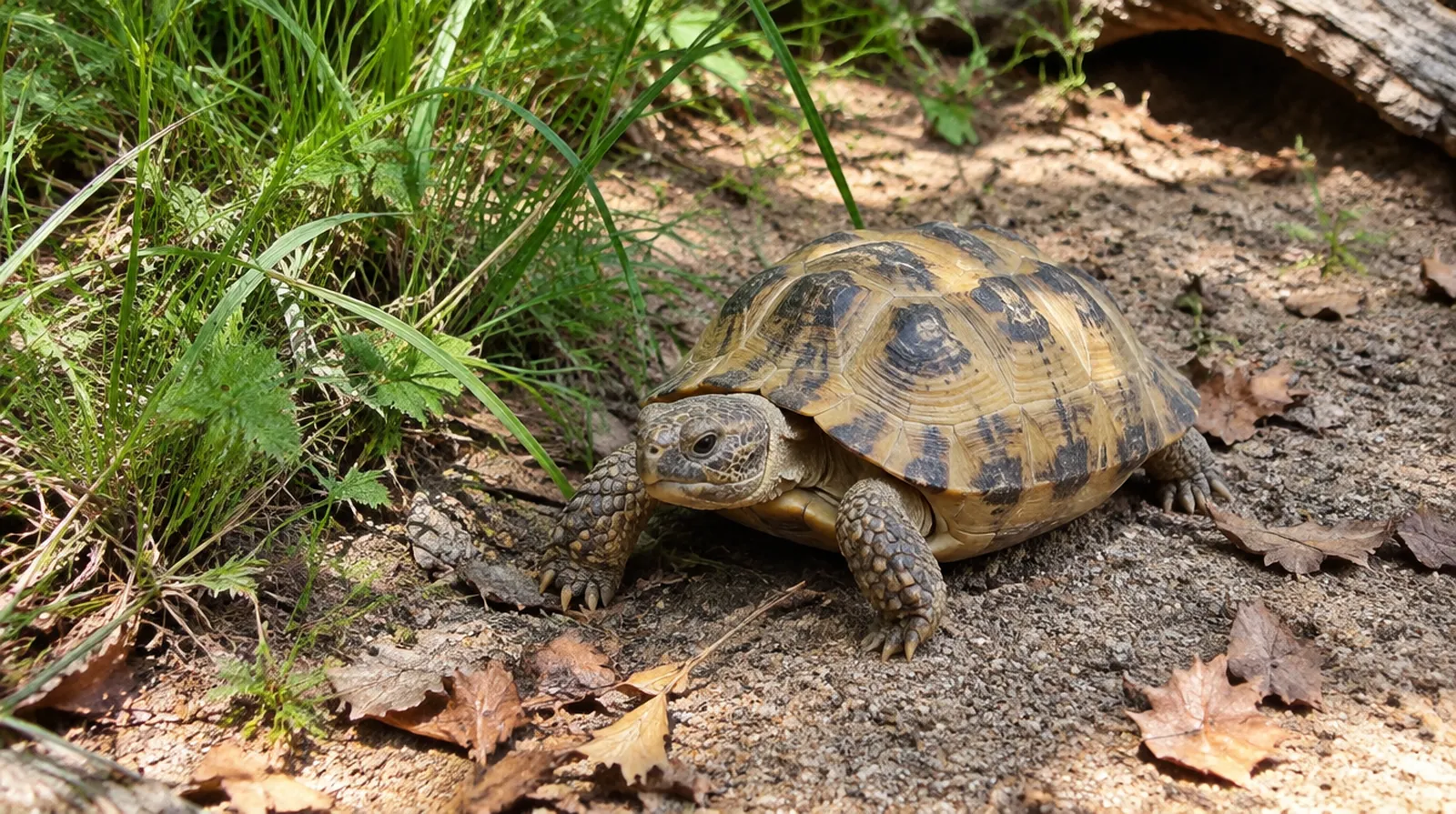
Paperwork. Russian tortoises (Testudo horsfieldii) are listed on CITES Appendix II and EU Annex B. In the EU and UK you should get proof of legal, captive-bred origin from the seller and keep it. Check local rules wherever you live.
Is a Russian tortoise right for you?
Russian or Horsfield's tortoises come from the dry steppes and hills of Central Asia, where they spend much of the year in burrows. They're one of the smallest common pet tortoises, hardy, active and easy to feed.
The catch: they live for decades, dig constantly, and need much more floor space than most pet shops suggest. Tortoises are also slow to show illness, so setup matters.
Enclosure
| Tortoise | Enclosure |
|---|---|
| Hatchling / juvenile | 36×18 in tortoise table, temporarily |
| One adult (minimum) | 4×2 ft (120×60 cm) |
| One adult (better) | 8×4 ft indoors, or a secure outdoor pen |
Use an open-topped tortoise table or a large enclosure with solid sides. Glass tanks are a poor fit: tortoises try to walk through the glass and airflow is poor.
Outdoor pens are excellent in warm, dry weather. Russian tortoises are serious diggers and good climbers, so sink the walls 12 in or more into the ground (or bury mesh), add an inward lip at the top, and cover the pen against predators.
Heating
- Basking surface: 95–100°F (35–38°C)
- Cool side: 70–75°F (21–24°C)
- Night: can drop to 60–65°F (16–18°C)
Use a halogen flood bulb over the basking area, controlled by a thermostat.
Lighting and UVB
UVB is essential indoors. Use a T5 HO 10–12% tube over the basking area, replaced every 12 months, with 12–14 hours of light a day. Natural sunlight outdoors (not filtered through glass) is even better.
Humidity and substrate
Keep ambient humidity around 40–60%. Use 4–6 inches of a soil/sand mix that holds a burrow, and keep the deeper layer slightly moist. That gives the tortoise a humid retreat, as in a wild burrow. A shallow water dish they can climb in and out of should always be available, and a weekly shallow soak is helpful for juveniles.
Diet
Russian tortoises are herbivores adapted to tough, high-fibre plants.
Feed often: dandelion leaves and flowers, plantain (Plantago), clover, chicory, endive, escarole, sow thistle, mallow, and grasses or hay.
Occasionally: romaine and other lettuces (fine, but low in nutrients), tortoise pellets as a supplement.
Avoid: fruit, meat, dog or cat food, bread, and large amounts of spinach, kale or other high-oxalate or goitrogenic greens.
Offer fresh food daily (adults can go a day without), and dust with plain calcium 3–5 times a week plus a multivitamin weekly.
Brumation
In the wild, Russian tortoises brumate (hibernate) through winter. Only healthy, well-fed adults should brumate, at a controlled 39–46°F (4–8°C). If you're new to tortoises, talk to a reptile vet before attempting it; many keepers keep them awake year-round instead.
Handling
They tolerate handling but don't enjoy being lifted. Support the shell from below with both hands and keep them low to the ground.
Common mistakes
- A small glass tank.
- No UVB or calcium, causing shell and bone problems.
- Feeding fruit, lettuce only or "tortoise mixes" with dyes.
- Outdoor pens without buried barriers.
- Brumating a sick or underweight tortoise.
Signs of a healthy tortoise
Active, alert and eating well, eyes clear, nostrils dry, shell hard and smooth. Bubbles from the nose, swollen eyes, a soft shell or lethargy outside brumation need a reptile vet.
FAQ
What size enclosure does a Russian tortoise need? 4×2 ft minimum for one adult; 8×4 ft or an outdoor pen is better.
What do Russian tortoises eat? Mostly weeds and leafy greens plus hay. No fruit or meat.
How long do Russian tortoises live? 40–50 years or more.