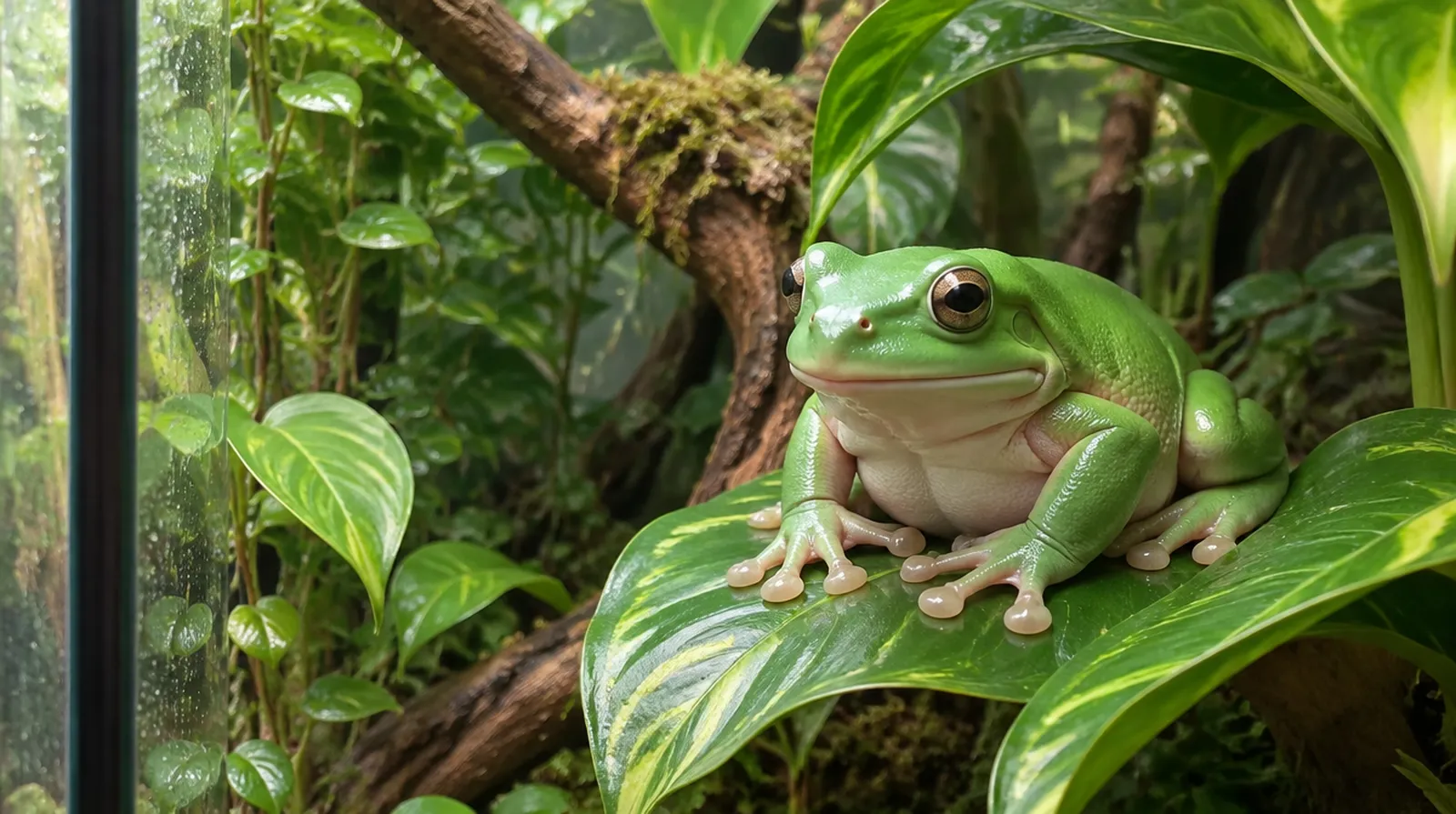
Is a White's tree frog right for you?
White's tree frogs (Ranoidea caerulea, formerly Litoria caerulea), also called dumpy or Australian green tree frogs, live across northern and eastern Australia and southern New Guinea, often near houses and water tanks. Pets are captive-bred, often in blue, "snowflake" and other colour forms.
They're hardy, nocturnal and calm, and tolerate more variation than most frogs. Their main risks are obesity, chlorinated water and handling with dirty or lotion-covered hands.
Enclosure
| Frogs | Enclosure |
|---|---|
| Juvenile | 12×12×18 in |
| 1–2 adults (minimum) | 18×18×24 in |
| 1–3 adults (better) | 18×18×36 in or larger |
They're arboreal, so prioritise height. Add sturdy branches and cork bark that can hold a heavy frog, broad-leaved plants (pothos, philodendron) for perching, and a large shallow water dish. A front-opening glass enclosure with a screen top is ideal.
Temperature
- Day: 75–85°F (24–29°C)
- Warm spot: up to about 85–88°F (29–31°C) near the top
- Night: 65–75°F (18–24°C)
Most homes need only a low-wattage basking bulb on a thermostat. Keep the bulb outside a mesh top so frogs can't touch it.
Lighting
Low-level UVB (ShadeDweller-type, 2–7%) with shaded areas is recommended, plus a plant light if you keep live plants. 12 hours of light per day.
Humidity and water
Keep humidity around 50–70%. Mist in the evening and let the enclosure dry partly during the day; White's tree frogs come from seasonally dry habitats and don't need a swamp.
Water safety: amphibians absorb water through their skin. Use dechlorinated water (with a conditioner that removes chlorine and chloramine) for misting and the dish, and change the dish daily.
Substrate
A coco fibre/soil mix with leaf litter, or a bioactive setup, holds humidity well. Avoid gravel and small pebbles that can be swallowed.
Feeding
| Age | Food | Frequency |
|---|---|---|
| Juvenile | Small crickets, dubia | Daily |
| Adult | Crickets, dubia roaches, silkworms, occasional hornworms | Every 2–3 days |
Gut-load insects and dust with calcium + D3 at most feedings and a multivitamin every 1–2 weeks. Don't feed pinky mice. Watch for obesity: fat ridges above the eyes and over the back mean feed less.
Housing together
White's tree frogs can live in small groups of similar size. Watch that every frog is eating, and never mix them with other species or much smaller frogs (they'll eat anything that fits in their mouth).
Handling
Keep it brief. Wash hands thoroughly (no soap residue, lotion or sanitiser) and wet them with dechlorinated water first. Let the frog climb onto your hand rather than grabbing it.
Common mistakes
- Overfeeding and obesity.
- Tap water that hasn't been dechlorinated.
- Short, horizontal tanks.
- Handling with lotions or sanitiser on hands.
Signs of a healthy White's tree frog
Bright skin colour (they change shade, which is normal), clear eyes, good appetite and active at night. Cloudy eyes, red skin on the belly or legs, a bloated body or lethargy need an exotics vet.
FAQ
What size tank does a White's tree frog need? 18×18×24 in minimum for 1–2 adults.
Can they live together? Yes, in small groups of similar-sized frogs.
How often should I feed them? Juveniles daily, adults every 2–3 days.