About the Asian water monitor
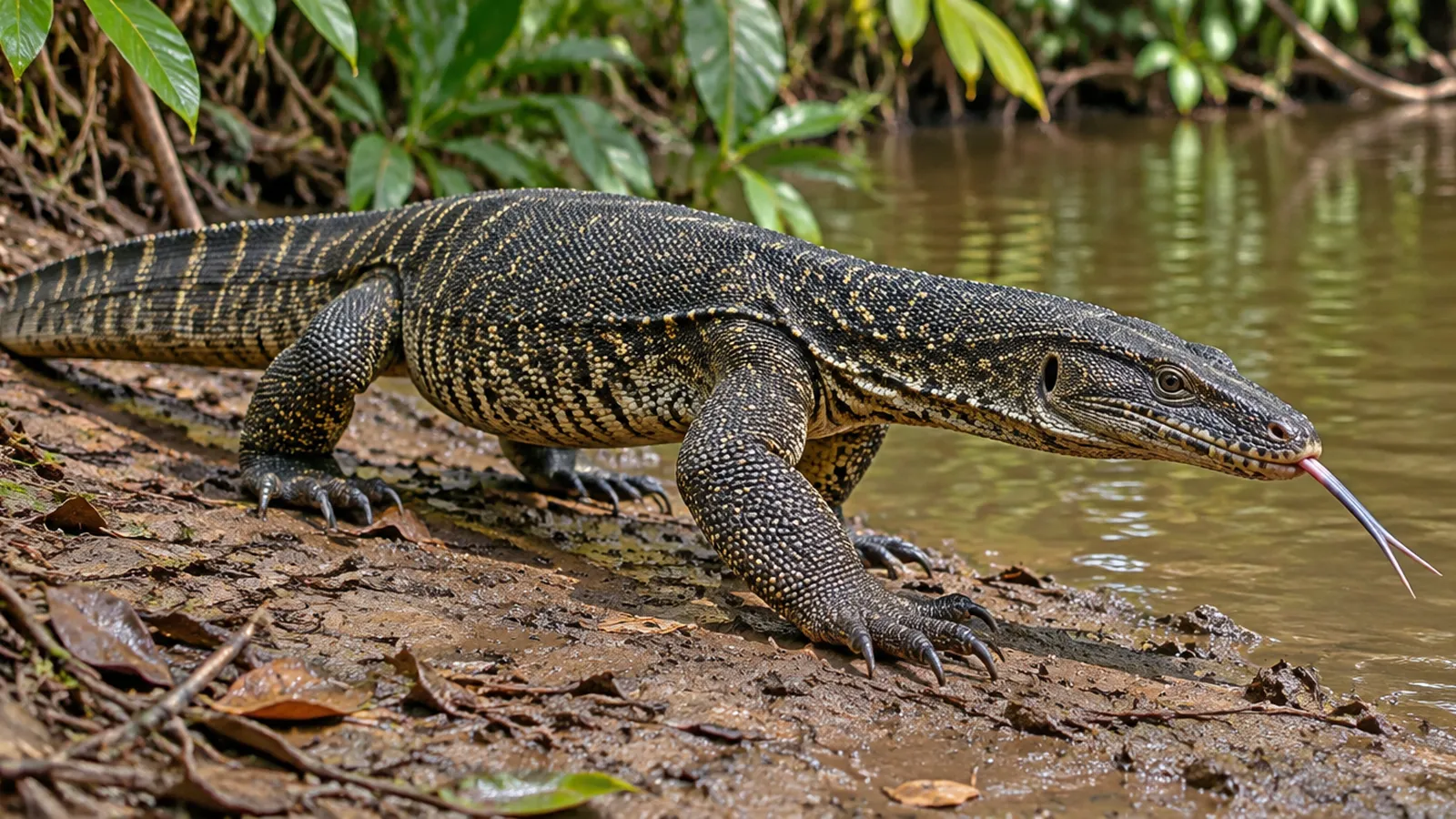
The Asian water monitor (Varanus salvator) is found across South and Southeast Asia, from India and Sri Lanka to Indonesia and the Philippines. It's one of the largest lizards in the world, second only to the Komodo dragon in weight, and commonly reaches 1.5–2.5 m (5–8 ft), with big males growing even larger.
As the name suggests, it's semi-aquatic. In the wild it lives along rivers, swamps, mangroves and coasts, and also around towns and rice fields, where it eats almost anything it can catch or scavenge: fish, frogs, crabs, birds, eggs, rodents and carrion. It's a powerful swimmer and can stay underwater for long periods.
Water monitors are dark grey to black with rows of pale yellow spots that fade with age, a long neck, a narrow head with nostrils near the tip of the snout and a long, flattened tail used for swimming. They're also highly intelligent. Captive-bred water monitors that are handled regularly can become remarkably tame and interactive, which has made them popular with experienced keepers. But their size, strength and needs mean they are only suitable for people who can commit to a room-sized enclosure for 20 years or more.
Water monitors are listed on CITES Appendix II, and many places restrict or require licences for large monitors. Check the rules where you live before buying.
Housing
An adult Asian water monitor needs an enclosure of at least 300×150×180 cm (10×5×6 ft), and bigger is better. Many keepers convert a spare room or build a custom enclosure. Juveniles can start in something around 120×60×60 cm (4×2×2 ft) but grow quickly, often reaching over a metre in their first year or two.
The enclosure must include a large pool that the monitor can fully submerge and swim in. Since water monitors often defecate in the water, the pool needs to be easy to drain and clean, ideally with a drain or pump. Provide sturdy branches and shelves for climbing (juveniles especially like to climb), large hides and a deep substrate area for digging.
Substrate
A deep mix of topsoil and sand, or cypress mulch, holds humidity well and allows digging. Keep the substrate slightly damp underneath.
Heating
Monitors need a very hot basking surface to digest food and stay healthy. Aim for a basking surface temperature of around 50–60°C (122–140°F), measured with an infrared thermometer, with the ambient air at 27–32°C (80–90°F). The cool side can be around 26°C (79°F), and night temperatures shouldn't drop below about 24°C (75°F).
Create a large basking area using several halogen flood bulbs over a flat rock or slate, so the whole body can warm up. Use a thermostat or dimmer and guard all bulbs.
Lighting
Water monitors are active by day and need UVB. Use high-output T5 UVB tubes over the basking area for around 12 hours a day.
Humidity
Keep humidity at around 60–80%. The pool, damp substrate and regular misting usually maintain this.
Feeding
Water monitors eat a varied diet in the wild, and variety is just as important in captivity. Feed a mix of whole prey (appropriately sized rodents and chicks), fish (whole fish such as smelt or tilapia, avoiding fish high in thiaminase as a staple), large insects such as roaches and locusts, and occasional eggs, crabs and shellfish.
Juveniles can be fed most days with insects and small prey. Adults are prone to obesity and should be fed two or three times a week. Avoid processed foods and fatty meats as staples. Dust insects with calcium.
Handling
Captive-bred water monitors that are handled regularly from a young age can become very tame, but a frightened or defensive monitor can bite, scratch and whip with its tail. Build trust slowly with short sessions and food training. Always support the body and keep handling calm. Large adults should be handled with care, ideally with a second person present.
Sexing
Sexing monitors is difficult. Adult males are usually larger, with broader heads and thicker tail bases, and may show hemipenal bulges. A reptile vet can confirm the sex by probing, ultrasound or X-ray.
Breeding
Water monitors reach maturity at around 3–4 years old. Females lay clutches of 10–30 eggs, usually in a burrow or nesting area with deep, damp substrate. Eggs hatch after around 6–9 months. Breeding is rarely done in captivity due to the space required.
Common health problems
Most problems come from enclosures that are too small, basking spots that aren't hot enough, poor water hygiene and overfeeding. Obesity is very common in captive monitors. Dirty pool water can cause skin and gut infections. A healthy water monitor is alert and curious, has clear eyes, a strong appetite and a lean, muscular body.
FAQ
How big do they get? Usually 1.5–2.5 m, sometimes more.
Are they good pets? For experienced keepers with space, yes.
Do they need water? Yes, a large pool to swim in.