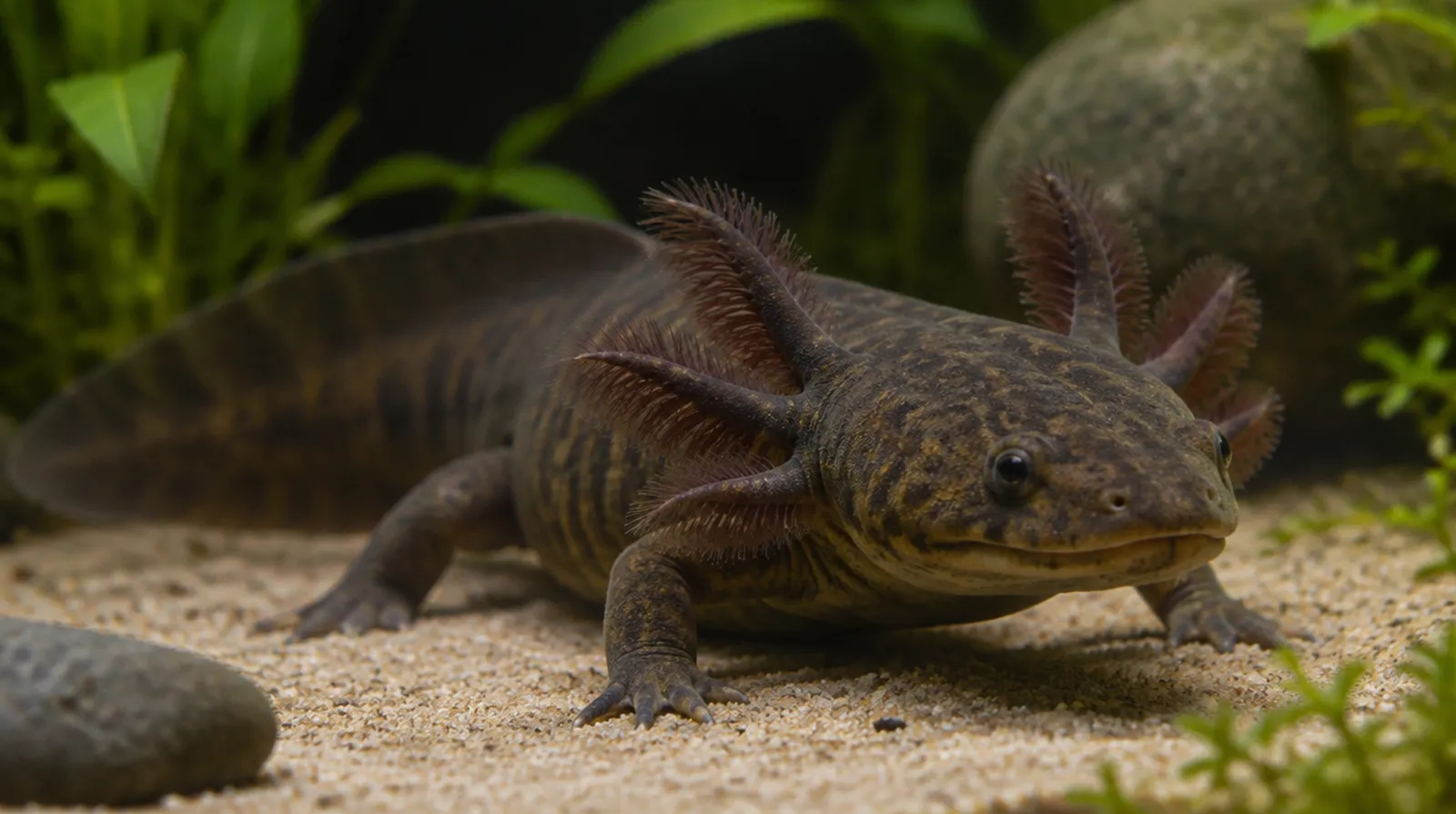
Check the law first. Axolotls are illegal or permit-only in some US jurisdictions, including California, Maine, New Jersey, Virginia and Washington DC, and effectively banned in Hawaii. Rules change, so confirm with your state or local wildlife agency before buying.
Is an axolotl right for you?
The axolotl (Ambystoma mexicanum) is a salamander that keeps its larval gills and stays fully aquatic for life. It's critically endangered in its only wild home, the canals of Lake Xochimilco in Mexico City, but bred in huge numbers in captivity in colours from wild-type brown to leucistic pink, gold and copper.
They're hardy if their water stays cool and clean, and fragile if it doesn't. The biggest mistakes are warm water, gravel, and putting an axolotl into a tank that hasn't been cycled.
Tank
| Axolotls | Tank |
|---|---|
| One adult | 20-gallon long (30×12 in) minimum |
| One adult (better) | 29–40 gallon |
| Two adults | 40-gallon breeder (36×18 in) or larger |
Floor space beats height: axolotls walk along the bottom. Use a lid, since they can jump. Add caves or wide pipes so they can get out of the light.
Water temperature
This is the rule that matters most. Keep the water at 60–64°F (16–18°C) and below 70°F (21°C). Above about 72°F (22°C), axolotls stop eating and become prone to fungal and bacterial infections.
You almost never need a heater. In summer, clip-on aquarium fans, a cool room or an aquarium chiller keep temperatures down. Don't rely on floating frozen bottles; the temperature swings are stressful.
Water quality and cycling
Axolotls produce a lot of waste, so the tank needs an established nitrogen cycle before the axolotl moves in. A fishless cycle usually takes 4–8 weeks.
- Ammonia: 0 ppm
- Nitrite: 0 ppm
- Nitrate: under 20 ppm
- pH: 6.5–8.0, stable
- Always use a water conditioner to remove chlorine and chloramine.
Use gentle filtration: a sponge filter or a canister with a spray bar. Strong current pushes their gills forward and stresses them. Test water weekly with a liquid test kit and do partial water changes of about 20–30% weekly.
Lighting
Axolotls have no eyelids and prefer dim conditions. They don't need UVB. If you want live plants, use low-light species (anubias, java fern, floating plants) and give the axolotl shaded hides.
Substrate
- Best: bare bottom or slate tiles.
- Fine sand (very fine, under about 1 mm) is OK for adults over roughly 5 inches.
- Never gravel or small pebbles. Axolotls suck food up from the bottom and swallow stones, which can cause fatal impaction.
Feeding
| Age | Food | Frequency |
|---|---|---|
| Juvenile (under ~5 in) | Bloodworms, chopped earthworms, small pellets | Daily |
| Adult | Earthworms (nightcrawlers), sinking axolotl pellets | Every 2–3 days |
Earthworms are the best staple: nutritionally complete and readily eaten. Buy them from bait shops or culture your own; avoid worms from areas treated with pesticides. Remove uneaten food so it doesn't foul the water. Feeder fish are not recommended: they can carry parasites and contain thiaminase.
Tank mates
Keep axolotls alone, or with other adult axolotls of a similar size. Juveniles nip limbs and gills off each other (they regrow, but it's stressful). Fish nip gills, and anything small enough to fit in an axolotl's mouth will be eaten. Snails can be swallowed too.
Handling
Avoid it. Axolotls have permeable skin, a protective slime coat and a skeleton made largely of cartilage. To move one, guide it into a container or use a soft fine-mesh net.
Common mistakes
- Warm water (above 70°F / 21°C).
- Adding an axolotl to an uncycled tank.
- Gravel substrate.
- Housing with fish or small juveniles together.
- Strong filter current.
Signs of a healthy axolotl
Full, fluffy gills held out to the sides, steady appetite, normal floating only briefly, and clear skin. Gills curled forward, fluffy white patches (fungus), constant floating or refusing food usually points to water temperature or quality. Test the water first, then see an exotics vet.
FAQ
What temperature should an axolotl tank be? 60–64°F (16–18°C), and below 70°F (21°C).
What size tank does an axolotl need? 20-gallon long minimum for one adult; 40-gallon breeder is better.
Can axolotls live with fish? No. Fish nip gills and small fish get eaten.
Are axolotls legal? In most places, but not in some US jurisdictions such as California, Maine, New Jersey, Virginia and Washington DC. Check locally.