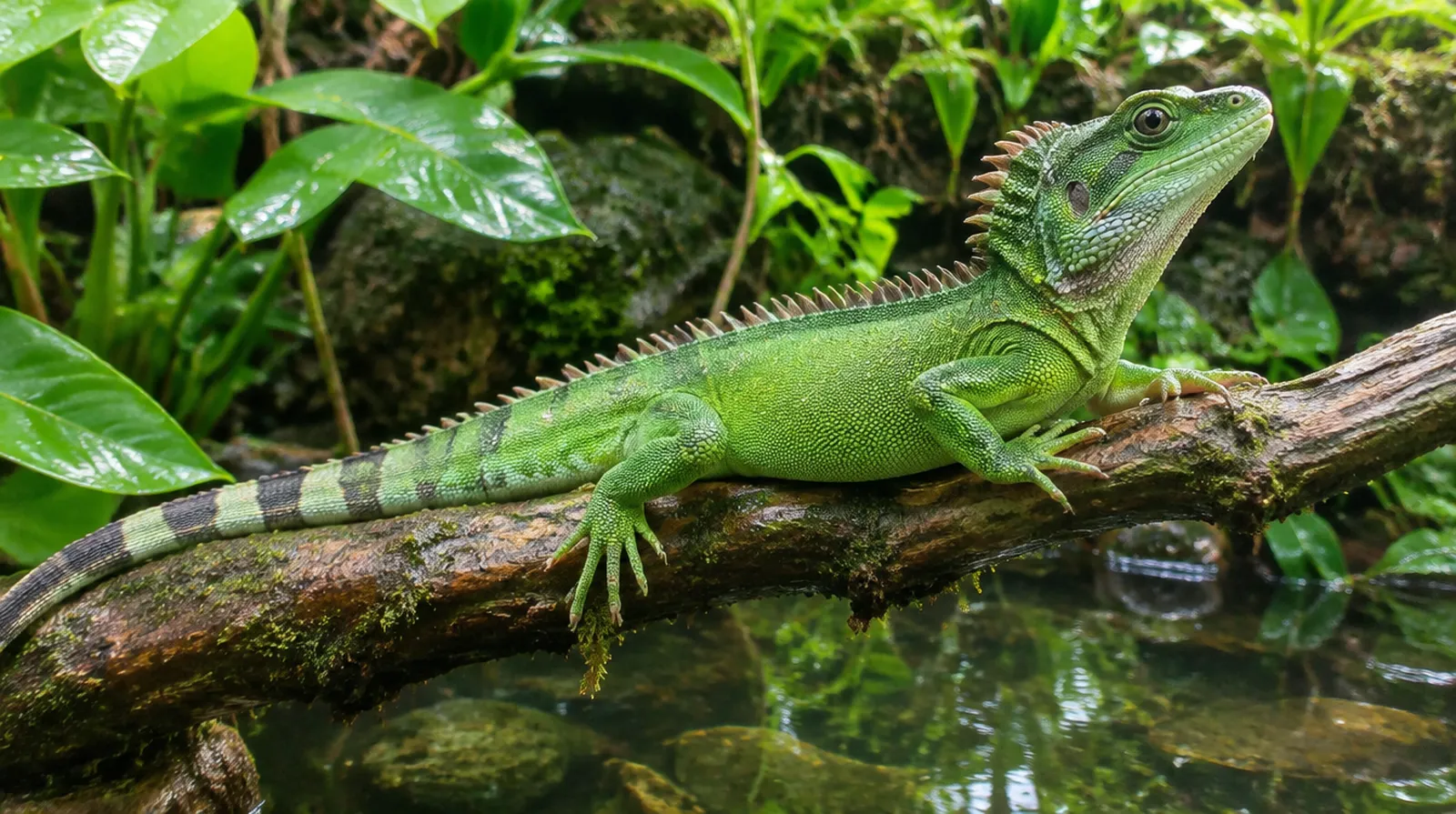
Is a Chinese water dragon right for you?
Chinese water dragons (Physignathus cocincinus) live along forested streams and rivers in southern China and Southeast Asia. They bask on branches over the water and drop in to escape danger.
They're beautiful and can become tame, but they're skittish, large and arboreal. Many end up in tanks far too small, where they injure their snouts by running into glass. If you can provide a tall enclosure with a big pool, they're very rewarding.
Enclosure
| Dragon | Enclosure |
|---|---|
| Hatchling | 36×18×36 in, temporarily |
| Juvenile | 4×2×4 ft or larger |
| Adult (minimum) | 6×3×6 ft (180×90×180 cm) |
Use a tall, solid-sided enclosure (PVC or custom wood) with mesh ventilation; solid sides reduce stress and help humidity. Glass aquariums are not suitable for adults. Add:
- A large water area the dragon can fully submerge in, cleaned often.
- Sturdy branches at different heights, one under the heat.
- Dense cover from live or artificial plants.
Nose rubbing: water dragons don't understand glass. Covering lower glass panels, adding cover and providing enough space reduces snout injuries.
Heating
- Basking branch: 90–95°F (32–35°C)
- Cool area: 77–86°F (25–30°C)
- Night: about 72–77°F (22–25°C)
Use halogen flood bulbs above the basking branch on a thermostat. Large adults may need more than one bulb.
Lighting and UVB
UVB is essential. Use a T5 HO 6% tube (or 10–12% mounted higher, as in a 6 ft tall enclosure) over the basking area, plus bright full-spectrum light. 12–14 hours of light per day; replace UVB every 12 months.
Humidity
Keep humidity 60–80%. A large water area, moisture-holding substrate, live plants and daily misting help. An automatic mister is worth considering. Keep ventilation good so the enclosure doesn't stagnate.
Substrate
A moisture-holding soil/coco mix, cypress mulch or bioactive substrate. Avoid sand, gravel and reptile carpet.
Diet
Chinese water dragons are mostly insectivorous.
- Staples: crickets, dubia roaches, black soldier fly larvae, silkworms, hornworms, earthworms.
- Occasional: small whole fish, and a little greens or fruit.
- Avoid: feeding pinky mice routinely (high fat).
| Age | Frequency |
|---|---|
| Juvenile | Daily |
| Adult | 3–4 times per week |
Dust insects with calcium at most feedings and a multivitamin weekly.
Housing together
Never house two males together. A male with females, or females together, can work in a large enough enclosure, but keeping one per enclosure is simplest.
Handling
Start with short, calm sessions. Many become tame with time; others stay jumpy. Adults have sharp claws, and a frightened dragon may leap, so handle low and close to the enclosure.
Common mistakes
- Enclosures far too small, especially glass tanks.
- No large water area.
- Low humidity.
- No UVB.
- Two males together.
Signs of a healthy water dragon
Bright green colour, active basking and climbing, good appetite, clean sheds. A swollen or wounded snout, a soft jaw, kinked tail, mouth discharge or dark colour all day need a reptile vet.
FAQ
What size enclosure does a Chinese water dragon need? 6×3×6 ft minimum for one adult.
What temperature? Basking 90–95°F (32–35°C); cooler area 77–86°F (25–30°C).
What do they eat? Mostly insects, plus occasional fish and a little greens or fruit.