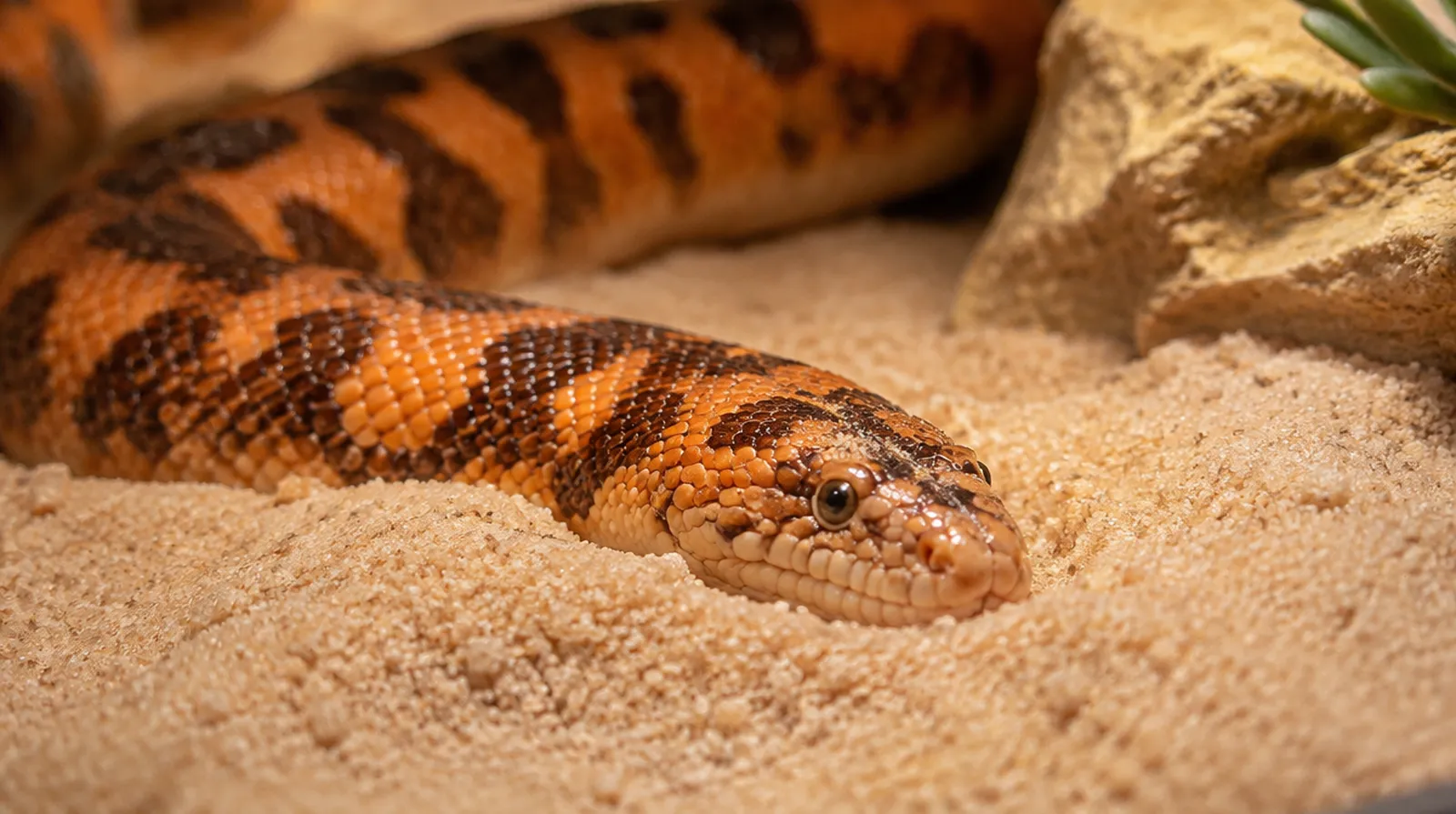
Is a Kenyan sand boa right for you?
The Kenyan sand boa (Eryx colubrinus, sometimes placed in Gongylophis) lives in the dry scrub and semi-desert of East and northeast Africa. It's a stout, small-eyed boa built for life under the sand, where it waits for prey to walk past.
They're slow, docile and rarely bite, need modest space and are bred in many colour morphs (anerythristic, albino, snow, "paradox" and more). The trade-off: you won't see them much, because a happy sand boa spends most of its time buried.
Like all boas, they're listed on CITES Appendix II (EU Annex B), so buy captive-bred.
Enclosure
| Snake | Enclosure |
|---|---|
| Hatchling | 10–20 gallon / small tub |
| Adult male | 24×18×12 in minimum |
| Adult female | 36×18×18 in minimum |
| Any adult (better) | 36×18×18 in or larger |
Use a secure lid. Provide a surface hide on each end plus the substrate itself, which is their main hide. A shallow, heavy water dish they can't tip over is important.
Heating
- Warm side surface: 90–95°F (32–35°C)
- Cool side: 75–80°F (24–27°C)
- Night: 70–75°F (21–24°C)
Sand boas thermoregulate by burrowing, so warming the substrate from above with a halogen or deep heat projector works well, as does a heat mat under one end. Use a thermostat either way.
Lighting
UVB is optional. Low-level UVB and a day/night light cycle can help activity patterns.
Humidity
Keep it fairly dry, around 30–50%. Damp substrate can cause skin infections. Mist one corner slightly, or provide a humid hide, around shed time.
Substrate
Give them at least 4 inches of something they can burrow in: a sand/soil mix, aspen shavings or a mix. Avoid cedar and pine, and avoid fine dusty calcium sand.
Feeding
| Age | Prey | Frequency |
|---|---|---|
| Hatchling | Pinky mouse | Every 5–7 days |
| Juvenile | Fuzzy to hopper mouse | Every 7 days |
| Adult male | Small adult mouse | Every 10–14 days |
| Adult female | Adult mouse | Every 7–14 days |
Offer frozen-thawed prey on tongs near where the snake is buried. They're ambush feeders and strike from under the sand, so feed with tongs and keep fingers out of the substrate if your hands smell of rodents. Some hatchlings prefer prey scented with lizard; most switch to plain mice.
Handling
Sand boas are very easy to handle. Gently dig them out rather than grabbing, support the body, and let them move through your hands. Avoid handling for 48 hours after a meal.
Common mistakes
- Too little substrate to burrow.
- Damp, cold conditions.
- Overfeeding adult males, who stay small.
- Cedar or pine bedding.
Signs of a healthy sand boa
Firm, rounded body, clean sheds, regular feeding and droppings. Mucus, wheezing, blisters on the belly, or a snake that stays on the surface constantly could mean a temperature, humidity or health problem.
FAQ
What size enclosure does a Kenyan sand boa need? Males 24×18×12 in; females 36×18×18 in.
How big do Kenyan sand boas get? Males 15–18 in; females 24–32 in.
What do they eat? Frozen-thawed mice, every 5–14 days depending on age and sex.