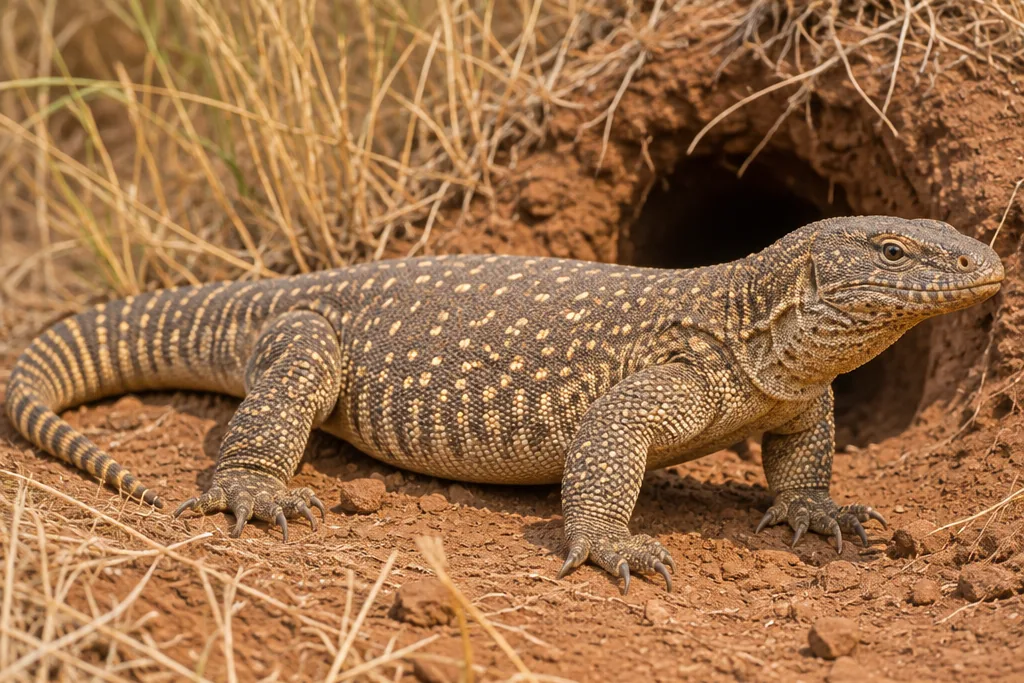
The short answer
Savannah monitors, also called Bosc monitors (Varanus exanthematicus), should eat mostly insects and other invertebrates: roaches, locusts, crickets, worms and captive-bred snails. Juveniles can eat as many insects as they want every day. Adults eat several times a week, with the amount set by body condition. Rodents, chicks and eggs are occasional treats, not the staple.
What they eat in the wild
Studies of wild Bosc monitors in West Africa found their stomachs full of invertebrates: beetles and their larvae, millipedes, snails, grasshoppers, crickets, scorpions and termites. Vertebrates such as rodents and birds turned up only rarely. Their short, blunt teeth are built for crushing hard-bodied insects and snail shells rather than for tearing meat.
They also eat heavily during the wet season, when insects are everywhere, and much less during the dry season. Adults in captivity often go through similar quieter phases, which is normal as long as they hold their weight.
The best feeders
| Food | How to use it |
|---|---|
| Dubia and other roaches | Excellent staple. Meaty, easy to breed, don't smell |
| Locusts and grasshoppers | Excellent staple, close to the wild diet |
| Crickets | Good staple for juveniles |
| Captive-bred land snails | Excellent, a natural favourite. Never use garden snails |
| Superworms, hornworms, silkworms | Good for variety |
| Earthworms, nightcrawlers | Good occasional food, buy bait-shop or bred worms |
| Eggs (quail or hen) | Occasional treat |
| Mice, rats, chicks | Rare treat only, for example once a month for an adult |
| Raw meat, cat or dog food, turkey mince | Avoid. High fat and poorly balanced |
Gut-load insects for a day or two before feeding with greens, vegetables and a good insect diet, so the monitor gets the nutrition stored inside them.
How often to feed
| Age | Feeding |
|---|---|
| Hatchling and juvenile (under about 60 cm) | Daily, as many insects as they eat in a session |
| Sub-adult | Most days, adjusted to growth and body shape |
| Adult | 3–4 times a week, with lean weeks if it gets round |
Watch the body, not the calendar. A healthy adult has a visible hip and pelvis outline, a tail base that isn't bulging with fat and a muscular, not round, belly. If your monitor starts to look like a sausage, cut back, check the basking temperature and give it more room to move.
Why rodent diets cause problems
Rodents are much higher in fat than insects and snails, and a captive Bosc moves far less than a wild one. Feeding mice as the main food leads to obesity and fat building up in the liver (hepatic lipidosis), which is one of the most common causes of death in captive savannah monitors. Low basking temperatures make it worse, because a cold monitor can't digest food properly. A hot basking surface of around 60–65°C (140–150°F) and an insect-based diet together prevent most of these problems.
Supplements
Dust insects with a calcium supplement. If your monitor has strong UVB (which we recommend), plain calcium or a light calcium with D3 is enough. A reptile multivitamin once every week or two helps cover any gaps. Whole snails with shells supply calcium naturally.
Sample weekly menu for an adult
- Monday: 20–30 large dubia roaches, dusted
- Wednesday: locusts and a handful of captive-bred snails
- Friday: mixed superworms, hornworms and crickets, dusted
- Sunday: roaches, plus one boiled egg every few weeks
Quantities depend on the size of your monitor. Adjust them to its body condition, and skip a day if it looks round. For full setup details, see our Bosc monitor care guide.
FAQ
Can savannah monitors eat mice? Occasionally, as a treat. Mice are high in fat, and diets built on rodents cause obesity and fatty liver disease. Insects and snails should make up most of the diet.
How often should I feed an adult savannah monitor? About 3–4 times a week, adjusted to body condition. Cut back if it starts to look round or has fat at the base of the tail.
Can savannah monitors eat raw meat or cat food? It isn't recommended. Raw meat, turkey mince and cat or dog food are high in fat and poorly balanced for monitors. Stick to whole insects, snails and occasional whole prey.