About the black-headed python
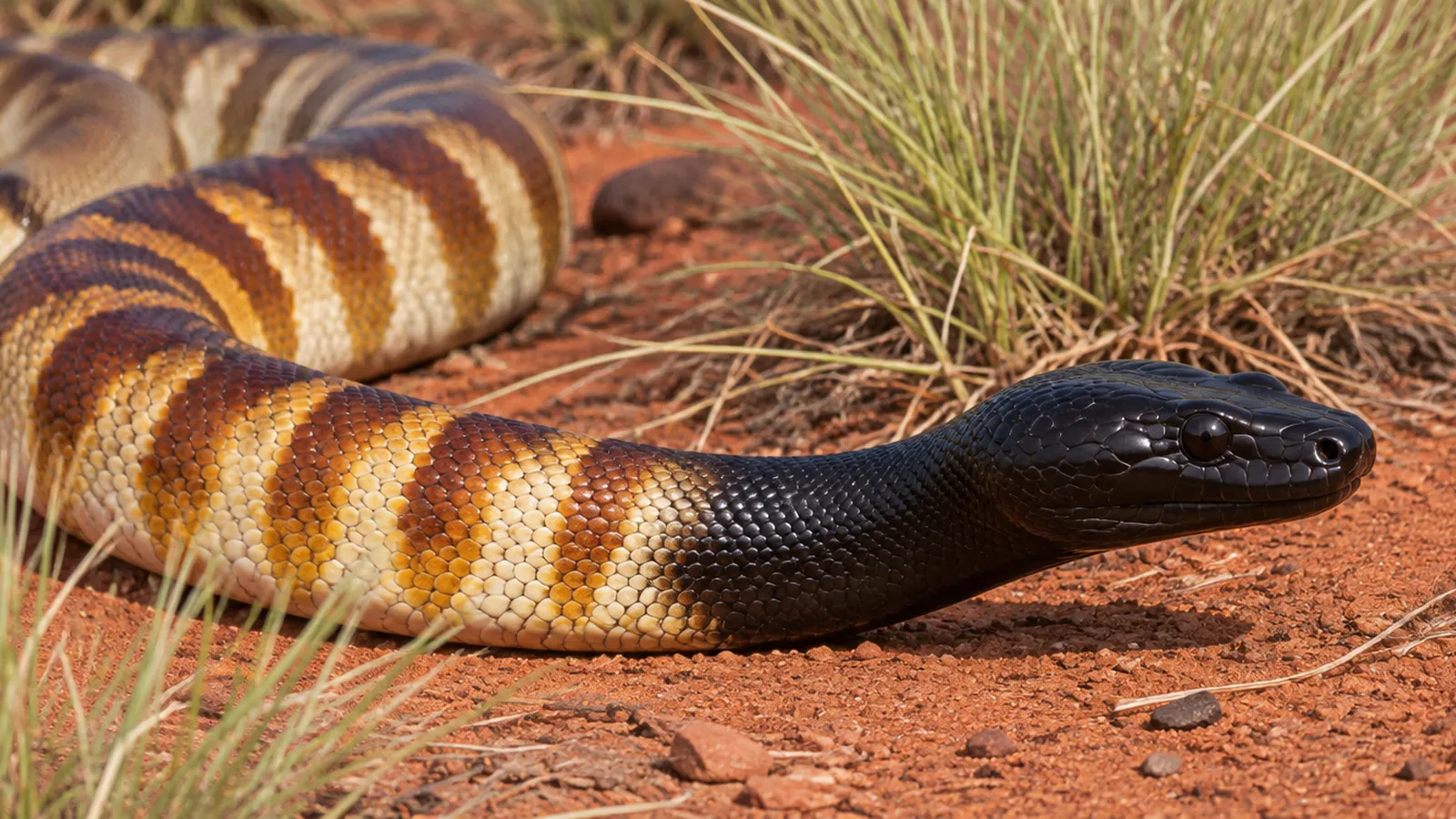
The black-headed python (Aspidites melanocephalus) lives across the tropical north of Australia, in woodland, grassland and rocky country. It's instantly recognisable: a glossy jet-black head and neck, followed by a body banded in cream, gold, rust or brown. Unlike most pythons, it has no heat-sensing pits along its lips, and in the wild it feeds mainly on other reptiles, including venomous snakes.
That black head isn't just for looks. It absorbs heat quickly, allowing the snake to warm up by poking only its head out of a burrow while the rest of its body stays safely underground. Interestingly, some black-headed pythons go through a subtle colour change in early adulthood, at around 5–7 years old, with the body colour deepening or shifting.
Black-headed pythons are active and curious, often seen exploring outside their hides during the day, which makes them a lot of fun to watch. Juveniles can be nippy, mostly because of their enthusiastic feeding response, but most grow into confident and tolerant adults. Australian species are expensive outside Australia, and all animals in the international trade are captive-bred.
Housing
Hatchlings can be kept in a 20–30 gallon enclosure, moving to around 120×60×60 cm (48×24×24 in) as juveniles. Once they reach about 1.2–1.5 m (4–5 ft), they need a floor space of at least 180×60 cm (72×24 in), and something larger, around 180×75×75 cm (72×30×30 in), is even better.
Black-headed pythons are terrestrial and love to burrow, so floor space and substrate depth matter more than height. Keeping them is actually quite simple: they need a proper temperature gradient, a suitable substrate, a hide at each end and a water bowl, and they'll thrive.
Substrate
A deep layer of substrate lets them burrow, which is one of their most natural behaviours. Use at least 10 cm (4 in) of a sandy soil mix or aspen shavings. Avoid dusty substrates and anything with sharp or small debris that could get stuck in the mouth. Newspaper is easy to clean and works fine for juveniles, but adults will be more settled with something they can dig into.
Heating
Black-headed pythons can tolerate a fairly wide range of temperatures, but they love a hot basking spot. Provide around 32–35°C (90–95°F) at the basking spot and 24–27°C (75–80°F) at the cool end. At night temperatures can drop to around 22°C (72°F).
Overhead heat from a halogen lamp or radiant heat panel suits their head-basking behaviour better than a heat mat. Always connect it to a thermostat.
Lighting
Black-headed pythons are often active by day, so a 12-hour light cycle and low-output UVB are beneficial.
Humidity
Coming from a dry environment, they need moderate to low humidity of around 40–55%. Provide a slightly more humid hide when they're in shed to help them shed cleanly.
Feeding
Feeding black-headed pythons is rarely a problem. They're eager feeders and grow quickly, and captive-bred animals take rodents readily. Hatchlings can be fed a fuzzy mouse every 5–7 days, juveniles an adult mouse or rat pup every 7–10 days, and adults a small to medium rat every 14–21 days. If raised well, they can reach maturity within 2½–3 years.
Watch their weight. An active-looking snake can still become overweight, especially once growth slows down. Use tongs to keep fingers out of the way of their enthusiastic strikes. See how to thaw frozen rodents.
Handling
Young black-headed pythons may bite simply because they assume anything moving is food. Using a hook to lift the snake out first helps signal that it's not feeding time. Adults are generally inquisitive and tolerate handling well. As always, wait 48 hours after feeding.
Sexing
Males usually have longer tails with a more gradual taper and larger spurs, while females are typically heavier-bodied. Probing confirms the sex.
Breeding
Black-headed pythons are usually bred from around 3 years old. A cooling period of several weeks with night-time drops to around 20°C (68°F) helps trigger breeding. Females lay a clutch of around 5–15 large eggs, which are incubated at around 30–31°C (86–88°F) for roughly 60–70 days.
Common health problems
Most issues come from not enough heat for a hot-basking species, shallow substrate that stops them burrowing, or overfeeding. A strong feeding response can also lead to accidental bites if you feed and handle the snake in the same way. Wheezing, mouth bubbles or weight loss need a vet. A healthy black-headed python has a glossy head, clean sheds, explores actively and has a good appetite.
FAQ
Why do they have a black head? It helps them warm up while the body stays hidden.
Are they venomous? No.
Do they eat rodents? Captive-bred animals usually do.