About the bull snake
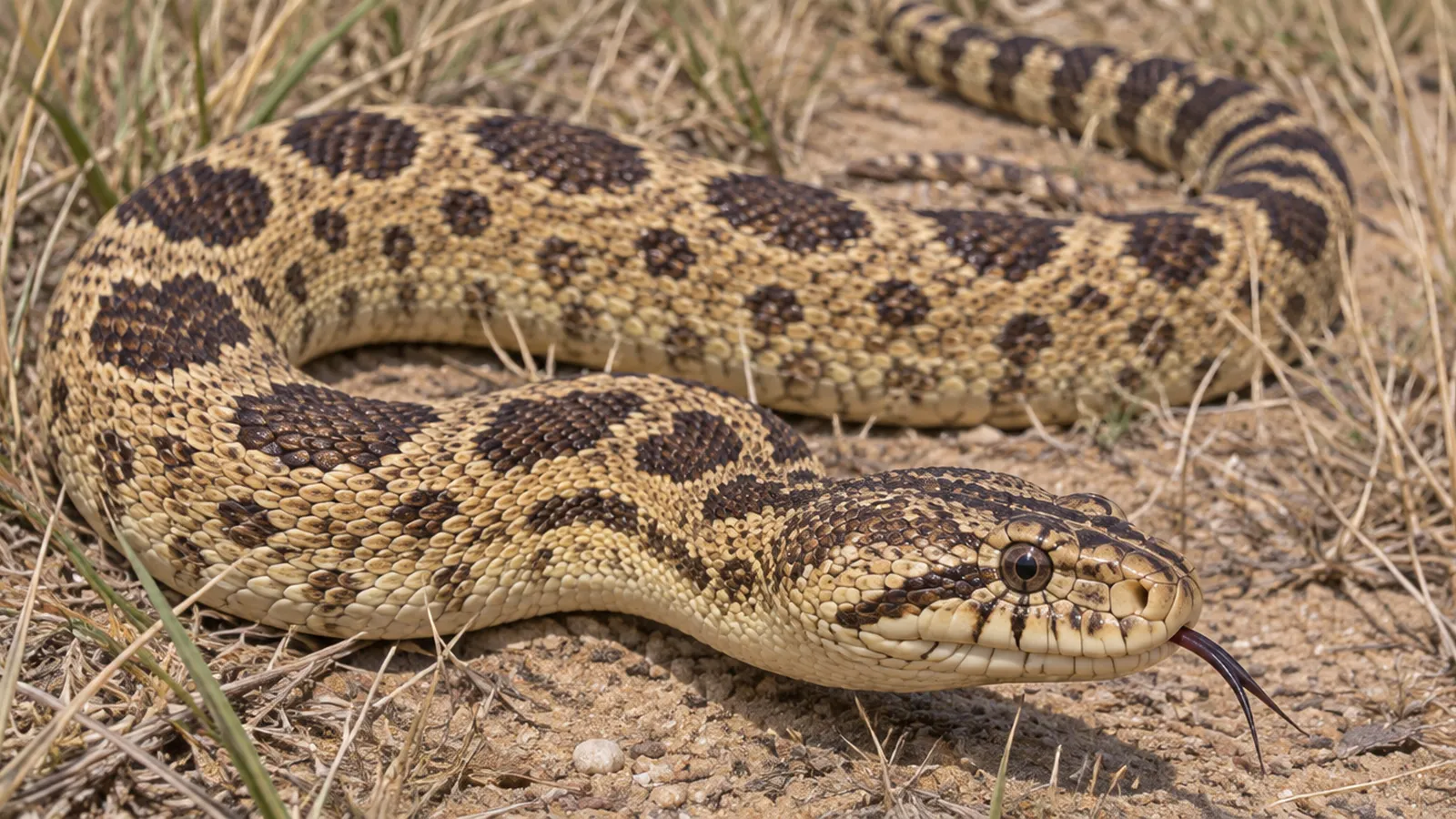
The bull snake (Pituophis catenifer sayi) is a type of gopher snake found across the prairies, grasslands and farmland of central North America, from southern Canada down into northern Mexico. It is one of the largest snakes on the continent, with a heavy, muscular body, a pointed snout built for digging and a pattern of dark blotches on a yellow, tan or cream background. Captive breeding has also produced a range of colour morphs, including albino, hypomelanistic, white-sided and snow.
What the bull snake is best known for is its bluff. When it feels threatened it flattens its head, puffs up its body, vibrates its tail and lets out a long, loud hiss made by a flap of cartilage in front of its windpipe. In dry grass, the tail vibration sounds a lot like a rattlesnake. It is mostly show. Captive-bred bull snakes that are handled regularly usually calm down, and they are some of the most enthusiastic feeders in the hobby. Their size and activity level mean they need more room than a corn snake, so they suit keepers who have already kept a smaller snake and are ready for something bigger.
Housing
A good rule of thumb for bull snakes is that the enclosure should be at least two-thirds as long as the snake. Babies up to about 70 cm (2 ft) can be kept in a 10–20 gallon enclosure, moving up to around 90×45×45 cm (36×18×18 in) as juveniles. Most adults do well in 120×60×60 cm (48×24×24 in), but a big, active adult will make good use of something closer to 180×60×60 cm (72×24×24 in).
Bull snakes are strong and will push at lids and doors looking for gaps, so the enclosure must be secure and preferably lockable. Provide a hide at each end so the snake can choose its temperature without giving up its sense of security, and a water bowl big enough for it to soak in if it wants to. A few pieces of cork bark or flat rocks give it extra cover and something to push through.
Substrate
Bull snakes love to dig, and a burrowing substrate makes a real difference to how settled they are. Use 8–10 cm (3–4 in) of aspen shavings, or a sandy soil mix that holds the shape of tunnels. Reptile bark and wood chips also work. Avoid pine and cedar, which release oils that irritate the airways. Spot-clean droppings as soon as you see them and replace the substrate completely every few months.
Heating
Give your bull snake a warm side of around 29–31°C (85–88°F) and a cool side of 22–24°C (72–76°F). At night, temperatures can drop to around 20–24°C (68–75°F), which mimics the natural cooling they experience in the wild.
A heat lamp or a heat mat at one end of the enclosure works well, but it must be controlled by a thermostat. Many experienced keepers run two thermostats: a proportional thermostat to control the heat day to day, with a simple on/off thermostat set a few degrees higher as a backup in case the main one fails. It is a cheap way to protect a snake you may keep for 20 years.
Lighting
Bull snakes are active during the day, so a 12-hour light cycle helps them keep a natural routine. UVB isn't strictly required, but a low-output UVB tube is beneficial and many keepers notice their snakes basking under it.
Humidity
Bull snakes come from fairly dry habitats and need low humidity of about 30–40% for most of the year. When your snake goes into shed (you'll notice the eyes turning cloudy blue), raise it to 40–50% to help it shed in one piece. A light misting or a hide with slightly damp moss is usually enough.
Be careful not to overdo it. Humidity kept above 50% for long periods can lead to blisters on the body and respiratory infections. If you notice your bull snake spending a lot of time soaking in its water bowl, check your humidity and temperatures, and look closely for mites, which also cause snakes to soak.
Feeding
Bull snakes are excellent feeders and will rarely turn down a meal. Hatchlings can be fed a pinky or fuzzy mouse every 5–7 days. Juveniles move up to hopper and adult mice every 7–10 days, and adults do well on large mice or small rats every 10–14 days.
Frozen-thawed prey is safer than live and most captive-bred bull snakes take it without hesitation. See our guide on how to thaw frozen rodents. Because their feeding response is so strong, always use tongs rather than your fingers, and never feed in the same way you pick the snake up for handling.
Bull snakes are prone to becoming overweight in captivity. Choose prey no wider than the widest part of the body and don't increase the size or frequency of meals just because the snake looks hungry.
Handling
Expect a fair amount of hissing at first, especially from young snakes. Move slowly, lift the snake from underneath rather than grabbing from above, and support its body. Short, regular sessions of a few minutes at a time are the best way to tame a bull snake. Most become calm and confident within a few weeks. Leave the snake alone for 48 hours after feeding.
Sexing
Male bull snakes usually have longer, thicker tails that taper gradually after the vent, while females have shorter tails that narrow sharply. Males also tend to have a slightly broader head. Hatchlings can be popped and older snakes can be probed to confirm the sex, which should be done by an experienced keeper or vet.
Breeding
Bull snakes reach breeding size at around 2–3 years old. Like most North American colubrids, they need a winter cooling period (brumation) of about 8–12 weeks at around 10–15°C (50–60°F) to cycle properly. Stop feeding two weeks before cooling so the gut is empty. After warming them back up and feeding well for a few weeks, the male can be introduced to the female. Clutches of large eggs are usually laid around 4–6 weeks after mating and hatch after about 60–70 days at 28°C (82°F).
Common health problems
Most problems in bull snakes come from humidity and temperature. Too much moisture causes blisters and respiratory infections, while poor sheds point to humidity that's too low during shed. Overfeeding leads to obesity, and handling after a meal can cause regurgitation. A healthy bull snake should be smooth and muscular, alert and tongue-flicking, with clean sheds and a steady weight.
FAQ
Do bull snakes make good pets? Yes, for keepers with room for a large, active snake.
Are bull snakes venomous? No. The hiss and tail rattle are a bluff.
What humidity do bull snakes need? About 30–40%.