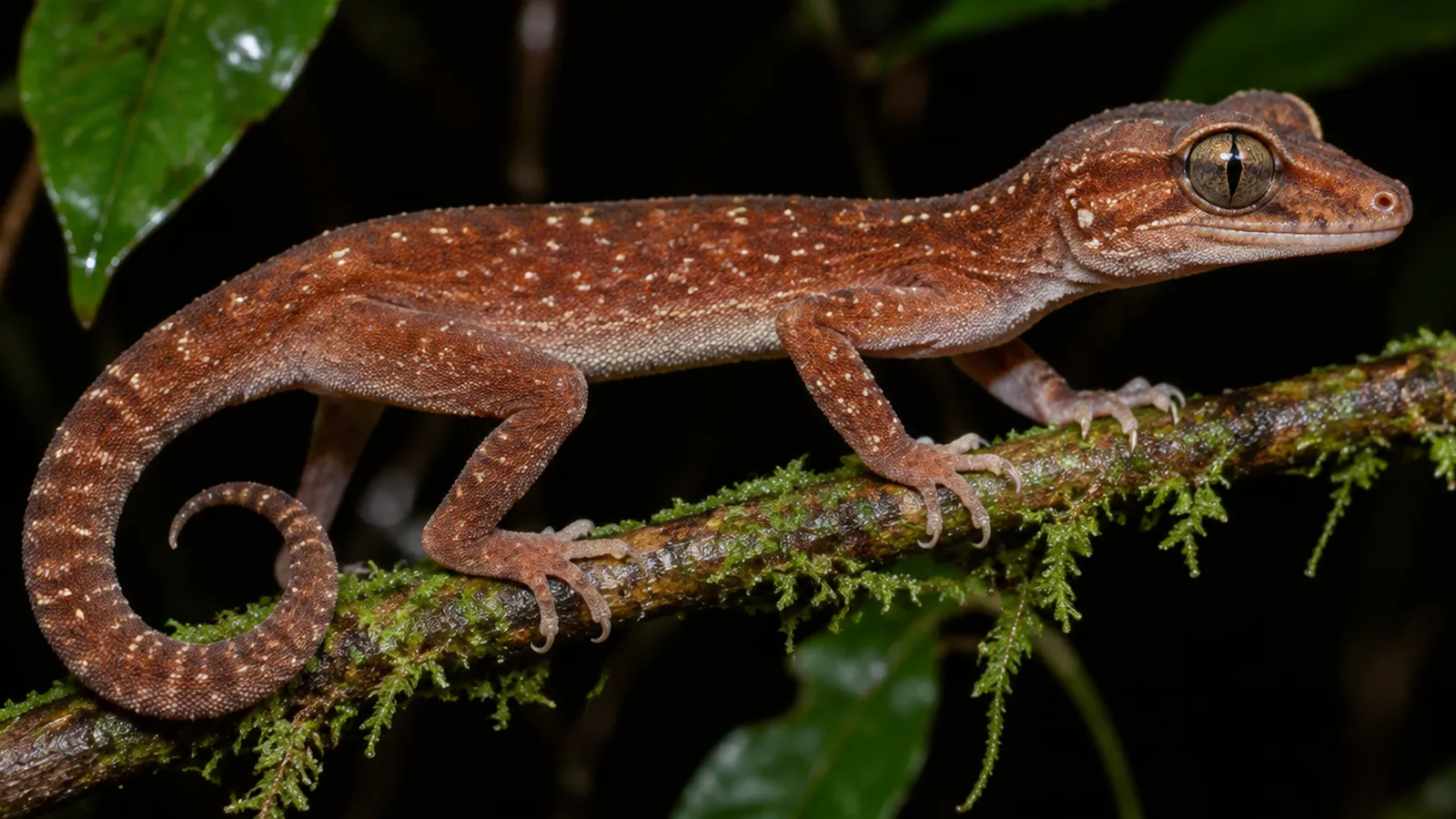
About the cat gecko
The cat gecko (Aeluroscalabotes felinus) lives in the forests of Malaysia, Borneo, Sumatra and southern Thailand. Many are found in cool upland areas such as the Cameron Highlands in Malaysia, which sits around 1,800 m above sea level. There, daytime temperatures hover around 21°C (70°F) and drop to about 10°C (50°F) at night, with heavy rainfall for much of the year.
It gets its name from its cat-like habits. It sleeps with its tail curled around its body, carries its tail raised and arched as it walks, and stalks prey slowly and deliberately. Its tail is also prehensile, so it can wrap it around branches as it climbs. Cat geckos are nocturnal and spend the day hidden among leaves.
Males reach around 10–13 cm (4–5 in) and have angular heads and visible hemipenal bulges. Females are larger, around 15–20 cm (6–8 in), with broader heads.
Cat geckos are fascinating but delicate. Heat, dryness and frequent disturbance can kill them quickly, and many animals in the trade are still wild-caught and carrying parasites. Look for captive-bred animals and have new arrivals checked by a vet.
Housing
A single male can be kept in an enclosure of around 40×30×30 cm (16×12×12 in). Females are larger and need more room, ideally around 45×45×55 cm (18×18×22 in). If you want to keep a pair together, go for at least 80×40×50 cm (32×16×20 in).
Fill the enclosure with thin branches, cork bark and dense live plants, and provide several hides, including at least one humid hide. Good ventilation is important. Hatchlings can be raised in small boxes of around 20×20×20 cm (8×8×8 in) with paper towel, some thin branches and a moist hide. After 6–8 weeks they can move into boxes of about 30×20×20 cm (12×8×8 in).
Substrate
A 50:50 mix of peat or coco fibre and sand holds humidity well. A bioactive soil mix topped with leaf litter is another good option and helps keep the enclosure clean.
Heating
Temperature is critical to success with cat geckos. Keep daytime temperatures at around 24–27°C (75–80°F) and night-time temperatures at 19–22°C (66–72°F). Avoid extremes at both ends.
Many homes need no extra heat at all. The bigger risk is overheating: above about 28°C (82°F), cat geckos quickly become stressed and can die. In warm weather you may need to keep the enclosure in a cool room or use air conditioning.
Lighting
As a nocturnal species, cat geckos only need a gentle day and night cycle. Low-output UVB is fine as long as there's plenty of shade, and it helps live plants grow.
Humidity
Lightly mist the enclosure once or twice a day to keep humidity at around 65–80% during the day, rising to 90% or more at night. Cat geckos drink droplets from leaves and glass after misting. Keep air moving so the enclosure doesn't become stagnant.
Feeding
Cat geckos will eat most types of insects, including crickets, roaches, small mealworms and snails. Snails are especially good for gravid females, as they provide extra calcium. Feed juveniles every one to two days and adults two or three times a week. Dust insects with calcium, and use a multivitamin weekly.
Only add a few insects at a time. Too many crawling insects in the enclosure stress cat geckos, and they may stop eating.
Handling
Keep handling to a minimum. Cat geckos are delicate and stress easily. If you need to move one, let it walk onto your hand rather than grabbing it.
Sexing
Males are smaller than females, with more angular heads and obvious hemipenal bulges at the base of the tail once mature. Females are larger with broader heads and no bulges.
Breeding
Females lay two eggs at a time, often several clutches a year. Depending on the temperature, eggs take around two to three months to hatch. Keep incubation temperatures on the cool side, around 22–24°C (72–75°F). Give gravid females extra calcium and snails, and make sure they have a damp laying site.
Common health problems
Overheating and dehydration are the biggest threats. Untreated wild-caught animals often carry parasites, which cause weight loss and poor appetite. Watch for lethargy, a thin tail base or sunken eyes, all of which need prompt attention. A healthy cat gecko has a plump tail base, sheds cleanly, is active at night and holds a steady weight.
FAQ
Why is it called a cat gecko? It curls its tail and walks like a cat.
What temperature does it need? 24–27°C by day, cooler at night.
Good for beginners? No.