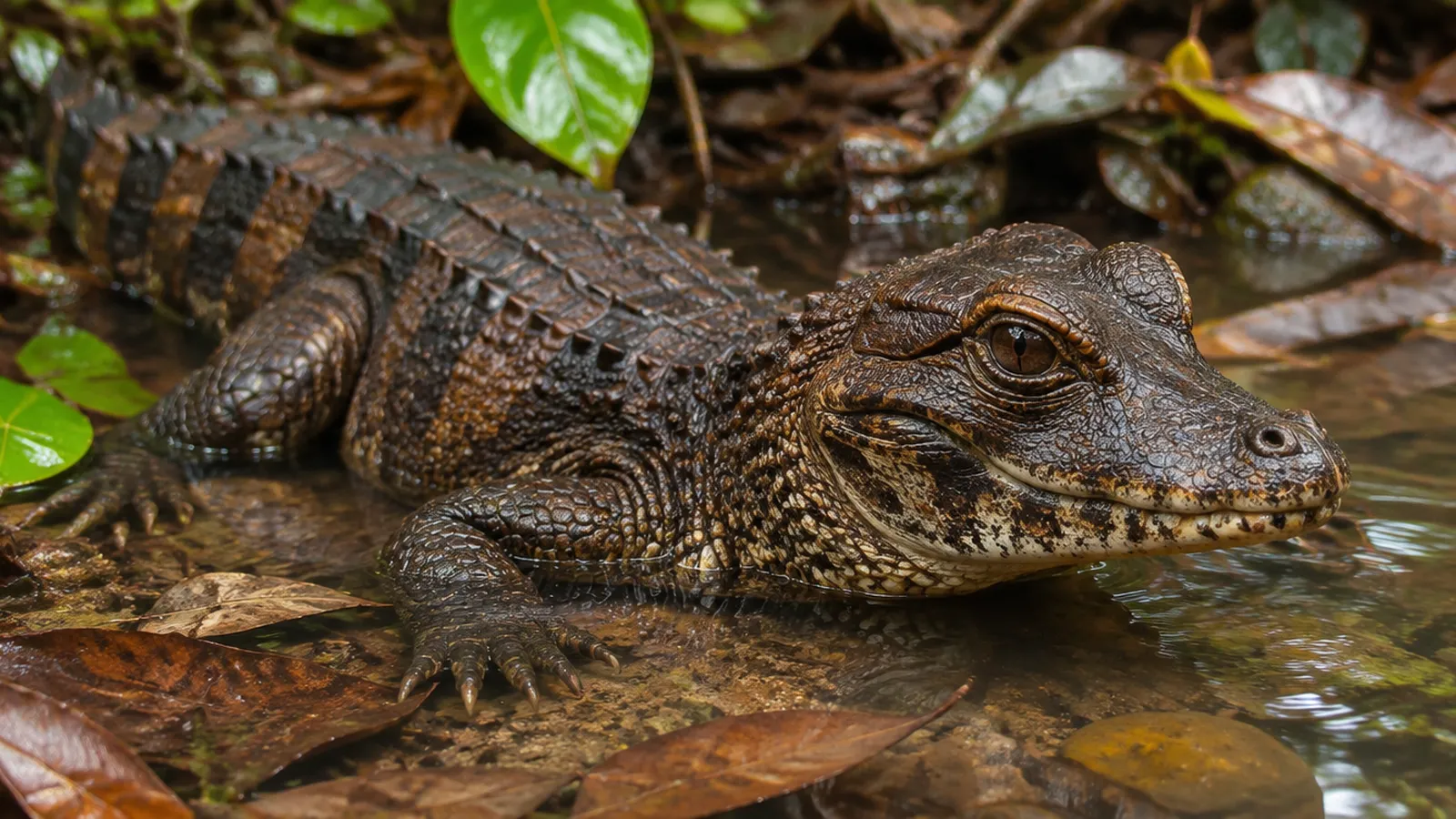
About Cuvier's dwarf caiman
Cuvier's dwarf caiman (Paleosuchus palpebrosus) lives in the rainforests of northern and central South America, including the Amazon and Orinoco basins. Unlike most crocodilians, it prefers fast-flowing, clear streams and flooded forest rather than large rivers and lakes, and it often hides in burrows or under fallen trees during the day.
It's the smallest crocodilian in the world. Most adults reach only 1.2–1.5 m (4–5 ft), with males slightly larger than females. It has a short, smooth, almost dog-like skull, rich brown eyes with bony upper eyelids (palpebrosus refers to these), heavy bony armour across the body, and a dark chocolate-brown colour.
Because of its relatively small size, it's the crocodilian most often kept by private specialist keepers. But it's important to be realistic. A dwarf caiman is still a strong, defensive predator with a powerful bite, it can live for 25–40 years or more, and it needs a large aquatic enclosure that's expensive to build and maintain.
The law
In the UK, all crocodilians require a licence under the Dangerous Wild Animals Act. Many US states ban or regulate crocodilians, and many European countries restrict keeping dangerous animals. Cuvier's dwarf caiman is listed on CITES Appendix II. Check your local laws and licensing requirements before buying, and buy only captive-bred animals with documentation.
Enclosure
An adult needs an enclosure with a floor area of at least 300×150 cm (10×5 ft), with roughly half given over to water and half to land. The water should be deep enough for the caiman to fully submerge, at least 30–45 cm (12–18 in), and the land area must be large enough for it to haul out completely and bask.
The enclosure must be extremely secure, as caimans are good climbers for crocodilians and strong enough to push through weak barriers. Provide hides on land, such as large cork bark or wooden shelters, since in the wild they spend much of the day hidden. Juveniles can start in a smaller aquatic setup but grow steadily.
Water quality
Caimans produce a lot of waste, so strong filtration is essential. Use an oversized canister or pond filter, carry out regular partial water changes, and ideally install a drain to empty the water easily. Clean water prevents skin and eye infections.
Heating
Keep the water at around 26–28°C (79–82°F) with guarded heaters, and provide a basking area of about 32–35°C (90–95°F) with heat lamps or radiant panels on a thermostat. Ambient air temperature should be around 27–30°C (80–86°F).
Lighting
Caimans need UVB for healthy bones. Use a high-output T5 UVB tube over the basking area for around 12 hours a day.
Feeding
In the wild, dwarf caimans eat fish, crustaceans, frogs, insects and small mammals. In captivity, feed a varied diet of whole prey: whole fish (avoid relying only on fish high in thiaminase), rodents, chicks, earthworms and large insects. Juveniles can be fed two or three times a week, and adults once or twice a week. Use long tongs and a consistent feeding area. Avoid feeding only muscle meat, and dust insects with calcium.
Handling and safety
Dwarf caimans are defensive and can deliver a powerful bite. They aren't suitable for handling and are stressed by it. Move them only when necessary, using proper restraint techniques and, for adults, two experienced people. Never let children or visitors access the enclosure.
Sexing
Sexing caimans is difficult and is usually done by a vet through cloacal examination. Adult males tend to be larger with broader heads.
Breeding
Dwarf caimans reach maturity at around 8–10 years old. Females build mound nests of plant material and lay around 10–25 eggs, which hatch after roughly 90 days. As with many reptiles, the incubation temperature determines the sex of the young. Breeding is rare in private collections.
Common health problems
Poor water quality, low temperatures and a lack of UVB are the main causes of problems, leading to skin and eye infections, respiratory infections and metabolic bone disease. Obesity from overfeeding is also common. A specialist reptile vet with crocodilian experience is essential. A healthy caiman has clear eyes, a firm body, clean skin and a strong feeding response.
FAQ
How big does it get? Usually 1.2–1.5 m.
Do you need a licence? In many places, yes.
Can they be handled? No; treat them as display animals.