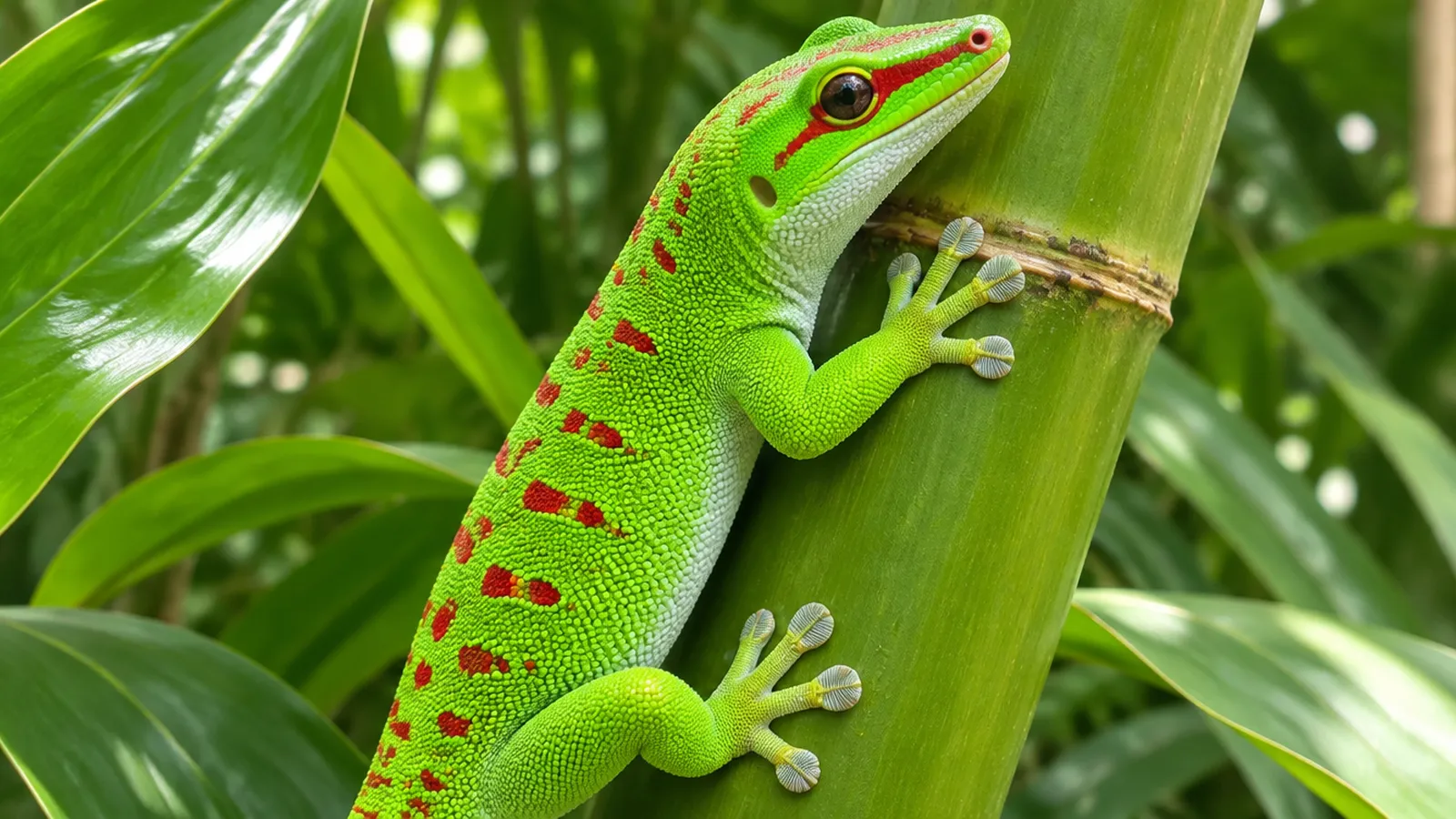
About day geckos
Day geckos (Phelsuma) come mainly from Madagascar and the islands of the western Indian Ocean, including Mauritius, the Seychelles and the Comoros. Unlike most geckos, they're active during the day, and many are brilliantly coloured in greens, blues, reds and yellows.
There are dozens of species, and they vary enormously in size. The smallest, such as Phelsuma kely, are only around 5 cm (2 in) long, while the giant day gecko (Phelsuma grandis) reaches around 25–30 cm (10–12 in). This guide focuses mainly on the giant day gecko and similar mid-sized species, which are the most commonly kept.
Day geckos are amazing climbers, with powerful legs and sticky toe pads that let them run up glass and the undersides of leaves. They're hardy and very rewarding to watch, but they are not handling pets. Their skin is fragile and tears easily, and they're fast enough to escape in a moment.
Housing
Because they climb so well, day geckos are best housed in tall glass enclosures. For smaller species, an enclosure of around 30×30×60 cm (12×12×24 in) works well. Giant day geckos need at least 45×45×90 cm (18×18×36 in), and larger is better.
Front-opening glass terrariums are ideal, as they give good visibility and let you reach in without the gecko escaping out the top. Good ventilation is essential. Fill the enclosure with live plants such as pothos, dracaena and sansevieria, along with bamboo tubes and vertical branches for climbing and basking.
Adults should be kept alone or in a carefully matched male and female pair. Two males will fight, often causing serious injuries.
Substrate
A bioactive soil mix or coco fibre supports live plants and helps hold humidity. Add leaf litter on top to help break down waste.
Heating
Provide a basking spot of 32–35°C (90–95°F) near the top of the enclosure, with an ambient daytime temperature of 26–29°C (78–85°F). At night, temperatures should drop to around 18–22°C (65–72°F).
A basking bulb aimed at an upper branch or bamboo tube works well, on a thermostat or dimmer. Use a digital thermometer to check temperatures in several places, ideally one that records the highest and lowest readings. Temperatures that are too high or too low quickly stress day geckos and can be fatal.
Lighting
UVB is essential for day geckos. As daytime lizards, they rely on UVB to make vitamin D3 and use calcium properly. Use a good-quality T5 UVB tube across the top of the enclosure for 12–14 hours a day, and replace it as recommended by the manufacturer. Without proper UVB, day geckos develop metabolic bone disease.
Humidity
Day geckos need humidity of around 50–80%. Lightly mist the enclosure in the morning and evening with warm water, and let the surfaces dry in between. Day geckos lick droplets from leaves and glass, and for many this is their main source of water even if a dish is provided. Good airflow prevents mould and keeps the enclosure healthy.
Feeding
In the wild, day geckos eat insects and other invertebrates, as well as flower nectar, pollen and soft fruit. In captivity, they do best on a mix of insects and a commercial fruit and nectar gecko diet.
Feed gut-loaded insects such as crickets, roaches and small locusts about three times a week. Gut-loading means feeding the insects oats, fruit and vegetables for a day before offering them, so they pass on more nutrition. Dust most insect feeds with calcium with D3, and use a multivitamin once a week. Offer a fruit and nectar diet in a small cup on a ledge two or three times a week. Juveniles and small species can be given wingless fruit flies.
Older advice often relied on baby food, but modern commercial gecko diets are far better balanced and are the better choice.
Handling
Avoid it. Grabbing a day gecko can tear its skin or cause it to drop its tail. If you need to move one, gently guide it into a tub or container rather than picking it up.
Sexing
Males usually have larger, more obvious femoral pores on the underside of the back legs and a bulge at the base of the tail. Females often have calcium sacs on the sides of their necks, which store calcium for egg-laying.
Breeding
Smaller species are usually ready to breed at around 1 year old, and larger species at about 1½ years. Females typically lay two hard-shelled eggs at a time, often glued to the inside of a bamboo tube or tucked into plants, and may produce several clutches a year. Eggs hatch after around 45–70 days depending on temperature. Make sure females get plenty of calcium during the breeding season.
Common health problems
Weak or missing UVB is the biggest cause of problems, leading to metabolic bone disease (signs include a kinked spine, soft jaw and weak grip). Handling causes torn skin, and housing males together causes injuries. A healthy day gecko is bright in colour, climbs actively, sheds cleanly, has a full rounded tail and a good appetite.
FAQ
Can you handle a day gecko? It's best not to.
Do day geckos need UVB? Yes.
What do they eat? Insects plus a fruit/nectar gecko diet.