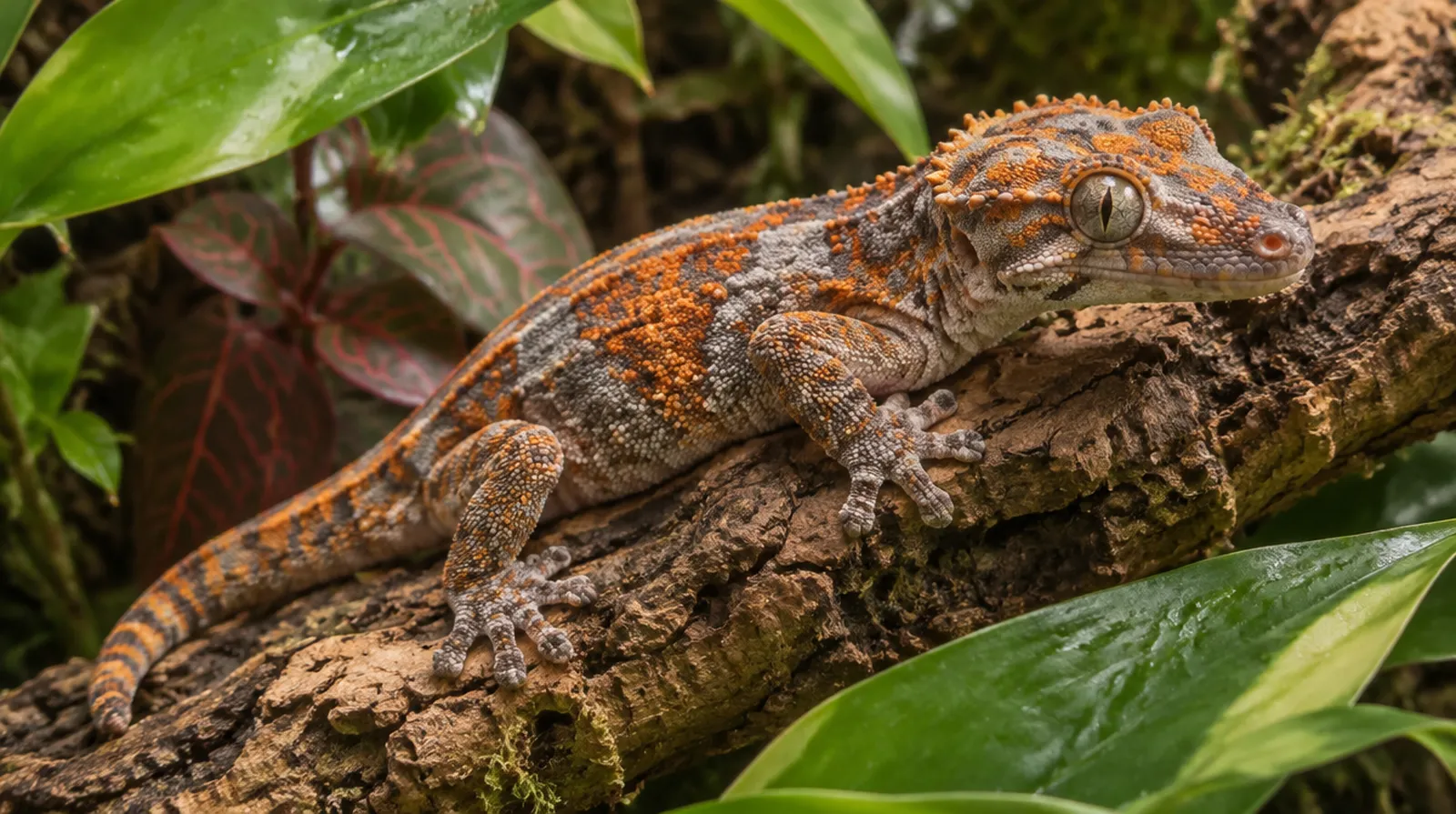
Is a gargoyle gecko right for you?
Gargoyle geckos (Rhacodactylus auriculatus) come from the scrubby forests of southern New Caledonia. They're named for the knobbly bumps on their heads, and come in striped, blotched and reticulated patterns in greys, oranges and reds.
Care is very similar to the crested gecko: no strong heat, a complete powdered diet and a planted vertical enclosure. Differences: gargoyles eat more insects, can bite harder, and are notorious for biting tails. Unlike crested geckos, a gargoyle's dropped tail does regrow (though it looks different).
Enclosure
| Gecko | Enclosure |
|---|---|
| Hatchling | 12×12×18 in |
| Adult (minimum) | 18×18×24 in |
| Adult (better) | 18×18×36 in or larger |
They're arboreal, so height and climbing cover matter. Use cork bark tubes and flats, branches at different angles, and live or artificial plants for cover. Front-opening glass or PVC enclosures work well.
Temperature
- Day: 72–80°F (22–27°C), with the top up to about 82°F (28°C)
- Night: 65–72°F (18–22°C)
- Avoid: above 85°F (29°C) for long periods — heat stress is dangerous
Most homes need no extra heat. If your room is cooler, use a low-wattage basking bulb on a thermostat at the top of the enclosure.
Lighting
Low-level UVB (a ShadeDweller-type 2–7% tube) plus a plant light is recommended. Give plenty of shaded areas and run lights 12 hours a day.
Humidity
Keep humidity 50–70%. Mist in the evening to spike humidity higher and let the enclosure dry out by morning. Constant wetness leads to mould and skin problems; constant dryness causes stuck shed.
Substrate
A coco fibre/soil mix or a bioactive substrate with leaf litter holds humidity well. Avoid loose small particles that can be swallowed with food.
Feeding
| Food | Frequency |
|---|---|
| Complete powdered diet (Pangea, Repashy etc.) | 3 times per week, fresh, removed after 24–48 hours |
| Gut-loaded insects (crickets, dubia, BSFL) dusted with calcium + D3 | 1–2 times per week |
Gargoyle geckos are more insect-driven than cresteds, so insects are worthwhile, not optional extras. Offer a shallow water dish and mist for drinking droplets.
Housing
House gargoyle geckos alone. Tail-biting is common even between females, and males fight. If you breed them, introduce pairs briefly and supervise.
Handling
Most gargoyles tolerate handling well once settled. They can be jumpy at first and bite a bit harder than crested geckos. Keep sessions short and close to the ground.
Common mistakes
- Housing gargoyles together.
- Too much heat.
- No insects in the diet.
- Horizontal tanks with no climbing space.
Signs of a healthy gargoyle gecko
Plump tail base, active at night, eating diet and insects, clean sheds. A thin tail base, kinked spine or jaw, retained shed on toes or lethargy need attention from a reptile vet.
FAQ
What size enclosure does a gargoyle gecko need? 18×18×24 in minimum; 18×18×36 in is better.
Can gargoyle geckos live together? Best not; they bite tails and fight.
What do gargoyle geckos eat? Complete powdered diet plus insects 1–2 times a week.