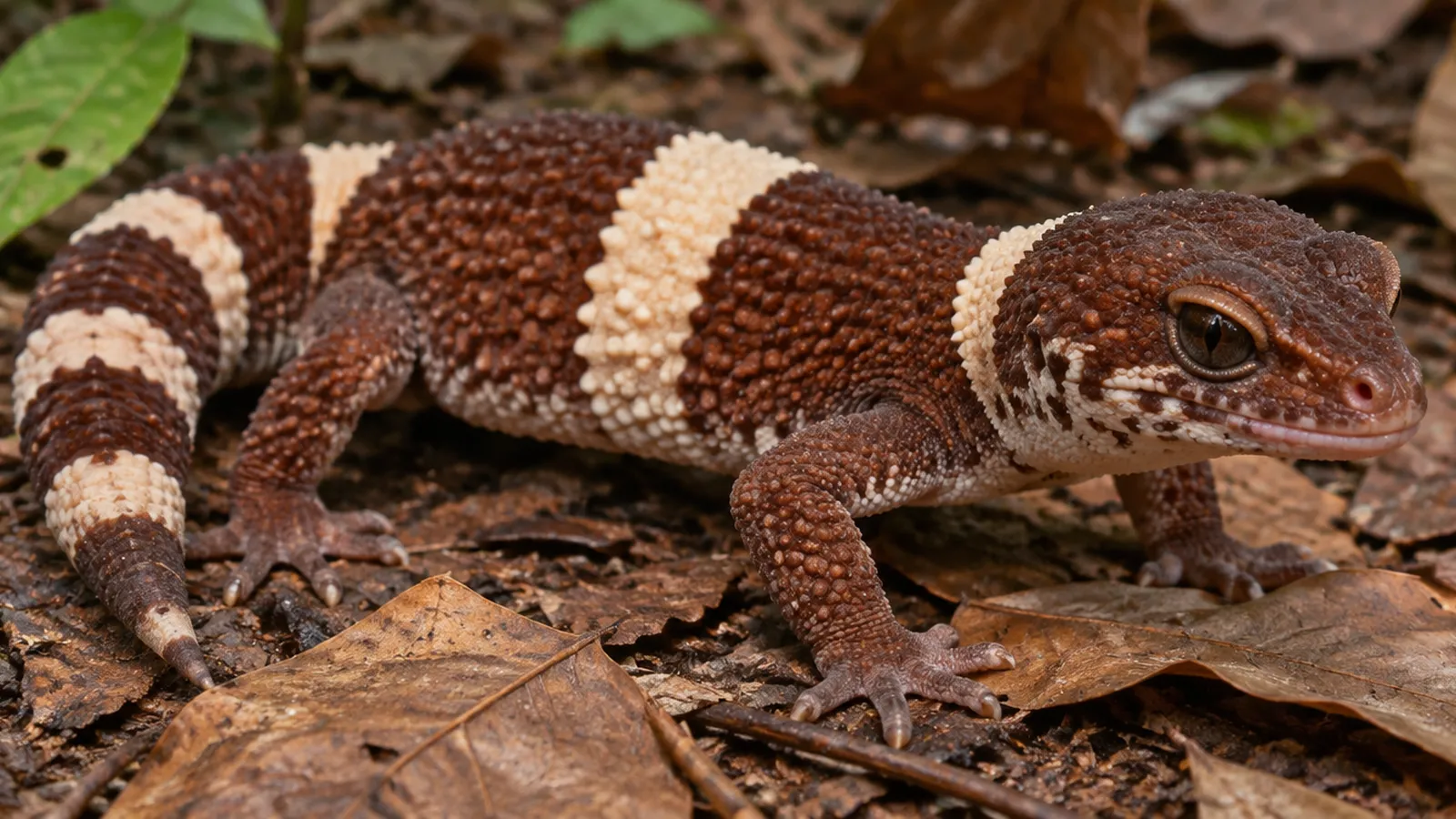
About the East Indian leopard gecko
The East Indian leopard gecko (Eublepharis hardwickii) lives on the moist forest floors of eastern India and Bangladesh. It's a close relative of the common leopard gecko, and reaches a similar size of around 20–23 cm (8–9 in). But it looks quite different: a rich reddish-brown body with a broad pale band across the back, a pale band behind the head and a banded tail. This pattern develops in juveniles and stays the same for the rest of the gecko's life.
Unlike the common leopard gecko, which comes from dry grassland and rocky desert, the East Indian leopard gecko lives in humid forest. That means it needs more humidity and slightly cooler temperatures. It's still relatively uncommon in the hobby, so it suits keepers who already have some gecko experience and want something a little different.
Interestingly, early wild-caught hardwickii were reported never to drink from water bowls in captivity. Instead they would wait for misting and lick the drops falling on their heads or sticking to surfaces. Captive-bred animals today usually drink from a dish without any trouble.
Housing
Juveniles can be kept in an enclosure of around 60×30×30 cm (24×12×12 in). Adults need at least 90×45×45 cm (36×18×18 in), and 120×60×60 cm (48×24×24 in) is better.
East Indian leopard geckos live on the ground, so floor space matters more than height. Provide a warm hide, a cool hide and a large humid hide filled with damp sphagnum or peat moss. Add cork bark, leaf litter and low plants for extra cover.
Substrate
Many keepers use paper towel as a substrate, combined with large humid hides filled with peat moss. This makes it easy to keep the enclosure clean and to check on droppings. A loose substrate such as bark chips, coco fibre or a bioactive soil mix topped with leaf litter also works well and helps hold humidity.
Heating
Provide a warm spot of around 29–31°C (84–88°F) on the surface, and a cool side of 22–24°C (72–76°F). At night, temperatures can drop to about 20–22°C (68–72°F). A heat mat or low-wattage bulb on a thermostat is ideal. Avoid the very hot basking spots used for desert reptiles.
Lighting
A regular 12-hour day is all they need. Low-output UVB with plenty of shade is beneficial.
Humidity
Keep humidity at around 40–60%, with the humid hide always damp. Lightly mist in the evening, when these geckos become active. Good ventilation stops mould from building up.
Feeding
East Indian leopard geckos are insectivores. Feed juveniles every one to two days with small crickets and roaches, and adults two or three times a week with crickets, roaches and worms. Some individuals won't eat mealworms, so offer a variety.
Gut-load insects before feeding, and dust them with calcium at most feeds. Every third feeding, use a calcium and vitamin supplement instead.
Handling
They're more secretive than common leopard geckos. Keep handling short and do it low over a soft surface in case the gecko jumps. Never grab the tail; like other eublepharids, they can drop it.
Sexing
Adult males have a row of pre-anal pores forming a V shape above the vent and visible hemipenal bulges at the base of the tail. Females lack the bulges and have much less obvious pores.
Breeding
Like leopard geckos, females lay clutches of two soft-shelled eggs and can produce several clutches a season. Provide a damp laying box. Eggs hatch after around 50–70 days depending on temperature. Be careful when raising hatchlings: cannibalism has been observed in young geckos kept together, so raise them separately.
Common health problems
Most problems come from keeping them like desert leopard geckos, too dry and too hot. Missing humid hides lead to stuck shed, especially on the toes; see how to fix stuck shed. A thin tail is a sign of poor health or parasites. A healthy East Indian leopard gecko has a plump tail, clean sheds, clear eyes and a good appetite.
FAQ
How is it different from a leopard gecko? It needs more humidity and cooler temperatures.
Does it drink from a bowl? Captive-bred ones usually do.
Can they live together? Best kept alone or as a pair; raise juveniles separately.