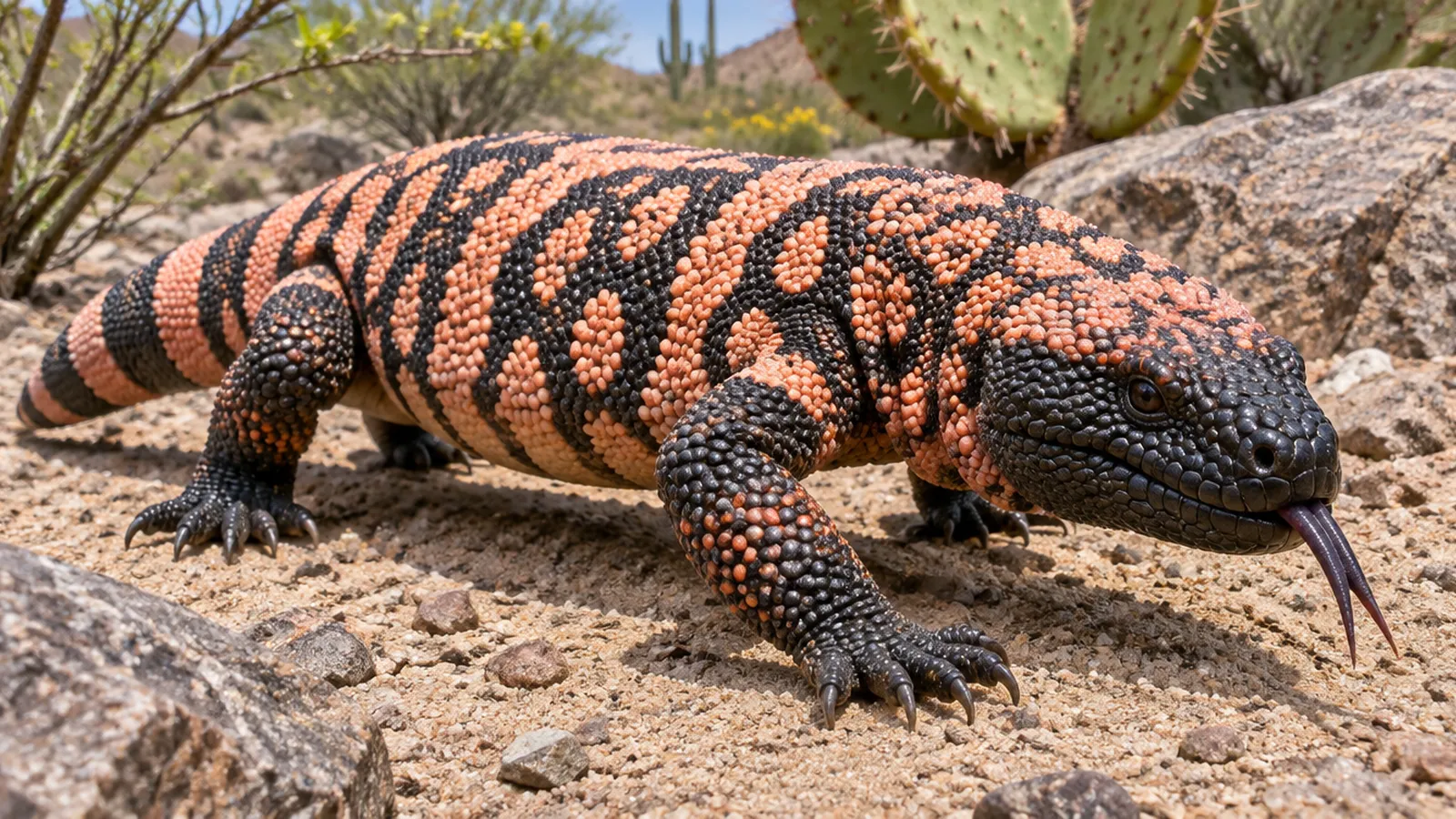
About the Gila monster
The Gila monster (Heloderma suspectum) lives in the deserts and scrublands of the south-western United States and north-western Mexico, including the Sonoran, Mojave and Chihuahuan Deserts. It's hard to mistake: a heavy, slow-moving lizard with bead-like scales and a bold pink, orange and black pattern, reaching around 45–60 cm (18–24 in). There are two subspecies: the reticulate Gila monster (H. s. suspectum) in the south of the range, with a more broken, net-like pattern, and the banded Gila monster (H. s. cinctum) in the north, mainly in the Mojave Desert, with broader bands.
Along with its relatives the beaded lizards (Heloderma horridum and related species), it's one of the best-known venomous lizards in the world. Gila monsters spend most of their lives in burrows, emerging mainly in spring to feed on eggs and young animals in nests. They can store fat in their thick tails and go months without eating.
Venom and safety
Gila monster venom is potent, but they rarely bite unless attacked or threatened. Unlike snakes, they produce venom in glands in the lower jaw. They can't inject it; instead, venom flows along grooves in the teeth and is worked into the wound by chewing. That's why a Gila monster that bites tends to hold on tightly and chew.
In more than 150 years of scientific record, there has not been a confirmed death from a Gila monster bite in a healthy adult, but bites are extremely painful, cause swelling and can cause nausea, low blood pressure and other symptoms. Medical treatment is always needed.
Interestingly, a compound found in Gila monster saliva (exendin-4) led to the development of diabetes medicines, including exenatide.
Experienced keepers handle Gila monsters with hooks and careful technique, but they are not a handling pet. Never handle one when it's agitated or after feeding, and keep a bite protocol ready.
The law
Gila monsters are protected in their native states, and the species is listed on CITES Appendix II. Many countries and states also require a dangerous wild animal licence to keep them. Buy only legally captive-bred animals with full paperwork.
Housing
An adult needs a secure enclosure of at least 120×60×60 cm (48×24×24 in). Gila monsters are strong and good diggers, so the enclosure must be solidly built and lockable. Provide a large, deep hide or artificial burrow, as they spend most of their time underground.
Substrate
Use a deep layer of a sand and soil mix that holds burrows, kept slightly damp in the lower layers. Avoid loose, dusty sand on its own.
Heating
Provide a basking spot of around 32–35°C (90–95°F) and a cool side of 24–27°C (75–80°F). Night temperatures can drop to around 20°C (68°F). Use a basking bulb on a thermostat or dimmer.
Lighting
Gila monsters benefit from UVB. Provide a UVB tube for around 12 hours a day, with plenty of places to retreat from it.
Humidity
Although they're desert lizards, Gila monsters spend most of their time in humid burrows. Keep the general enclosure fairly dry, around 20–40%, but provide a humid hide or burrow with damp substrate. Offer a large water dish; many like to soak, especially before shedding.
Feeding
In the wild, Gila monsters eat mainly eggs and nestlings. In captivity, feed appropriately sized pre-killed rodents (mice and rat pups) and occasional chicken or quail eggs. Adults only need feeding every 1–2 weeks, and less in winter.
The biggest problem in captive Gila monsters is obesity. Their bodies are designed to survive long periods without food, so they gain weight very easily. A healthy Gila monster has a plump but not swollen tail; a tail wider than the neck and body suggests overfeeding.
Breeding
Gila monsters need a winter cooling period of around 2–3 months at 10–15°C (50–59°F) to breed. Females lay clutches of around 3–12 eggs in late summer. Eggs have a very long incubation period, often 4–5 months or more.
FAQ
Is the bite deadly? No confirmed deaths in healthy adults, but bites are very painful and need treatment.
How do they deliver venom? By chewing; venom flows along grooves in the teeth.
Do you need a licence? In many places, yes.