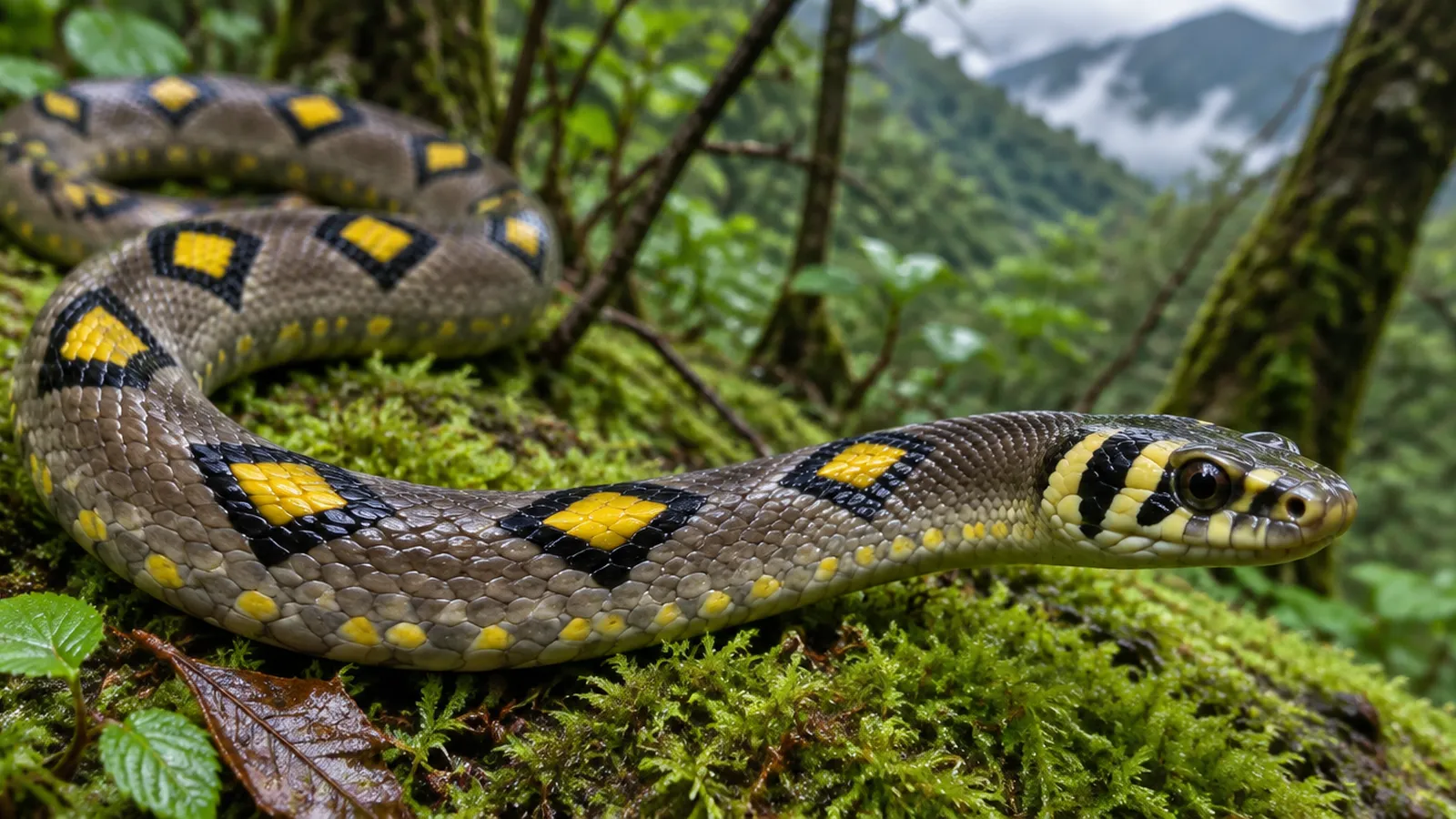
About the mandarin rat snake
The mandarin rat snake (Euprepiophis mandarinus) comes from the mountain forests of central and southern China, northern Myanmar, northern Vietnam and Taiwan. It's widely considered one of the most beautiful snakes in the world: a soft grey body marked with bright yellow diamonds, each outlined in black, and a bold black and yellow pattern on the head.
For a long time, almost all mandarins available were wild-caught. These animals were often heavily infested with parasites, badly stressed by collection and transport, and very difficult to keep alive. That gave the species a reputation as a "death sentence" snake. Thankfully, captive-bred mandarins are now much more widely available, and they are far easier to keep. They still have very specific needs, though, especially when it comes to temperature, and they suit keepers who already have some experience with snakes.
Adults reach around 1–1.2 m (3–4 ft) and are fairly slender. They're secretive by nature and spend much of their time burrowed out of sight.
Housing
Mandarins can be kept in the same kind of enclosure you'd use for a milk snake, kingsnake or corn snake. A hatchling does well in a 10-gallon enclosure or small tub, while an adult needs at least 90×45×45 cm (36×18×18 in), and 120×60×60 cm (48×24×24 in) is better.
Because they're shy, plenty of cover makes a big difference. Provide several hides, cork bark, leaf litter and some plants. A secure lid is essential, as with any colubrid.
Substrate
Mandarins love to burrow. A thick layer of substrate, around 10 cm (4 in), covering the whole bottom of the enclosure is ideal. Aspen, coco husk or a soil and moss mix all work. Paper towel or newspaper isn't suitable for adults, because it doesn't let them burrow and leaves them feeling exposed.
Heating
This is the most important part of mandarin care. A very common husbandry mistake is keeping them too warm. Overheating these snakes quickly makes them sick, so keep daytime temperatures at around 22–26°C (72–78°F), with a warm spot no higher than 27°C (80°F). At night, temperatures should drop to around 16–18°C (61–65°F).
In many homes you'll need very little supplemental heat, and in summer you may actually need to keep the room cool. If you do need heat, a low-wattage heat mat on a thermostat is usually enough. Always check temperatures with a digital thermometer.
Lighting
A natural day and night cycle is all they need. Low-output UVB is optional.
Humidity
Mandarins need fairly high humidity, around 60–80%. You can usually achieve this by misting the enclosure every couple of days. Make sure to also provide a humid hide half-filled with damp sphagnum moss. Mandarins love these and will often spend hours at a time inside. Keep air moving with good ventilation so the enclosure doesn't go stale.
Feeding
Hatchlings can be fed a pinky mouse every 5–7 days, juveniles a fuzzy mouse every 7 days, and adults a hopper or small adult mouse every 7–10 days.
Some hatchlings are reluctant to take their first mouse meals. Offering a pinky at night, inside a small enclosed container or deli cup with the snake, often helps. Scenting with lizard can be a last resort for stubborn babies. See how to thaw frozen rodents.
If a new mandarin won't feed, loses weight or has loose, smelly droppings, it's worth having a vet check for parasites. This is especially important for any snake that might be wild-caught.
Handling
Mandarins are shy and would rather flee or musk than bite. Keep handling sessions short and gentle, and don't handle a snake that's just been introduced to a new home until it's feeding well. They're best enjoyed as a display snake that tolerates occasional handling.
Sexing
Males have longer, thicker tails with a more gradual taper after the vent; females have shorter tails that narrow sharply. Probing or popping by an experienced keeper confirms the sex.
Breeding
Mandarins need a proper winter cooling period to breed, around 2–3 months at roughly 10–12°C (50–54°F). Stop feeding a few weeks before cooling so the gut is empty. After warming them back up and feeding well, pair the male and female. Females lay a small clutch of around 3–10 eggs, which hatch after roughly 50–60 days at a cool 24–26°C (75–79°F).
Common health problems
Overheating and parasites are the two big killers of mandarins. Watch for weight loss, regurgitation or abnormal droppings, all of which need a vet. Low humidity causes stuck sheds. A healthy mandarin has bright colours, clean sheds, a firm body and feeds regularly.
FAQ
What temperature do they need? Cool: 22–26°C by day, warm spot up to 27°C.
Are they hard to keep? Captive-bred ones are manageable if kept cool and humid.
Do they need a humid hide? Yes.