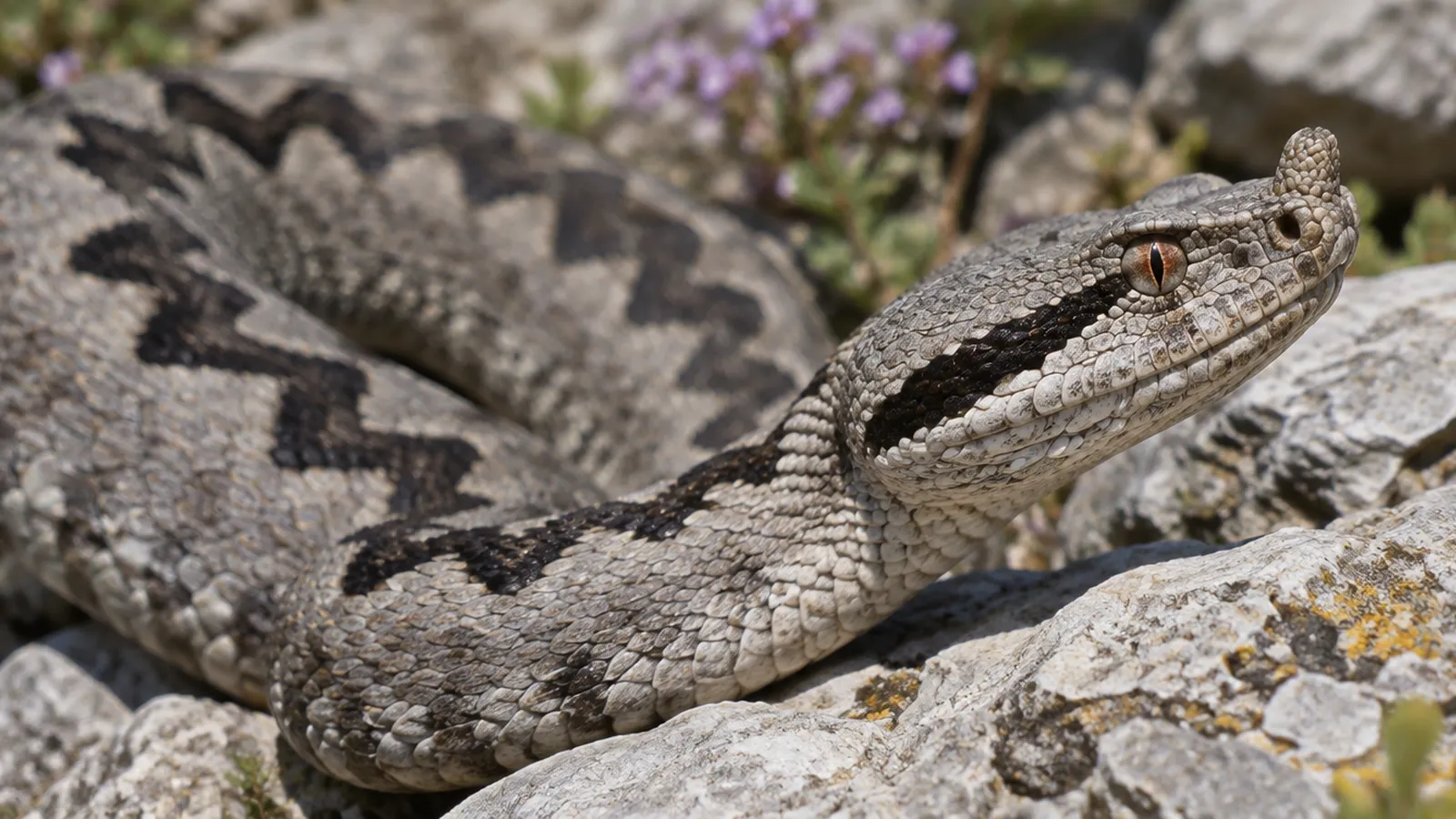
About the nose-horned viper
The nose-horned viper (Vipera ammodytes), also known as the long-nosed viper or sand viper, is found across south-eastern Europe, including the Balkans, Italy, Austria, Greece and parts of Turkey. It lives in rocky, sunny habitats from coastal areas up to around 2,000 m in the mountains. Its most distinctive feature is the soft, fleshy horn on the tip of its snout.
It's a heavily built viper, usually growing to around 65–80 cm in the wild, and often 95 cm or more in captivity. Males tend to be brighter in colour than females, with sharper, higher-contrast markings on the dorsal zigzag stripe and face, which makes sexing fairly easy. Body colour ranges from grey to brown, reddish or yellowish depending on locality.
Venom and safety
The venom of the nose-horned viper is probably the strongest of the European vipers. It contains proteolytic components (which break down tissue), haemotoxins (which damage blood cells and disrupt clotting) and neurotoxic components. Bites cause pain, swelling and bruising and need urgent hospital treatment with antivenom. Interestingly, V. ammodytes venom is used to produce antivenom for bites from other European vipers.
This snake should only be kept by experienced venomous keepers. Use hooks, tongs and a lockable transfer box, never free-handle, and keep a written bite protocol including the correct antivenom.
The law
Most countries require a dangerous wild animal licence and secure housing to keep venomous snakes. Many European countries also protect wild vipers, so buy only legally captive-bred animals. Check your local laws first.
Housing
A terrestrial enclosure of around 90×45×45 cm (36×18×18 in) suits an adult. It must be escape-proof and lockable, ideally with a lockable hide or trap box. Use rocks, cork bark and hides to recreate their rocky habitat, and secure all heavy rocks so they can't shift.
Substrate
A sandy soil mix with gravel or aspen works well.
Heating
Nose-horned vipers love to bask. Provide a basking spot of 30–32°C (86–90°F) under a lamp, with the cool side at 20–24°C (68–75°F). At night, temperatures can drop to around 16–18°C (61–64°F). Always use a thermostat.
Lighting and humidity
UVB is beneficial for this sun-loving species; use a quality UVB tube for 12 hours a day in summer. Keep humidity moderate at 40–60%.
Winter hibernation
Coming from regions with cold winters, nose-horned vipers do best with a winter cooling period of around 8–12 weeks at 6–10°C (43–50°F). Stop feeding at least two weeks beforehand so the gut is empty. Hibernation is also needed for successful breeding.
Feeding
Feed pre-killed mice with long tongs. Juveniles can be fed every 7–10 days and adults every 10–14 days during the active season. Some neonates start more easily on small lizards.
Breeding
Nose-horned vipers give birth to live young, usually 4–15 neonates, in late summer after breeding in spring following hibernation. Neonates are fully venomous.
FAQ
Is it Europe's most venomous snake? It's considered the most venomous of the common European vipers.
Does it need hibernation? It does best with one, and it's needed for breeding.
How do you sex them? Males have brighter, sharper markings.