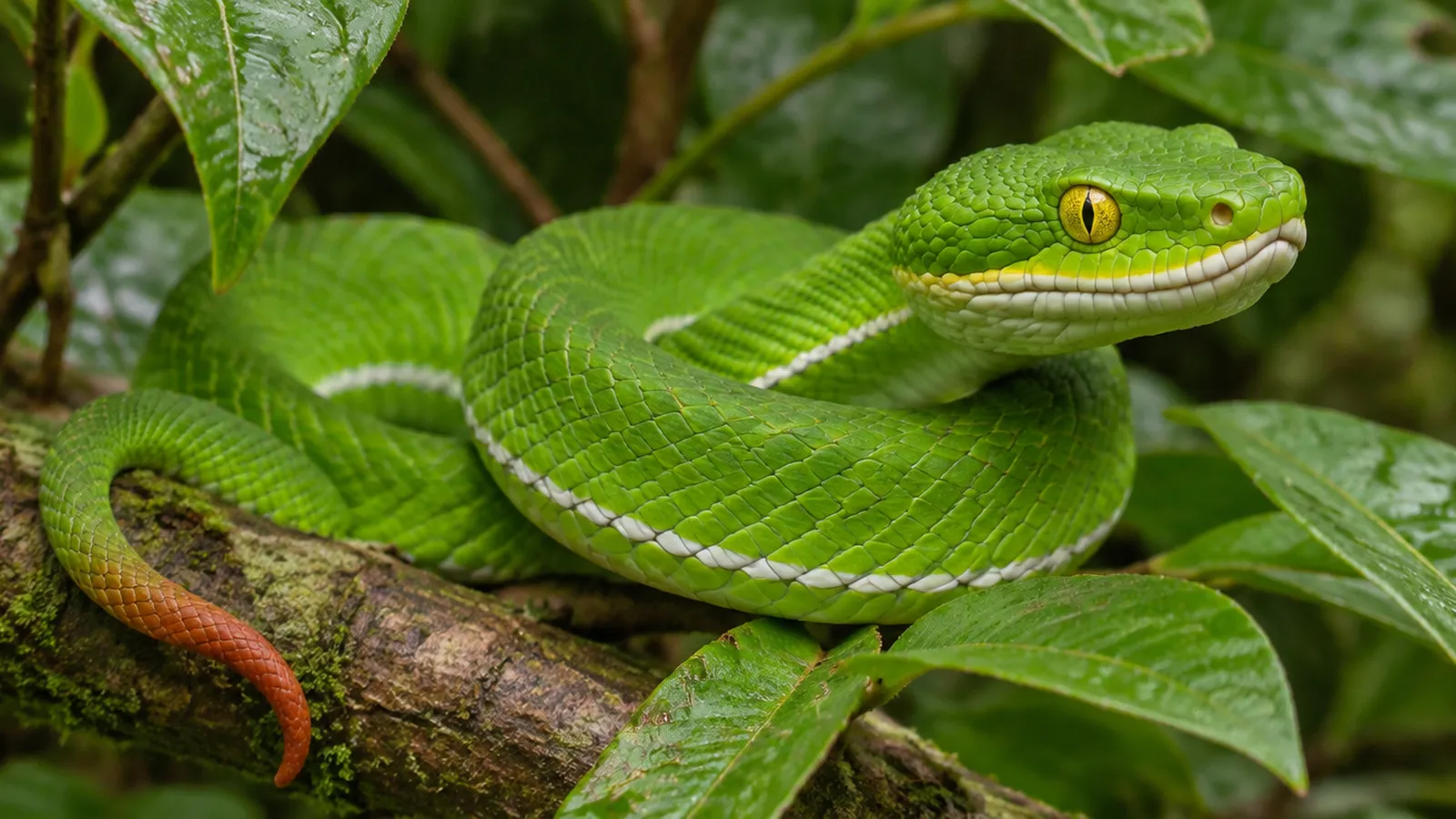
About the white-lipped tree viper
The white-lipped tree viper (Trimeresurus albolabris) is found across much of South and Southeast Asia, from north-eastern India through Myanmar, Thailand, Vietnam and southern China to Indonesia. It's a bright green pit viper with a broad triangular head, yellow eyes with vertical pupils, a pale white or yellowish upper lip (which gives it its name) and often a rusty red tail tip. Adults reach around 75–100 cm (2.5–3.3 ft), with females larger than males.
Among venomous keepers it's often called a good "first viper", because it's hardier than most arboreal vipers and tolerates changes in temperature and humidity better than many related species. That only applies to people who already have experience with venomous snakes. Despite how common it is in collections, surprisingly little has been published about its care and breeding.
Venom and safety
While rarely fatal to healthy adults, a bite from a white-lipped tree viper is a serious matter. The venom is mainly cytotoxic: local swelling and bruising are common, and many bites cause tissue damage. Every bite needs hospital evaluation.
Use hooks, tongs and lockable transfer boxes, and never free-handle. Always have a written bite protocol ready to give to emergency responders and doctors. Many doctors have little experience with exotic snakebite and may not know how to treat it, so your protocol should include the species, the type of venom, the appropriate antivenom and where it can be sourced.
The law
Keeping venomous snakes usually requires a dangerous wild animal licence and secure housing, and some places ban them outright. Check your local laws.
Housing
A vertical enclosure of around 45×45×60 cm (18×18×24 in) suits a single adult, with plenty of horizontal and diagonal branches and foliage for cover. Front-opening enclosures make it easy to see where the snake is before opening the door. The enclosure must be escape-proof and lockable, ideally with a trap box or lockable hide.
Substrate
Coco husk, cypress mulch or a soil mix holds humidity well.
Heating
Keep the warm area near the upper branches at about 27–29°C (80–84°F) and lower areas around 23–25°C (73–77°F). A small night-time drop is fine. Heat from above with a radiant panel or guarded lamp on a thermostat.
Lighting and humidity
A 12-hour light cycle with low-output UVB is beneficial. Keep humidity around 60–80% and mist regularly; these vipers often drink droplets from leaves. Allow surfaces to dry between mistings and keep good ventilation.
Feeding
Feed pre-killed mice with long tongs at branch height. Juveniles can be fed every 7–10 days and adults every 10–14 days. Some juveniles start more readily on small frogs or lizards before switching to mice. Don't overfeed.
Breeding
White-lipped tree vipers give birth to live young, usually 7–15 neonates. Neonates are fully venomous, and breeding should only be done by experienced, licensed keepers.
FAQ
Is it deadly? Rarely, but bites are serious and need hospital care.
Why a "good beginner viper"? It's hardy, but only for people with venomous experience.
What do they eat? Pre-killed mice.