About the plumed basilisk
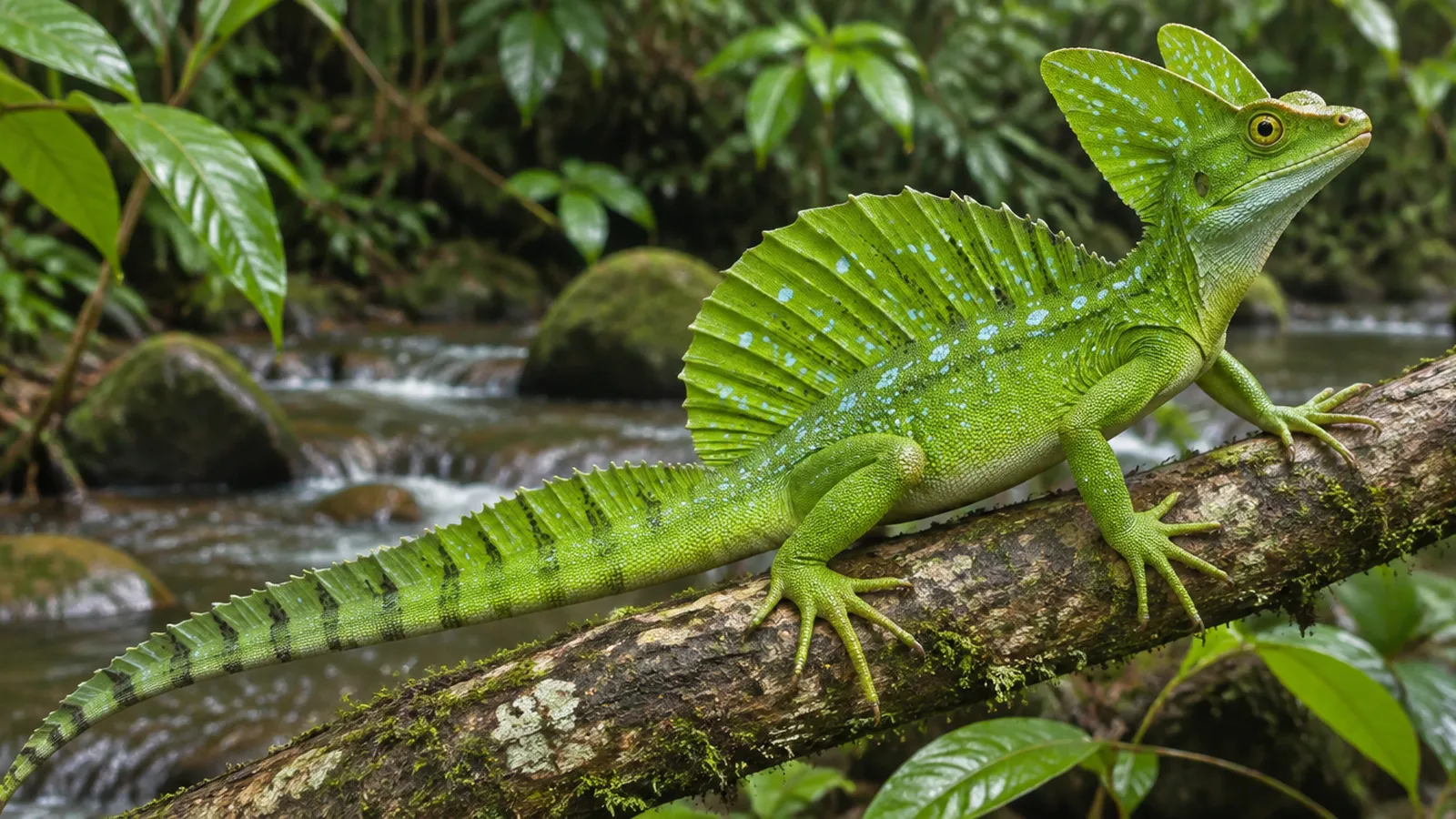
The plumed or green basilisk (Basiliscus plumifrons) lives along rivers and streams in the lowland rainforests of Central America, from Honduras to Panama. It's the largest of the four basilisk species, reaching up to around 80 cm (30 in) including its long tail. Adults are a vivid green with pale blue spots, and males grow tall, sail-like crests on the head, back and tail.
Basilisks are famous for their ability to run across the surface of water. When threatened, they drop from overhanging branches and sprint across the water on their hind legs, using their speed and fringes of skin on their toes to stay on the surface for a short distance. This has earned them the nickname "Jesus Christ lizard".
In the wild they live in warm, stable lowland conditions, with cooler temperatures of around 20–23°C (68–73°F) and warmer temperatures of 24–34°C (75–93°F). They're stunning but easily startled. In small or bare enclosures, they often rub their snouts raw or crash into the glass, so a large, heavily planted setup is essential. Captive-bred animals settle in much better than wild-caught ones.
Housing
Juveniles can be kept in an enclosure of around 90×45×90 cm (36×18×36 in). Adults need at least 180×60×120 cm (72×24×48 in), and larger is better.
Provide horizontal and vertical branches, dense live or artificial plants for cover, and a large water area where the basilisk can soak and swim. If your basilisk keeps running into the glass, cover the lower part of the sides to make the boundaries more visible.
Substrate
Cypress mulch, coco husk or a bioactive soil mix all hold humidity well and are comfortable underfoot.
Heating
As a daytime lizard, the plumed basilisk needs a proper basking spot. Provide around 35°C (95°F) at the basking spot, with an ambient daytime temperature of 27–30°C (80–86°F) and night-time temperatures of about 21–24°C (70–75°F). A basking bulb aimed at an upper branch, on a thermostat or dimmer, works well.
Lighting
Basilisks kept indoors need two kinds of light: a basking light for heat, and a UVB light to replace natural sunlight. Use a high-output T5 UVB tube for around 12 hours a day. UVB bulbs lose strength over time, so replace them as the manufacturer recommends. It helps to write the date on each new bulb so you know when it's due.
Humidity
Plumed basilisks enjoy a relative humidity of around 70–80%. A large water dish placed near the basking light will often maintain this on its own. Daily misting is also fine, as long as the enclosure and substrate don't become waterlogged. Keep air moving to avoid mould.
Feeding
Plumed basilisks are mainly carnivorous, but they should also be offered some plant matter. Feed juveniles daily with small gut-loaded insects such as crickets and roaches, and adults every two to three days with larger insects such as locusts, roaches and worms. Dust insects with calcium at most feeds and use a multivitamin once a week.
Offer finely chopped greens and vegetables a few times a week, and occasional grated fruit, which some individuals enjoy more than others.
Older guides often recommend feeding mice regularly. This is no longer recommended as a staple, as it leads to obesity. An occasional pinky mouse for an adult is plenty.
Handling
Basilisks are skittish and rarely enjoy being handled. Keep handling to essential maintenance and health checks, and move slowly around the enclosure so they don't panic and injure themselves.
Sexing
Adult males are easy to tell apart by their tall head, back and tail crests. Females have only a small head crest and are usually a little smaller.
Breeding
Plumed basilisks usually reach breeding age at around 18–24 months. Females lay clutches of around 5–15 eggs in damp substrate several times a year. Provide a deep, moist laying area. Eggs hatch after around 60–75 days at 28–29°C (82–84°F).
Common health problems
Small or bare enclosures lead to snout rubbing and injuries from hitting the glass. Weak or old UVB causes metabolic bone disease. Too many mice lead to obesity. A healthy basilisk has bright eyes, an intact snout, clean sheds, strong climbing and a good appetite.
FAQ
Can they really run on water? Yes, briefly, as an escape.
Are they good pets? Good display lizards for experienced keepers.
What do they eat? Mostly insects, plus some greens.