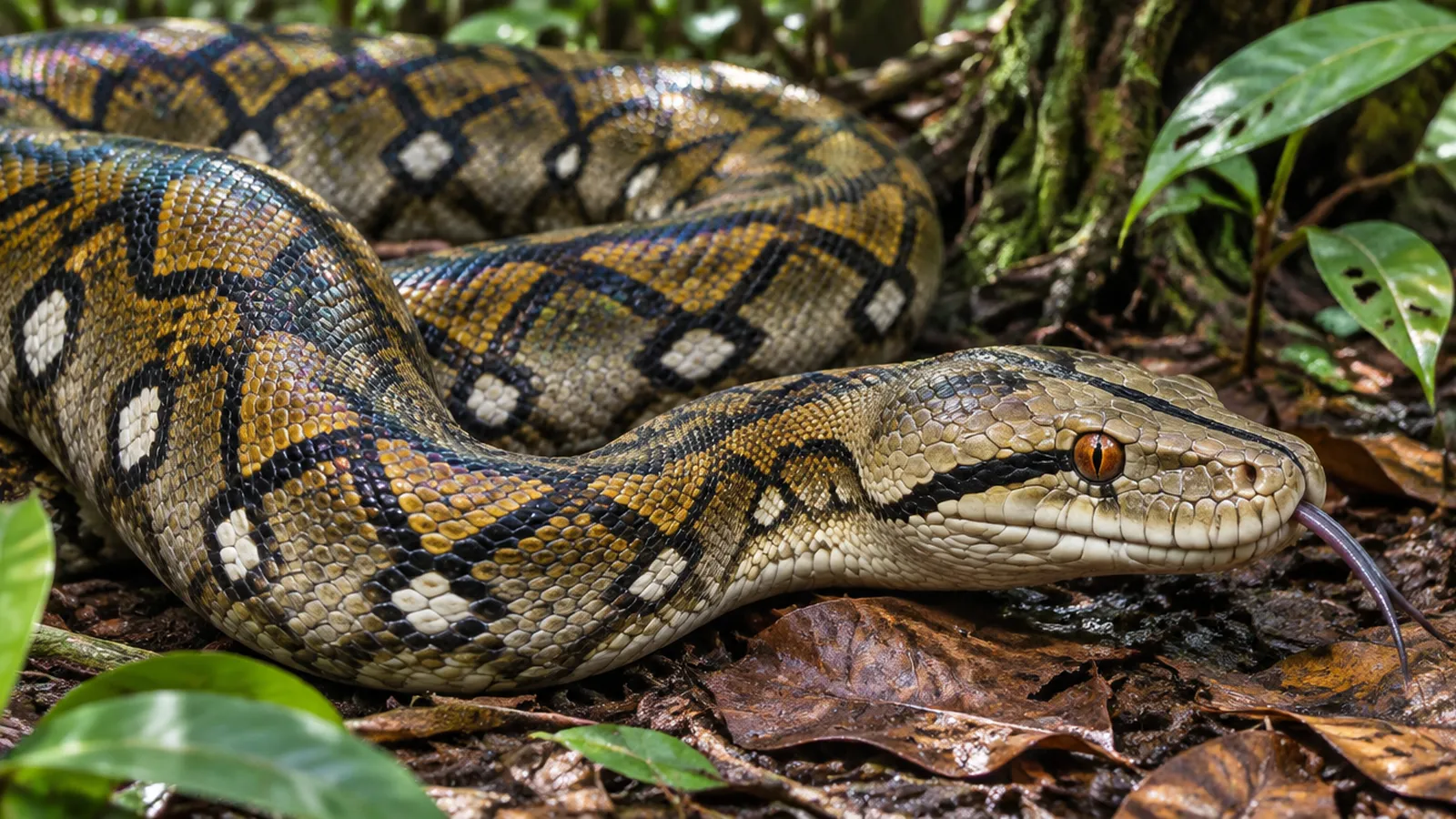
About the reticulated python
The reticulated python (Malayopython reticulatus) ranges across Southeast Asia, from Myanmar and Thailand through Malaysia, Indonesia and the Philippines. It's one of the longest snakes on Earth, named for the intricate net-like ("reticulated") pattern of gold, black, brown and white along its body.
Not long ago, retics were regarded purely as dangerous giants. In recent years, though, they've become one of the more mainstream large snakes in the hobby. Captive-bred retics are often calm and responsive, and many keepers describe them as the most intelligent snakes they've kept. They're active and curious, watching what's going on around them.
Size is the deciding factor. A mainland retic can grow to 3–6 m (10–20 ft) or more and outgrow a room. Dwarf and super dwarf retics come from smaller island populations, such as Kayuadi, Jampea and Selayar, and usually stay around 1.8–3.6 m (6–12 ft). Dwarf and super dwarf babies can be under 30 cm at hatching, while mainland babies are typically 64–80 cm. Retics also come in a huge range of morphs, including tiger, super tiger, motley, sunfire and albino.
Retics are best suited to experienced keepers who are already comfortable with large snakes. Many places require a permit for giant snakes, so check your local laws before buying.
Housing
Hatchlings can start in an enclosure of around 90×45×45 cm (36×18×18 in). Adult super dwarfs need at least 180×60×60 cm (72×24×24 in), and dwarfs at least 240×90×90 cm (96×36×36 in). A mainland adult needs something like 300×120×120 cm (10×4×4 ft) or a custom-built, room-sized enclosure.
Retics are strong and curious, and they'll test every gap, door and vent. The enclosure must be solidly built and lockable. Provide a hide large enough for the whole snake and a water container big enough to soak in.
Substrate
Cypress mulch, coco husk or a soil and bark mix all help with humidity. In very large enclosures, many keepers use an easy-to-clean floor with a deep humid hide instead.
Heating
Retics come from the tropics, where temperatures stay warm year-round. They don't know anything about a cold winter or dry air, so don't expect them to adapt to these conditions. Provide a basking spot of 32–35°C (90–95°F), an ambient temperature of 27–29°C (80–85°F), and keep night temperatures above about 25°C (77°F).
When given the right temperature gradient, retics are remarkably hardy and less prone to colds than Burmese pythons. For large enclosures, radiant heat panels on a thermostat are ideal. Guard any bulbs.
Lighting
A 12-hour light cycle helps them keep a regular routine, and UVB is beneficial for activity and overall health.
Humidity
Keep humidity at around 60–80%. Dry conditions lead to poor sheds and dehydration. Large water containers and a moisture-holding substrate make this much easier.
Feeding
Hatchlings can be fed a rat pup or weaned rat every 5–7 days, juveniles a small to medium rat every 7–10 days, dwarf adults a large rat every 2–3 weeks, and mainland adults rabbits or large rats every 3–4 weeks.
Retics have a very strong feeding response. Always use long tongs, feed in a consistent way that's different from how you handle the snake, and never handle a retic with the smell of prey on your hands. See how to thaw frozen rodents.
Handling and safety
A large retic is powerful enough to seriously injure or kill a person. Follow these rules every time:
Never handle a large retic alone; have one extra person present for roughly every 2.5 m (8 ft) of snake. Use a hook to tap the snake first so it knows it's not feeding time. Wash any prey scent off your hands before you go near the enclosure. Support the body well and let the snake move through your hands rather than restraining it.
Sexing
Males usually have longer, thicker tails and larger spurs, while females grow larger and heavier. Probing confirms the sex.
Breeding
Retics are bred from around 3–4 years old depending on size. Night-time temperature drops of a few degrees during the cooler months help trigger breeding. Females lay large clutches, often 20–60 eggs for mainland animals and fewer for dwarfs, which are incubated at around 31–32°C (88–90°F) for about 80–90 days. Retic genetics are complex: for example, breeding a super tiger to a normal produces all tiger babies.
Common health problems
Most problems come from cool or dry conditions, or from accidents caused by mixing feeding and handling. Wheezing or mouth bubbles need a vet who is experienced with large snakes. A healthy retic is alert and tongue-flicking, sheds cleanly, holds good body condition and has a strong feeding response.
FAQ
How big do they get? Mainland: 3–6+ m. Dwarf locales: about 1.8–3.6 m.
Are they dangerous? Large ones can be. Never handle alone.
Is a dwarf retic a good pet? For experienced keepers, yes.