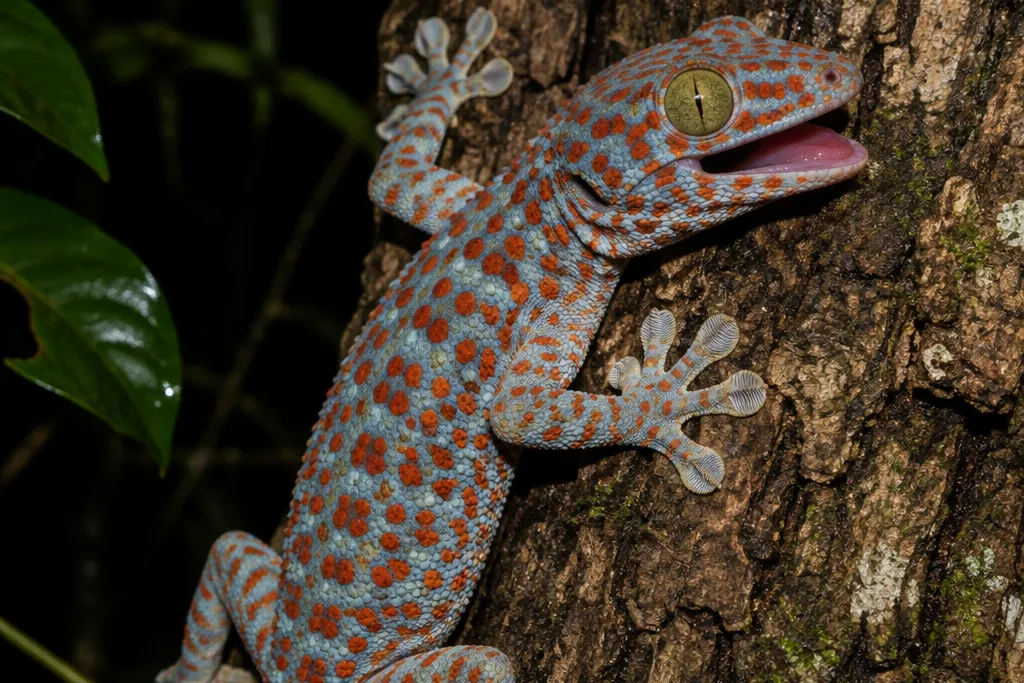
About the tokay gecko
The tokay gecko (Gekko gecko) is one of the largest geckos in the world. It ranges from north-east India and Bangladesh through southern China and Southeast Asia to Indonesia and the Philippines, living in rainforest trees, rocky outcrops and very often on the walls of houses, where it hunts insects around lights. Its loud "to-kay" call, usually given by males at night, gives it its name.
Tokays are heavy-bodied with large heads, big eyes with vertical pupils and wide toe pads that let them climb glass and ceilings. The usual colour is blue-grey covered in orange to red spots, and they can darken or lighten quite quickly. Captive breeders now produce several colour morphs as well.
Their reputation for biting is earned. A defensive tokay opens its mouth, barks and bites with a strong grip, and it often refuses to let go for a while. Many tokays in the trade are still wild-caught, and these are usually the most defensive. If you can, buy a captive-bred animal from a breeder who can tell you how it behaves.
Tokay geckos were added to CITES Appendix II in 2019 because of heavy harvesting for traditional medicine, so international trade now needs permits. Keep the paperwork for your gecko.
Housing
Tokays are arboreal, so height matters more than floor space. A single adult needs at least 45×45×90 cm (18×18×36 in), and 60×60×120 cm (24×24×48 in) is better. Large males over about 30 cm do best in something around 90×60×120 cm (36×24×48 in). Front-opening glass or PVC enclosures work well. Make sure every gap is sealed: tokays are fast and can squeeze through surprisingly small openings.
Fill the enclosure with climbing surfaces. Cork bark flats and tubes fixed to the walls are ideal, because tokays like to hide in vertical crevices. Add branches, a textured background and live or artificial plants for cover. Keep tokays alone. Two males will fight, and even pairs should only be put together for breeding by experienced keepers.
Substrate
Tokays rarely come down to the floor, but a layer of moisture-holding substrate helps keep humidity up. Use about 5–10 cm (2–4 in) of a soil and coconut fibre mix topped with leaf litter, or set up a bioactive enclosure with springtails and isopods to break down waste.
Heating
Tokays need a warm enclosure with a gradient from top to bottom. Aim for a basking area of about 32–38°C (90–100°F) on a branch or cork flat near the top, an ambient cool zone of 26–29°C (80–85°F) lower down, and night temperatures of about 24–26°C (75–80°F). Use halogen or incandescent bulbs on a dimming thermostat for the day, and a low-wattage ceramic heat emitter on a thermostat if your room gets cold at night. Guard all heat sources, because tokays climb onto anything.
Lighting
Tokays are nocturnal, but low-level UVB is still recommended and helps prevent metabolic bone disease. A ShadeDweller-type or 5–7% T5 tube, set up so the gecko gets a UV index of about 1–2 near the basking area with plenty of shade elsewhere, is enough. Run the lights for about 12 hours a day and switch everything off at night. Tokays are most active and visible in the evening, so a dim red or "moonlight" bulb isn't needed and may disturb them.
Humidity
Keep humidity at around 60–80%, measured in the middle of the enclosure. Mist heavily in the evening and again in the morning if needed, so humidity rises at night and falls during the day. Tokays usually drink droplets from the walls and leaves after misting, but provide a water bowl on a ledge too. Good ventilation matters: a constantly wet, stagnant enclosure causes skin and respiratory infections.
Feeding
Tokays are insect-eaters with big appetites. Feed a variety of live insects: dubia or other roaches, crickets, locusts, hornworms, silkworms, black soldier fly larvae and the occasional superworm or waxworm. Offer insects no longer than the width of the gecko's head.
Juveniles can be fed daily and adults every other day, offering as many insects as they eat in about five minutes. Gut-load feeders for a day or two before feeding, dust them with calcium at most feeds and use a reptile multivitamin about once a week. Tokays bite feeding tongs hard, so use soft-tipped tongs.
Handling and bites
Treat a tokay as a display animal and you won't be disappointed. Give a new gecko at least two weeks to settle before you interact with it. Never grab it. Instead, let it get used to you by offering food from tongs and moving slowly near the enclosure. Some captive-bred tokays become calm enough to sit on a hand, but many never do.
If you are bitten, don't pull your hand away, as that can hurt both of you. Set the gecko down on a surface and wait. It usually lets go once it feels secure, and a gentle stream of water helps if it doesn't. Clean the bite well. Our article on tokay gecko bites covers this in more detail.
Sexing
Adult males are noticeably larger, with broader heads, a row of pre-anal and femoral pores and clear hemipenal bulges at the base of the tail. Females are smaller and lack obvious pores. Males also call far more often.
Breeding
Females lay two hard-shelled eggs at a time, glued to a wall or the underside of cork bark, and can lay several clutches a year. Because the eggs are glued in place, most keepers leave them where they are and cover them with a mesh cup taped over them, since adults may eat hatchlings. At around 28–30°C (82–86°F), eggs usually hatch after two to three months, and longer when cooler. Hatchlings must be raised separately.
Common health problems
Wild-caught tokays often arrive dehydrated and carrying internal parasites, so a vet faecal check is worthwhile. Other common problems are retained shed on toes and tail tips (from low humidity), mouth injuries from biting glass or tongs, and metabolic bone disease from missing calcium or UVB. Tokays can drop their tail when stressed. It does grow back, but looks different. A healthy tokay has clear eyes, a thick tail base and climbs with a strong grip.
FAQ
Do tokay geckos bite? Yes. Most tokays bite when handled or cornered, and the bite is strong and often held for a while. Captive-bred animals can calm down, but many stay defensive for life.
How big of a tank does a tokay gecko need? At least 18×18×36 inches (45×45×90 cm) for one adult, and 24×24×48 inches (60×60×120 cm) or larger is better. Height matters more than floor space.
Can tokay geckos live together? Not usually. Two males will fight. Keep one tokay per enclosure, and only pair a male and female for planned breeding.