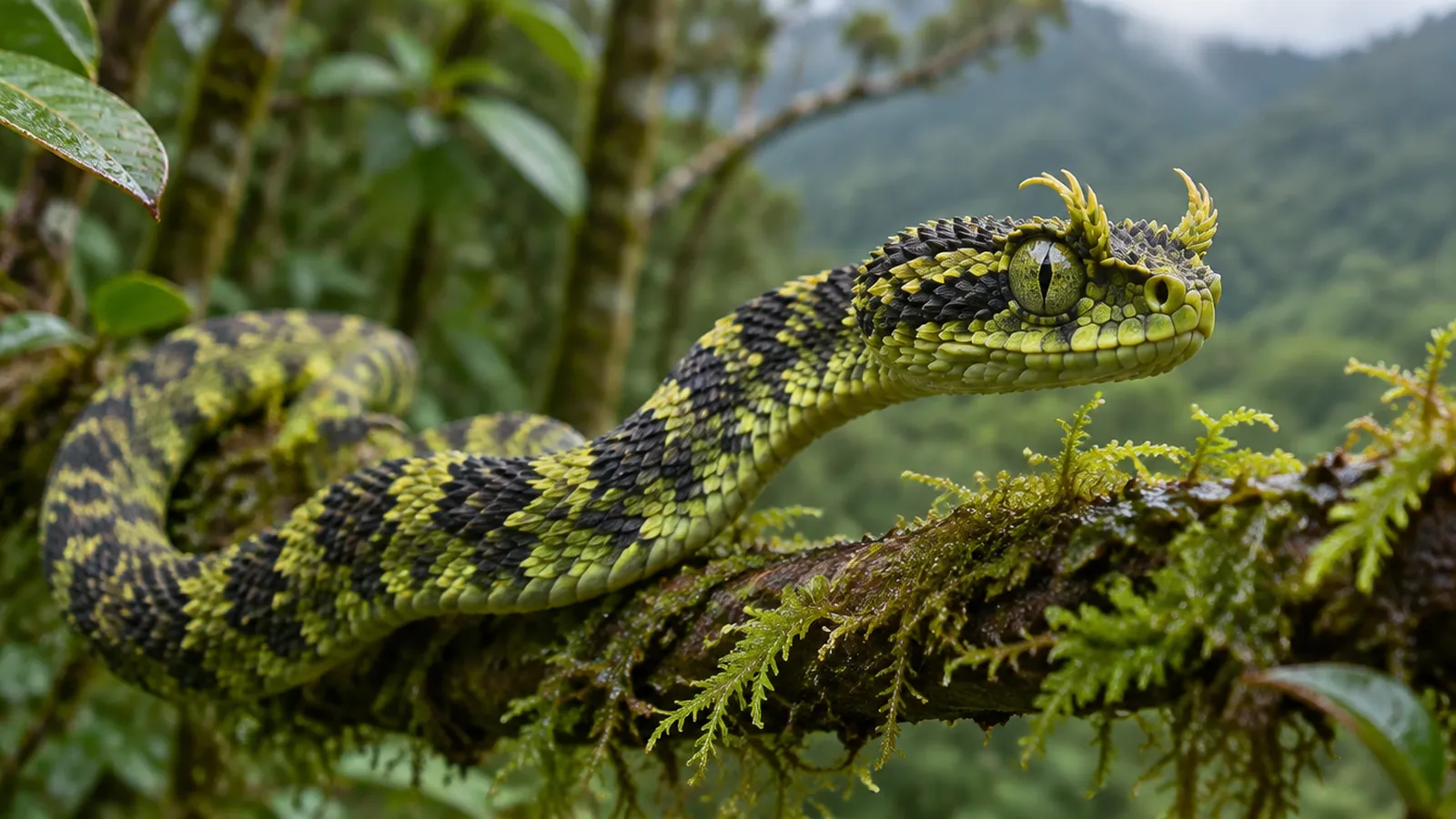
About the Usambara eyelash viper
The Usambara eyelash viper (Atheris ceratophora), also called the horned bush viper, is found only in the Usambara and Uluguru Mountains of north-eastern Tanzania, where it lives in cool, humid montane forest. It's a small, mostly nocturnal and heavily arboreal viper, with adults reaching only 42–54 cm (17–21 in), and males somewhat smaller than females.
Its most striking feature is the cluster of enlarged, horn-like scales above each eye, which give the species its name. Body colour is highly variable, with several recognised colour phases: drab olive, banded black and yellow, mottled green and black, and a very rare solid black phase. Many keepers consider it the most beautiful of all the Atheris bush vipers.
It's not related to the South American eyelash viper (Bothriechis schlegelii), which is a pit viper. The Usambara eyelash viper is an African bush viper, closely related to the variable bush viper.
Venom and safety
Like other Atheris species, its venom is haemotoxic, and there is no specific antivenom for bush viper bites. Always use hooks and tongs, never free-handle, and keep a written bite protocol for emergency services.
The law
Keeping venomous snakes usually requires a dangerous wild animal licence and secure housing. Check local laws before acquiring one.
Housing
A single adult can be kept in a vertical enclosure of around 40×40×60 cm (16×16×24 in), with lots of thin branches and dense live plants. It's recommended to house all animals individually, even though aggression and cannibalism haven't been observed in this species. Males and females can be testy with each other during breeding cycles.
Substrate
A moisture-holding bioactive soil mix with moss and leaf litter suits this species well.
Heating
This is a montane species that dislikes heat. Keep daytime temperatures around 22–25°C (72–77°F) and night temperatures around 17–20°C (63–68°F). In many homes little or no extra heat is needed; in summer, you may need to keep the room cool. If heat is needed, use a low-output, guarded source on a thermostat.
Lighting and humidity
A 12-hour light cycle with low-output UVB and plenty of shade is ideal. Keep humidity high, around 70–90%, misting at least once a day, with good ventilation to prevent stagnant air.
Feeding
Feed pre-killed pinky or fuzzy mice with long tongs. Adults can be fed every 10–14 days. Neonates and some adults may initially prefer small frogs or lizards, and tease feeding (gently tapping the snout with the prey) can help start reluctant feeders.
Breeding
Usambara eyelash vipers give birth to live young, and litters are small: five babies is considered a large litter. Neonates are fully venomous and very small. Breeding should only be attempted by experienced, licensed keepers.
FAQ
Why is it called an eyelash viper? Horn-like scales above each eye.
Same as the South American eyelash viper? No, they're unrelated.
What temperature does it need? Cool: 22–25°C days, 17–20°C nights.