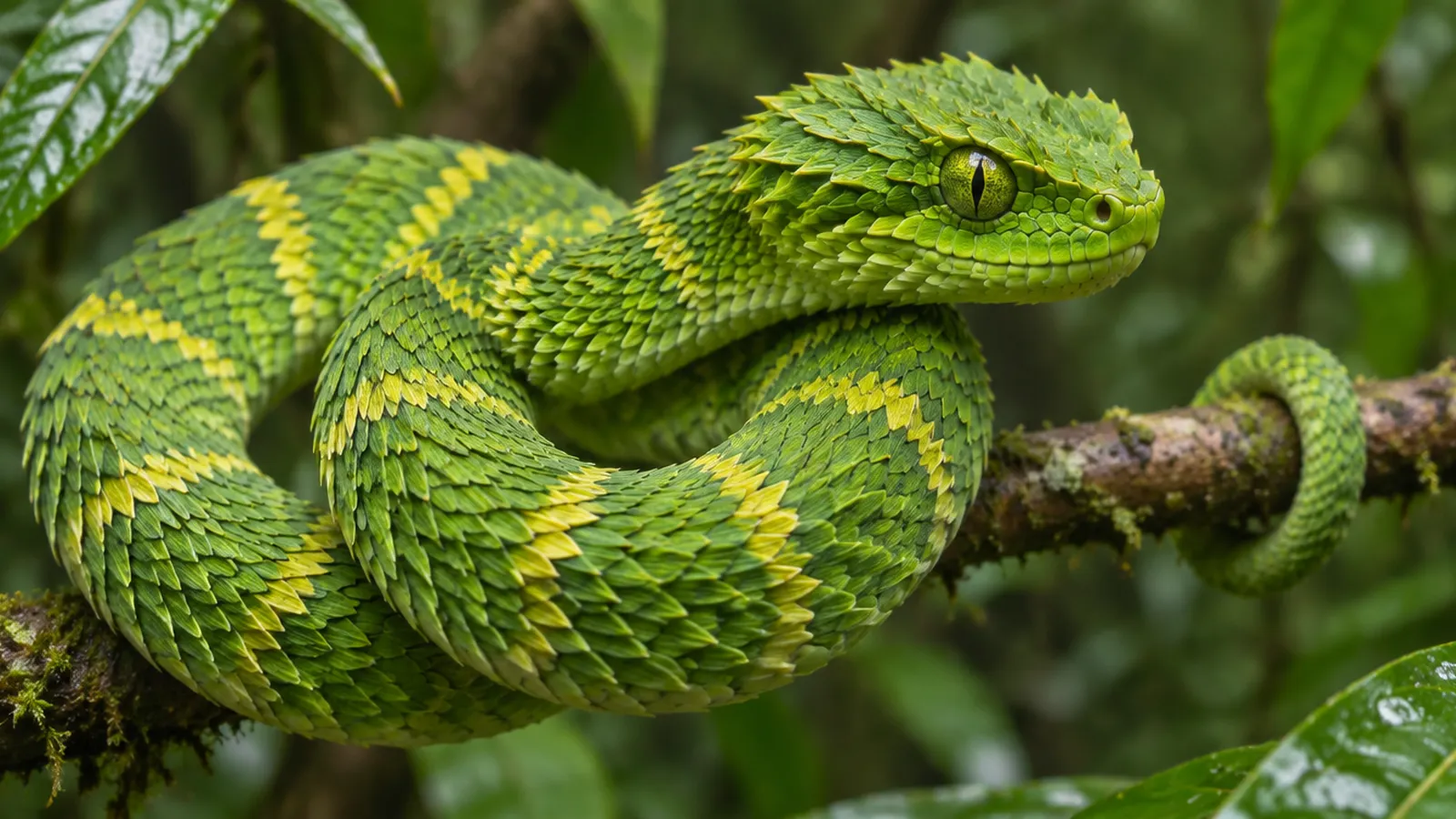
About the variable bush viper
The variable bush viper (Atheris squamigera), often called a "squam", lives in the rainforests of West and Central Africa, from Ghana and Nigeria to the Democratic Republic of Congo, Uganda and western Kenya. It's a small arboreal viper that seldom grows beyond about 70 cm (28 in), with males noticeably smaller than females.
With its strongly keeled, slightly raised scales, triangular head and prehensile tail, it has an almost dragon-like look that leaves many venomous keepers stunned. As the name suggests, colour is highly variable and depends partly on locality: green, olive, yellow, blue, red and grey animals all occur. Many change colour dramatically as they mature: a baby born plain green may become a blue adult, or the reverse.
Variable bush vipers are one of the few arboreal vipers that really thrive in captivity. The main problem keepers face is overfeeding.
Venom and safety
Atheris venom is haemotoxic, and serious bites have caused severe bleeding and clotting problems. Importantly, there is no specific antivenom for bush viper bites. This makes prevention and preparation critical: use hooks, tongs and lockable enclosures, never free-handle, and keep a written bite protocol for emergency services.
The law
Most places require a dangerous wild animal licence and secure housing to keep venomous snakes, and some ban them outright. Check local laws before acquiring one.
Housing
A single adult can be kept in a vertical enclosure of around 45×45×60 cm (18×18×24 in), with plenty of thin branches and live or artificial foliage for cover and climbing. Front-opening glass enclosures let you see where the snake is before opening. Neonates can be raised in small ventilated containers with a perch. House individually.
Substrate
A moisture-holding substrate such as coco husk, sphagnum moss or a bioactive soil mix helps maintain humidity.
Heating
Bush vipers prefer moderate temperatures: around 26–28°C (79–82°F) near the top of the enclosure and 22–24°C (72–75°F) lower down, with a slight night-time drop. Avoid overheating. Use a guarded heat source on a thermostat.
Lighting and humidity
A 12-hour light cycle with low-output UVB is beneficial. Keep humidity at around 70–80% and mist daily; most bush vipers drink droplets from leaves and their own coils. Ensure good airflow.
Feeding
In the wild, variable bush vipers eat frogs, lizards, birds and small rodents, and can occasionally be cannibalistic. In captivity they readily take a diet of rodents alone. Offer a prey item about once every other week for adults; they love to eat, and obesity is the most common problem in captive squams.
Neonates often take whole pinky mice, though very small babies may need pinky heads or hindquarters. Tease feeding is often the only way to get neonates started: hold the prey with long tongs and gently tap the snake's snout until it strikes. Once established, most feed reliably.
Breeding
Variable bush vipers give birth to live young, typically around 6–12 neonates. Neonates are fully venomous. Breeding should only be attempted by experienced, licensed keepers.
FAQ
Is there antivenom? No specific antivenom exists.
Why does it change colour? Colour often changes from juvenile to adult.
How often should I feed one? About once every other week for adults.