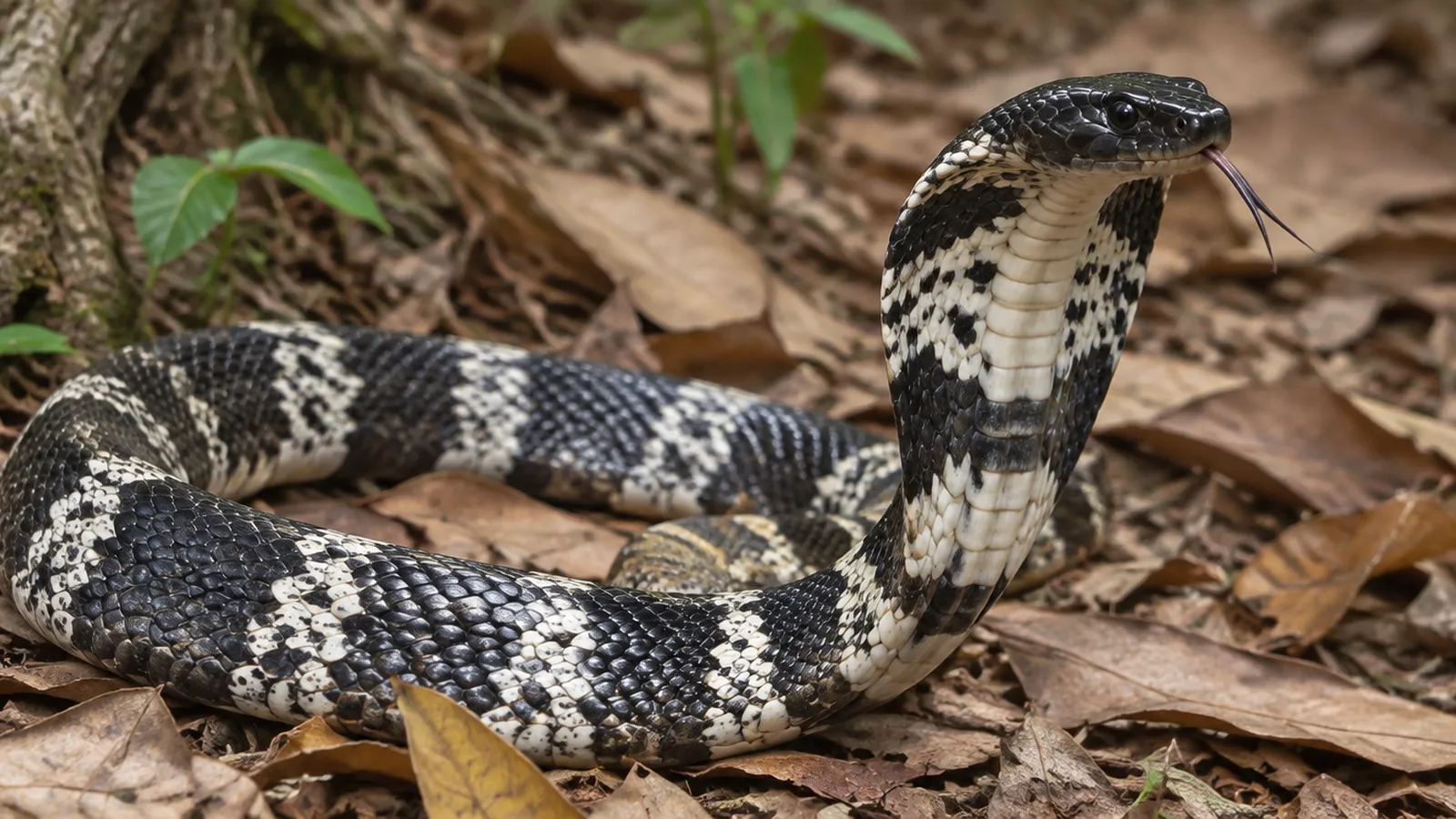
About the black and white spitting cobra
The Indochinese spitting cobra (Naja siamensis), often called the black and white spitting cobra, lives in Thailand, Cambodia, Laos and Vietnam. It's a medium-sized, fairly thick-bodied cobra, usually reaching 1–1.5 m (3.3–5 ft). Colour varies a lot: many are a dramatic mix of black and white bands and speckles, while others are grey, brown or almost black.
Like other spitting cobras, it can spray venom from small openings in its fangs, aiming at the eyes of a threat from a distance of a couple of metres. This is purely defensive, but it makes the species especially dangerous to work with.
This is a species for experienced venomous keepers only. It should never be kept by anyone under 18, or by anyone without prior experience with venomous snakes and the correct licences.
Venom and safety
The venom is cytotoxic, like that of most spitting cobras. A bite causes intense pain, swelling and necrosis (tissue death) around the wound, and is potentially lethal to an adult human. Most deaths in the wild happen in rural areas where antivenom is hard to get. Venom sprayed into the eyes causes immediate, severe pain and can lead to temporary or even permanent blindness.
Before keeping this species you need:
- Eye protection (sealed goggles or a full face shield) every time the enclosure is opened.
- Proper tools: snake hooks, long tongs and a lockable transfer box. Never free-handle.
- A written bite protocol, including the species, the correct antivenom and where it can be obtained, to hand to emergency services. Many doctors have little experience with exotic snakebite.
- A plan for venom in the eyes: flush immediately with large amounts of water or saline and seek medical help.
The law
Most countries, states and regions require a dangerous wild animal licence, secure facilities and inspections to keep venomous snakes, and some ban them altogether. Check your national and local laws before considering this species, and never buy an animal without the correct paperwork.
Housing
Cobras need space. Adults are best kept in enclosures of around 200×100×80 cm (6.5×3.3×2.6 ft). Cobras kept in cramped enclosures often end up with battered faces and missing snout scales from rubbing and striking at the walls. Your cobra should never feel cornered; a snake that feels trapped is more stressed and more defensive.
The enclosure must be escape-proof and lockable, ideally with a hide box that can be closed from outside so the snake can be shut away safely during cleaning. Front-opening enclosures with a viewing window let you always see where the snake is before opening. Many keepers also lock the room the enclosure is in.
Substrate
Aspen, cypress mulch or a soil mix all work. Avoid anything dusty.
Heating
Place a heat mat or radiant heat panel at one back corner, set to around 32°C (90°F), with the opposite end cooler at about 24–26°C (75–79°F). Always use a thermostat. A small night-time drop is fine.
Lighting and humidity
A natural 12-hour day and night cycle is ideal; low-output UVB is optional. Moderate humidity of 50–70% suits them, with a humid hide during shed.
Feeding
Feed pre-killed, frozen-thawed rodents offered with long tongs. Juveniles can be fed a mouse every 5–7 days, and adults a rat or several mice every 10–14 days. Cobras often have a strong feeding response, so never put your hand near the enclosure while food is present. See how to thaw frozen rodents.
Maintenance
Lock the snake in its hide box before servicing the enclosure whenever possible. Use hooks to move the snake and tongs for spot-cleaning and water changes. Never work with a venomous snake when tired, distracted or alone.
Breeding
Females lay clutches of around 10–20 eggs. Breeding venomous snakes should only be attempted by highly experienced, licensed keepers, as neonates are fully venomous from birth.
FAQ
Can it blind you? Venom in the eyes can cause temporary or permanent blindness without quick treatment.
Is the bite deadly? Potentially, yes.
Do you need a licence? In most places, yes.