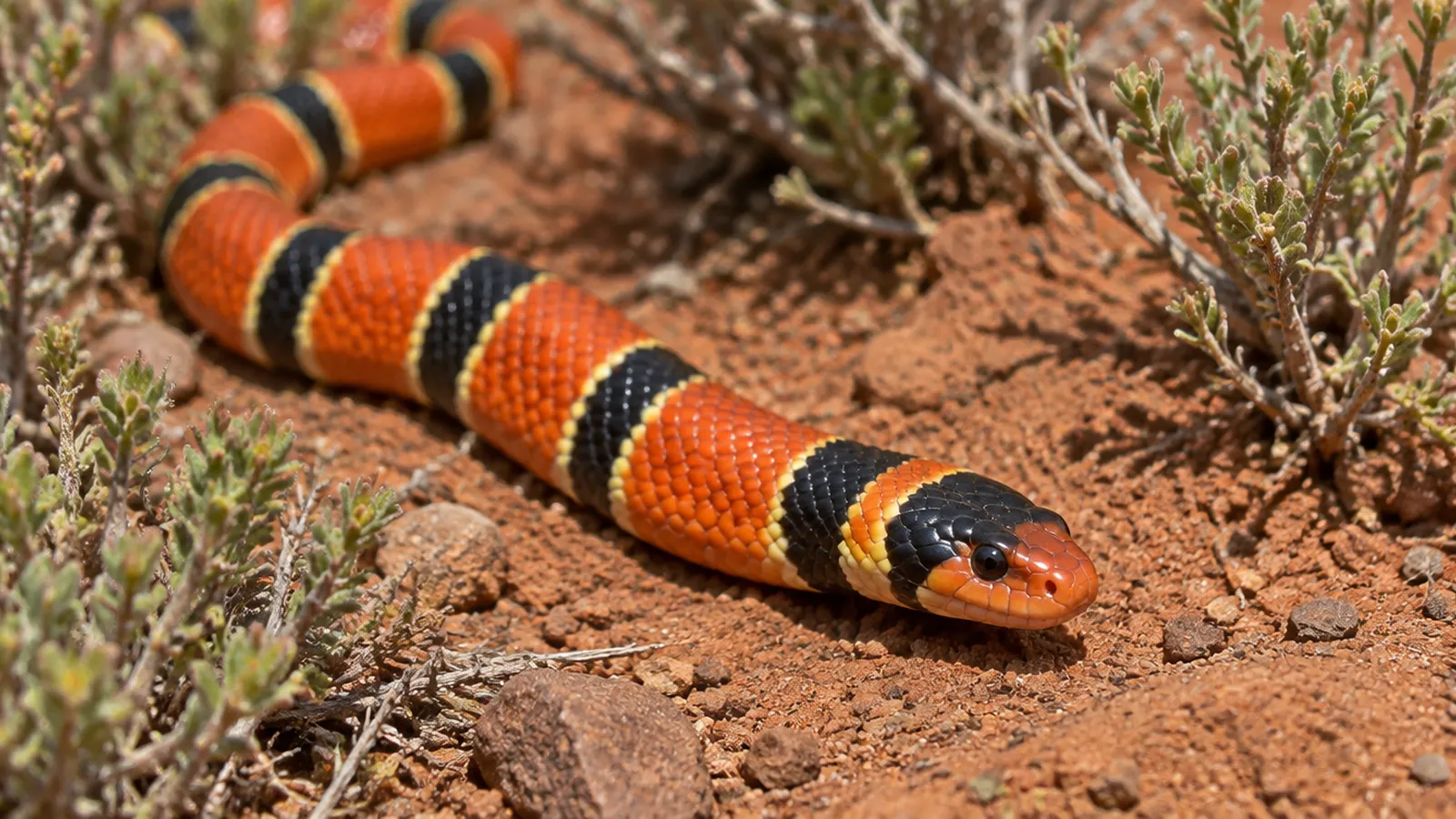
About the Cape coral cobra
The Cape coral cobra (Aspidelaps lubricus), also called the coral snake or coral shield cobra, is found in the arid western parts of South Africa, especially the Karoo and Western and Northern Cape, extending into southern Namibia. It's a small, stout snake that rarely grows larger than 75 cm (2.5 ft), with most adults around 30–60 cm (1–2 ft).
It's one of South Africa's most attractive snakes: a bright coral-orange to red body crossed by bold black bands, often edged in yellowish cream. It has an enlarged, shovel-like scale on the tip of its snout, which it uses for burrowing in sandy soil. Captive breeders have selected for colour over generations, producing animals with especially clean bands and brilliant colours.
What coral cobras lack in size they make up for in attitude. They're quick to hiss, raise a small hood and flick around the enclosure, especially when young. They are venomous and should only be kept by people experienced with venomous snakes.
Venom and safety
Coral cobras have neurotoxic venom. In South Africa, bites from coral cobras have not caused life-threatening symptoms, but every person reacts differently to venom, and there is no specific antivenom. Treat every bite as a medical emergency.
Always use proper tools (snake hooks, tongs and a lockable transfer box), never free-handle, and keep a written bite protocol with the species name ready for emergency services.
The law
In South Africa, keeping indigenous snakes, and especially venomous ones, generally requires a provincial permit. Check with your local conservation authority or parks board before acquiring one. Outside South Africa, most places require a dangerous wild animal licence. Buy only captive-bred animals: they tend to be more colourful, feed better and breed more reliably in captivity.
Housing
An adult can be kept in a secure enclosure of around 60×40×30 cm (24×16×12 in), and slightly larger for a display. It must be escape-proof and lockable. Provide hides at both ends; a hide box that can be closed from outside makes maintenance safer.
Substrate
Coral cobras love to burrow. Use a few centimetres of sand mixed with soil, or aspen, and add flat rocks or bark for them to hide under.
Heating
Provide a warm side of around 28–30°C (82–86°F) and a cool side of 20–24°C (68–75°F) using a heat mat on a thermostat. They come from a region with cool nights, so a night-time drop is natural.
Lighting and humidity
A natural day and night cycle is enough. Coral cobras come from a dry region, so keep humidity low at 30–50%, with a slightly damp hide when shedding.
Feeding
Captive-bred coral cobras readily accept pre-killed mice. Feed hatchlings a pinky every 5–7 days and adults a small mouse every 7–10 days, offered with tongs. Some hatchlings start more easily on scented prey or small lizards. See how to thaw frozen rodents.
Breeding
Coral cobras are bred in captivity in South Africa, often after a cool winter period. Females lay small clutches of around 3–11 eggs in summer. Neonates are venomous from birth and have the same attitude as adults.
FAQ
Is it dangerous? It's venomous with neurotoxic venom; treat every bite seriously.
Do you need a permit? Usually yes, in South Africa and elsewhere.
What do they eat? Pre-killed mice in captivity.