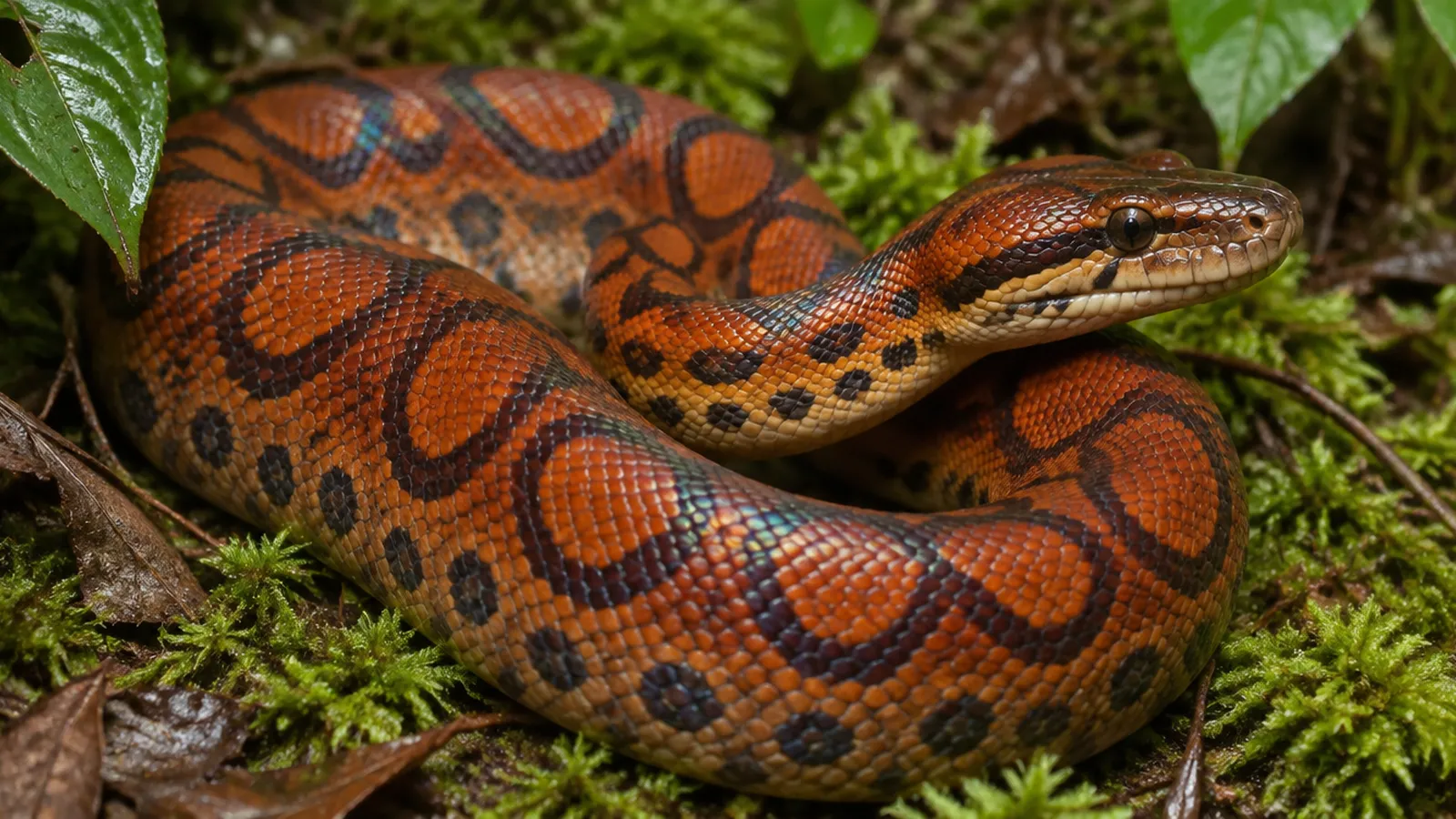
About the Brazilian rainbow boa
The Brazilian rainbow boa (Epicrates cenchria) is found across the humid lowland forests of the Amazon basin. Its base colour is a rich orange to red-brown, with dark rings along the back and spots down the sides. What makes it famous, though, is the shimmer: microscopic ridges on each scale split light like a prism, so the snake flashes blue, green and purple as it moves, especially just after a shed.
Adult rainbow boas average 1.5–1.8 m (5–6 ft), though some individuals stay a little over 1.2 m (4 ft) and the occasional big female can approach 2.1 m (7 ft). They are long-lived snakes and can easily pass 25 years with good care. Babies are often nippy and quick to strike, but most grow into calm, tolerant adults. The one thing you can't get wrong with this species is humidity. Rainbow boas dehydrate quickly in a dry enclosure, and nearly every problem keepers run into traces back to moisture.
Housing
Babies up to about 60 cm (2 ft) can be housed in a 10–20 gallon enclosure, moving to around 90×45×45 cm (36×18×18 in) as juveniles. A single adult needs at least 120×60×60 cm (48×24×24 in), and many keepers prefer 180×60×60 cm (72×24×24 in) for a large female.
The type of enclosure matters more with rainbow boas than with most snakes. PVC or wooden enclosures hold humidity far better than glass tanks with mesh lids. If you do use glass, cover part of the screen top with plastic or glass to stop moisture escaping, and adjust it until you can hold humidity without the enclosure going stale. Rainbow boas will climb a little, so a few sturdy branches are welcome, along with a hide at each end and a large water bowl.
Substrate
Choose a substrate that holds moisture well. A mix of coco husk and reptile bark is a good start, and some keepers add a little peat. Lay it 8–10 cm (3–4 in) deep so the bottom layer can stay damp. Clumps of sphagnum or green moss are a great addition: they look natural, give the snake somewhere to push into, and release moisture each time you mist. Live plants help with humidity for babies, though an adult will usually flatten them.
Heating
Rainbow boas come from the tropics and need a warm side of around 29–31°C (84–88°F) with a cool side of 24–27°C (75–80°F). At night, adults can tolerate a drop to around 24°C (75°F), but babies should be kept warm around the clock.
A radiant heat panel or a heat lamp works well, as long as it's on a thermostat. Avoid uncovered heat bulbs inside the enclosure; rainbow boas love to coil around warm objects and can be badly burned.
Lighting
UVB is optional for rainbow boas. A regular 12-hour day and night cycle is enough, though a low-output UVB tube is a nice addition and helps any live plants.
Water and humidity
This is the most important part of rainbow boa care. Aim for humidity of 70–90%. The substrate should stay slightly damp for most of the day, then be close to dry on the surface before you mist again. Constantly soaking wet substrate causes scale rot and blisters, while a dry enclosure quickly leads to wrinkled skin, poor sheds and retained eye caps.
Misting once or twice a day usually does the job, and an automatic misting system makes life much easier. A large water bowl placed on the warm side also adds moisture to the air. Rainbow boas drink a lot, so keep the water clean and topped up. See our guide on how to raise humidity in a terrarium for more ideas.
Feeding
Rainbow boas are good feeders. Babies can be offered a pinky or fuzzy mouse every 5–7 days, juveniles move on to hopper and adult mice every 7–10 days, and adults do well on a large mouse or small rat every 10–14 days. The prey should be about as wide as the thickest part of the snake.
Feed frozen-thawed prey that has been properly warmed; our guide on how to thaw frozen rodents explains how. Some babies are shy about their first meals and feed better at night or when left alone in a covered container with the prey.
Handling
Young rainbow boas often bite, and many keepers use a snake hook to lift juveniles out of the enclosure. Short, calm handling sessions help them get used to you. Most adults are relaxed and tolerate handling well. As with any snake, wait 48 hours after a meal before handling.
Sexing
Males have longer tails that stay thick for a while after the vent before tapering, and their pelvic spurs are usually larger. Females have shorter tails that narrow sharply and grow larger and heavier overall. Probing by an experienced keeper or vet will confirm the sex.
Breeding
Rainbow boas usually reach breeding size at around 3 years old. A gentle cooling period with night-time drops to around 22°C (72°F) for a few weeks, combined with slightly shorter days, helps trigger breeding. The male is then introduced to the female. Like all boas, rainbow boas give birth to live young, usually around 5 months after a successful pairing. Litters of 10–25 babies are typical.
Common health problems
Low humidity is the number one cause of problems, showing up as wrinkled skin, stuck shed and retained eye caps; see how to fix stuck shed. Soaking wet substrate causes scale rot. Wheezing or bubbles around the mouth point to a respiratory infection and need a vet. A healthy rainbow boa has strong iridescence, clean one-piece sheds, a firm body and a good appetite.
FAQ
What humidity does a Brazilian rainbow boa need? 70–90%.
Are they good for beginners? A good second snake once you're confident with humidity.
Do they bite? Babies often do; adults usually calm down.