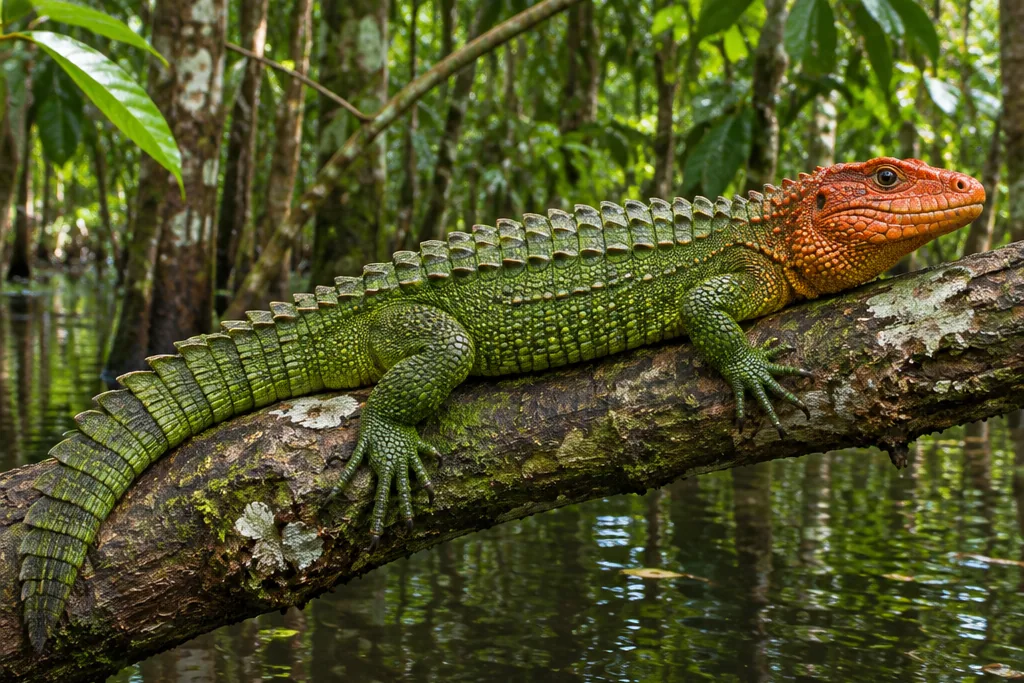
About the caiman lizard
The northern caiman lizard (Dracaena guianensis) lives in the flooded forests, swamps and riverbanks of the Amazon basin and the Guianas, in Brazil, Peru, Colombia, Ecuador, Suriname and French Guiana. It's a large relative of the tegus that has become semi-aquatic. It basks on branches hanging over the water and drops in at the first sign of danger.
Adults are bright green to olive with a red to orange head and rows of large, raised, bony scales on the back that look like a crocodile's. The tail is flattened from side to side for swimming. Most adults reach about 1–1.2 m (3.5–4 ft), and large males can approach 1.5 m (5 ft).
In the wild, caiman lizards are snail specialists. Their back teeth are broad and flat for crushing shells, and they eat large apple snails along with crayfish, clams, crabs and fish. Some imported adults refuse anything but snails at first, which is one reason they've been considered difficult. Captive-bred animals are now more widely available and usually accept a broader diet.
The species is listed on CITES Appendix II, so international trade requires permits. Some countries and states also regulate large lizards. Check your local rules before buying.
Housing
An adult needs at least 240×120×180 cm (8×4×6 ft), and bigger is strongly recommended. Height matters because caiman lizards climb and bask high up. Build or buy an enclosure that can handle constant humidity and a heavy pool, such as PVC panels or sealed, waterproofed wood. Keep one lizard per enclosure.
The pool should take up roughly a third to half of the floor and be at least 30 cm (12 in) deep, so the lizard can fully submerge and swim. A stock tank, pond liner or pre-formed pond works well, ideally with a drain or canister filter, since caiman lizards often defecate in the water. Fix sturdy branches and shelves over the pool so the lizard can bask directly above it, and give it a large dry land area with hides. Juveniles can start in a 120×60×120 cm (4×2×4 ft) setup with a smaller pool.
Substrate
Use at least 15 cm (6 in) of a soil, cypress mulch and sand mix on the land area. It holds humidity and allows some digging. Replace it completely every few months, and remove waste and food scraps daily, since damp, dirty substrate breeds bacteria.
Heating and water temperature
Provide a basking surface of about 49–54°C (120–130°F), measured with an infrared thermometer, using a cluster of halogen flood bulbs above a basking branch or shelf over the water. The air near the basking area should be about 27–32°C (80–90°F) and the cool side about 21–27°C (70–80°F). Keep night temperatures above about 22°C (72°F).
Heat the pool to about 24–27°C (75–80°F) with a guarded aquarium heater or an external inline heater, since cold water chills a lizard that spends hours swimming. Put all heaters and bulbs on thermostats and guards.
Lighting
Caiman lizards are active by day and need UVB. Use a full-length T5 HO 10–12% tube over the basking area, mounted at the distance recommended by the manufacturer, plus bright 6500K LED lighting. Run the lights for about 12–13 hours in summer and 11 in winter, with full darkness at night.
Humidity
Keep humidity at around 70–80%, and never let it fall below 60%. The pool does a lot of the work, helped by damp substrate and a misting system or daily misting. Make sure there's still some airflow, as stagnant, soaking-wet conditions cause skin problems.
Feeding
Build the diet around snails and other shelled or aquatic prey. Good options include frozen-thawed or captive-bred apple snails and other aquatic snails, crayfish, shrimp, mussels and clams in the shell, and whole fish such as smelt or tilapia. Add variety with roaches, superworms, hornworms, occasional eggs, an occasional frozen-thawed rodent and a little fruit such as mango or papaya. Never feed wild-collected garden snails, which can carry parasites and pesticides. Tinned snails are high in salt, so rinse them well and use them sparingly.
Juveniles can be fed daily and adults two or three times a week. Each meal should be about the size of the lizard's head. Dust non-whole-prey foods with a calcium and vitamin D3 supplement, especially if snails without shells are used. Some keepers feed in a shallow dish or drop food into the water, which caiman lizards seem to enjoy.
Handling
Captive-bred caiman lizards are often fairly calm and can become tolerant of handling, but they're large and powerful with a crushing bite designed for snail shells. Build trust with tong-feeding and short sessions, always support the body and tail, and avoid grabbing. Wild-caught adults are usually more nervous.
Sexing
Adult males are larger and heavier, with broader heads, more swollen jowls and often brighter red heads. They may also show hemipenal bulges. A vet can confirm the sex with ultrasound or probing.
Breeding
Captive breeding of caiman lizards is still uncommon and has mostly been achieved by zoos and a few specialist breeders. It needs very large enclosures, well-conditioned adults and a lot of experience, so most keepers should focus on keeping one animal well.
Common health problems
Dirty water causes skin infections and blister disease, so filtration and frequent water changes are essential. Other common problems are metabolic bone disease from missing UVB or calcium, obesity from overfeeding fatty foods, and parasites in imported animals. A healthy caiman lizard swims and basks actively, has clear eyes and a strong appetite, and keeps its body and tail well filled out.
FAQ
What do caiman lizards eat? In the wild mainly large aquatic snails, plus crayfish, clams, crabs and fish. In captivity feed captive-bred or frozen snails, crayfish, shrimp, shellfish and whole fish, with insects and the odd egg or rodent for variety.
How big of an enclosure does a caiman lizard need? At least 8×4×6 ft (240×120×180 cm), with a pool covering a third to half of the floor and at least 12 in (30 cm) deep.
Are caiman lizards good pets? For experienced lizard keepers with space and budget, yes. They need a huge humid enclosure, a heated, filtered pool and a specialised diet, so they aren't suitable for beginners.