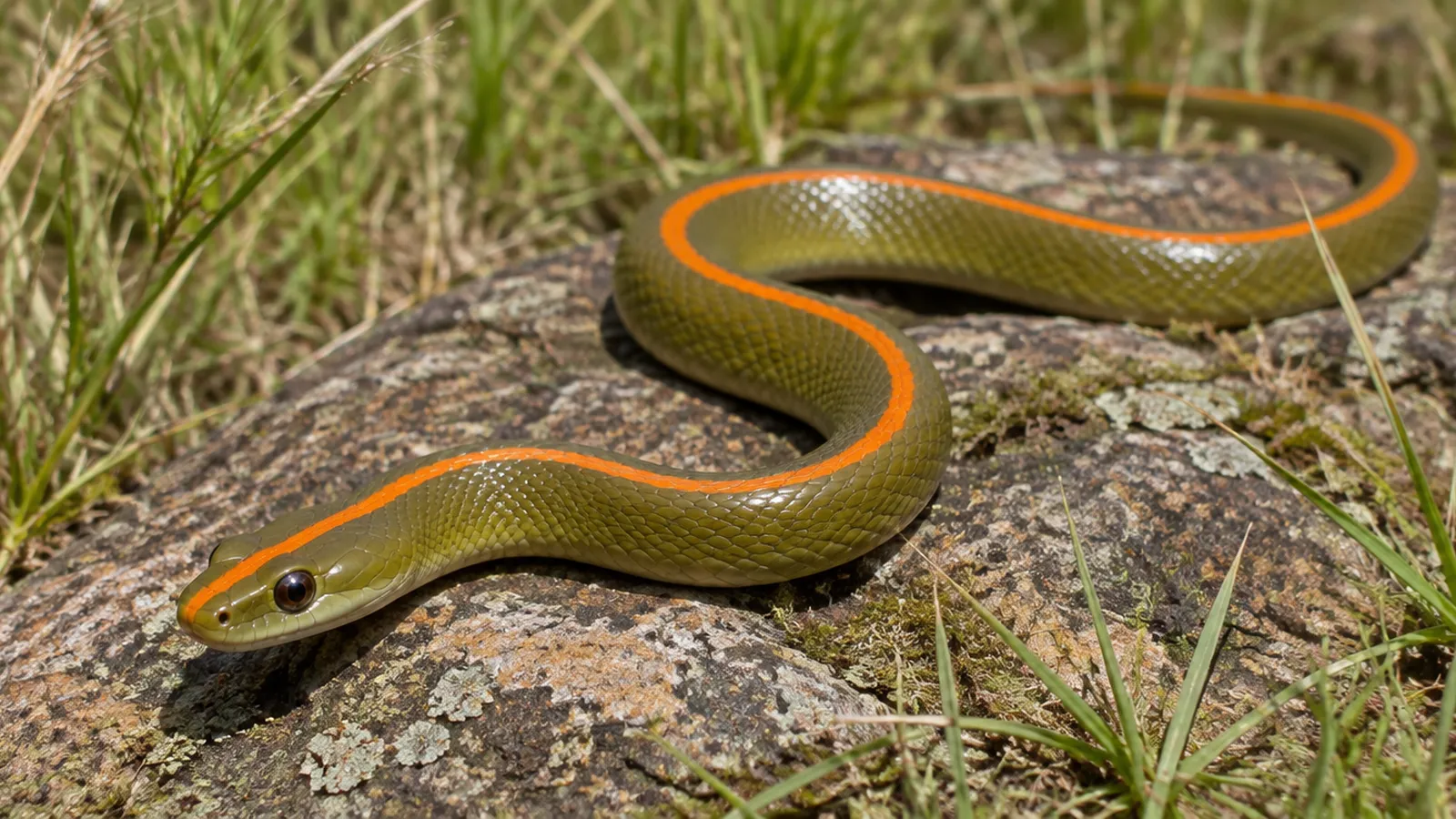
About the aurora house snake
The aurora house snake (Lamprophis aurora) is found only in South Africa and Lesotho, living in grassland, fynbos and rocky hillsides. It's a small, slender snake, usually 45–60 cm (18–24 in) long, with glossy olive-green scales and a single bright orange stripe that starts between the eyes and runs all the way down the back to the tip of the tail. The shade of green varies with locality, from very dark olive to a bright yellowish green.
Aurora house snakes have been kept by South African reptile keepers for many years and do well in captivity. They're calm and easy to care for, but they're a little different from the more common brown house snakes (Boaedon): they prefer cooler conditions, are a bit shy, and grow much more slowly.
Because they're indigenous to South Africa, keeping them there usually requires a provincial permit. Outside South Africa, make sure any animal you buy is legally captive-bred.
Housing
Aurora house snakes don't need a large enclosure. A hatchling does well in a small tub, and an adult can be kept in something around 60×30×30 cm (24×12×12 in), such as a 26-litre tub or a small glass terrarium. Make sure it's fully secure, as all house snakes are good escape artists. Provide a hide at each end and a water bowl.
Substrate
Wood shavings such as aspen work well and let the snake burrow. Some keepers prefer newspaper or paper towel for easy cleaning. Add a little leaf litter or bark for extra cover.
Heating
Aurora house snakes seem to prefer cooler temperatures than other house snakes. A hot spot of around 27–28°C (80–82°F) at one end is plenty, with the other end at room temperature, around 20–24°C (68–75°F). A small heat mat on a thermostat is ideal.
Lighting
A natural day and night cycle is enough. Low-output UVB is optional and shows off the snake's glossy colour.
Humidity
Moderate humidity of 40–60% suits them, with a humid hide during shed.
Feeding
Aurora house snakes eat small rodents in captivity. Feed hatchlings a pinky mouse every 5–7 days, juveniles a fuzzy mouse every 7 days, and adults a small mouse every 10–14 days. Some hatchlings may be reluctant to start on mice; see snake not eating for tips.
Handling
They're usually calm and tolerate gentle handling, though they can be shy at first. Keep sessions short and wait 48 hours after feeding.
Sexing
Females grow larger and heavier than males. Males have longer tails that taper gradually after the vent. Popping or probing confirms the sex.
Breeding
Aurora house snakes mature slowly, with females often taking 3–4 years to reach breeding size. Once mature, they need a brumation period, much like kingsnakes, milk snakes and corn snakes. Stop feeding two weeks beforehand, then lower temperatures gradually. Keepers have found that night-time temperatures below 10°C (50°F), even as low as 4°C (39°F), with daytime temperatures below 18°C (64°F), work well. The difference between day and night temperatures seems to be important. Keep them cool for 2–3 months, then return to normal temperatures and resume feeding.
Females usually lay a small clutch of 4–10 eggs around two months after mating.
Common health problems
Keeping them too warm can stress aurora house snakes. Stuck sheds point to low humidity during shed. A healthy aurora house snake has glossy scales, a bright stripe, clean sheds and holds steady weight.
FAQ
Where do they come from? South Africa and Lesotho.
Do they need a permit? In South Africa, usually yes. Check local rules.
How fast do they grow? Slowly; females can take 3–4 years to mature.