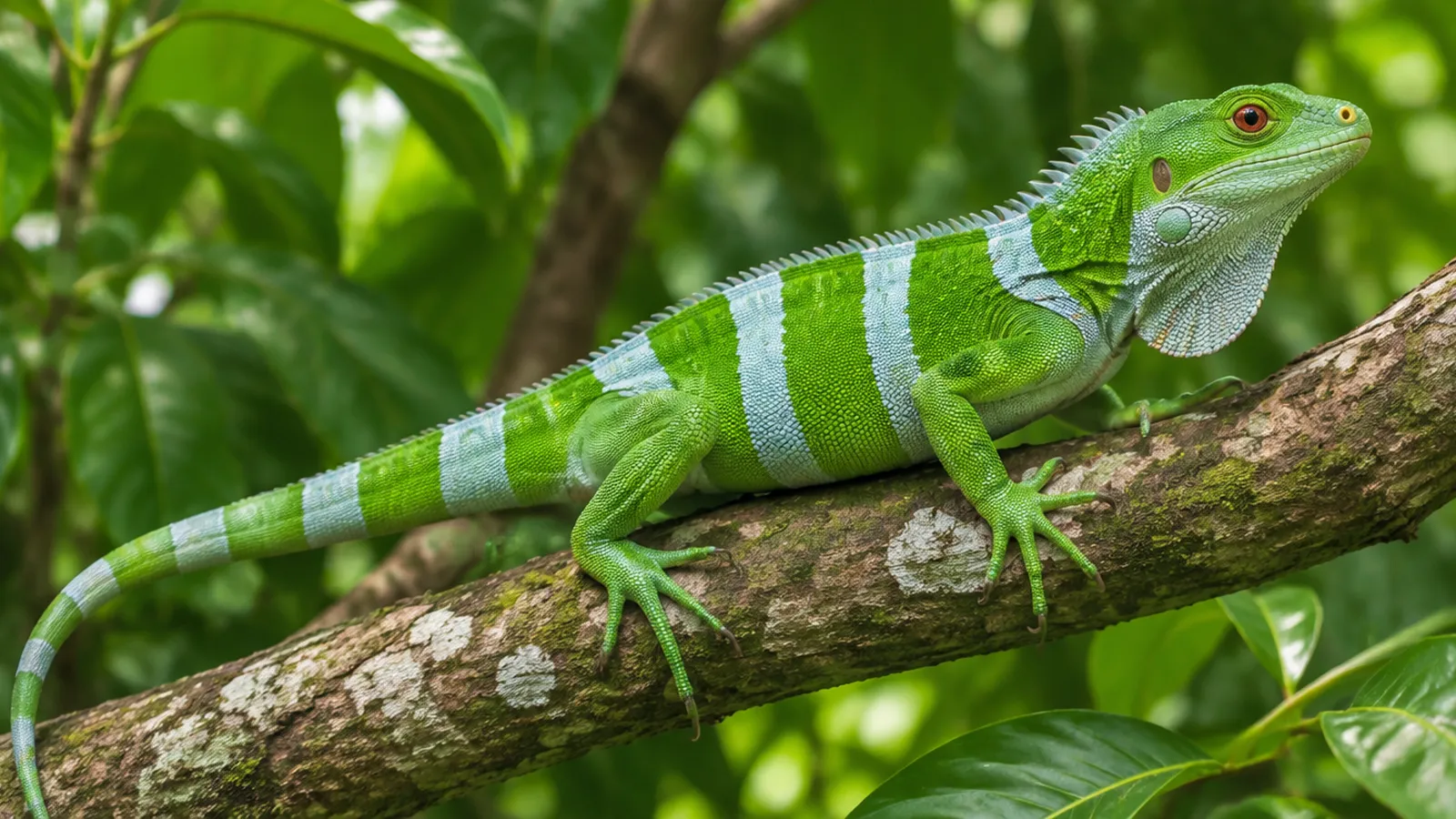
About the Fiji banded iguana
Fiji banded iguanas (Brachylophus) live in the tropical dry and moist forests of Fiji and Tonga in the South Pacific. Males are a brilliant green with bands of pale blue or white across the body, while females are usually plain green or have fainter markings. The species most often kept is Brachylophus bulabula, along with the closely related Lau banded iguana (B. fasciatus).
They are much smaller than the green iguanas (Iguana iguana) commonly kept as pets, usually reaching only around 60–75 cm (24–30 in) from snout to tail tip. They're diurnal, feeding and basking during the day and retreating to the treetops at night.
Fiji banded iguanas are endangered, with small, scattered wild populations threatened by habitat loss and introduced predators. Some estimates suggest fewer than 10,000 remain in the wild. They're rarely available, expensive and protected internationally, so they suit experienced lizard keepers who are prepared to meet permit requirements and provide a large, warm, humid enclosure.
Housing
Juveniles can be kept in an enclosure of around 60×45×90 cm (24×18×36 in). Adults need at least 120×60×120 cm (48×24×48 in), and a pair will do best in something around 180×90×180 cm (72×36×72 in).
These are tree-dwelling lizards, so height is important. Provide branches at different heights, plenty of foliage for cover and good ventilation. Adult males should be kept apart.
Substrate
Washed river pebbles that are too large to be swallowed make a hygienic, attractive and easy-to-clean substrate. They're also too small for feeder insects to hide under. A bioactive soil mix or coco fibre also works well. Avoid fine, loose substrates that could be swallowed with food.
Heating
During the day, provide a basking spot of around 35°C (95°F) and an ambient temperature of 27–29°C (80–85°F). In Fiji, temperatures rarely rise above 35°C or fall below 15°C, so keep night temperatures above 15°C (60°F), ideally around 20–24°C (68–75°F). A basking bulb aimed at an upper branch on a thermostat or dimmer is ideal.
Lighting
Strong UVB is essential for Fiji banded iguanas. Use a high-output T5 UVB tube running most of the length of the enclosure, for around 12 hours a day. Position basking branches within the distance the manufacturer recommends so the iguana gets enough exposure. Replace tubes on schedule, as UVB output drops long before the light stops working.
Humidity
Fiji banded iguanas need high humidity of around 70–90%, combined with good ventilation. Mist the enclosure regularly and provide a water bowl. Many also drink droplets from leaves after misting.
Feeding
Fiji banded iguanas are mostly herbivorous, and leaves make up the bulk of their diet. Aim for around 70% leafy greens (such as collard greens, dandelion, mustard greens, turnip greens and hibiscus leaves) and 30% vegetables (such as squash, green beans and bell pepper). Offer at least three different types of leaves each day, plus two different vegetables.
Variety is important. Feeding several different greens helps make sure all their nutritional needs are met with minimal supplements, and lowers the risk of them taking in too much of a particular vitamin or mineral (vitamin A, for example, can be toxic in high doses). Fruit and flowers can be offered as an occasional treat. Dust food with calcium a few times a week.
Juveniles and breeding animals benefit from a small amount of insect protein, such as roaches, silkworms or crickets, once or twice a week. Many keepers notice young iguanas grow faster and look healthier when insects are included.
Handling
Many Fiji banded iguanas become calm with gentle, regular handling, but they're fast climbers. Lift them from below and support the body. Never grab them by the tail.
Sexing
Adult males are easy to tell apart by their bold blue or white bands. Females are mostly plain green. Males also tend to have larger femoral pores on the underside of their back legs.
Breeding
Fiji banded iguanas have one of the longest incubation periods of any lizard. Females lay a small clutch of around 3–6 eggs, which can take 5–8 months to hatch. Breeding is a long-term commitment and should only be attempted with healthy adults and the correct permits, as part of responsible conservation breeding.
Common health problems
Weak UVB or bulbs placed too far away lead to metabolic bone disease (signs include weak limbs, a soft jaw or a kinked spine). Low humidity causes dehydration and shedding problems. Diets heavy in fruit or lettuce lead to poor nutrition. A healthy Fiji banded iguana is bright in colour, alert, has a strong grip, sheds cleanly and has a good appetite.
FAQ
Are they legal to keep? Only with proof of captive breeding and any required permits.
What do they eat? Mostly leafy greens with some vegetables.
Do they need UVB? Yes.