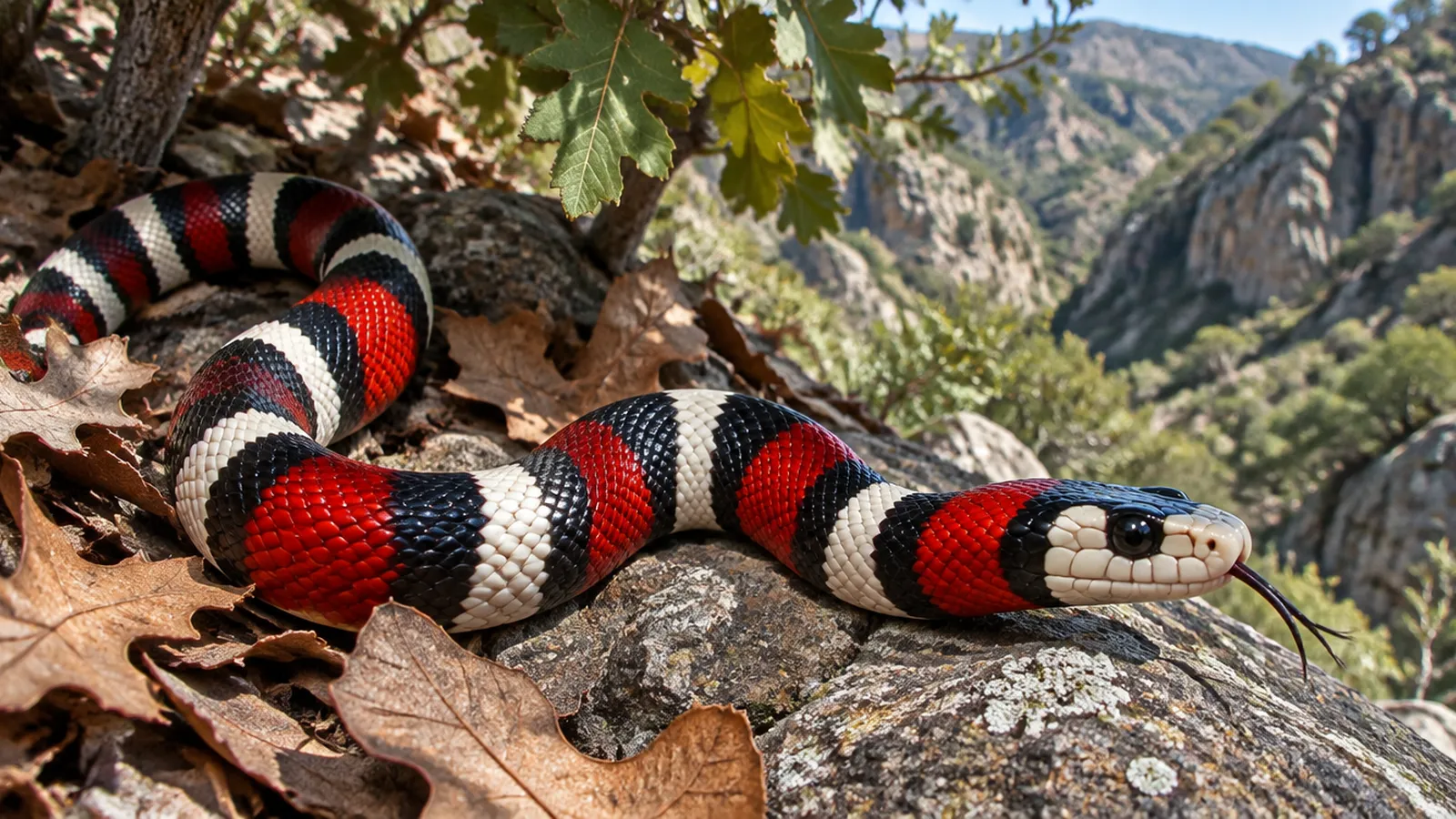
About mountain kingsnakes
The Sonoran mountain kingsnake (Lampropeltis pyromelana) lives in the pine-oak forests and rocky canyons of the mountains of Arizona, New Mexico, Utah and northern Mexico, often above 1,000 m. Its bold bands of red, black and white, along with a white or cream snout, make it one of the most striking tricoloured snakes in the world. The Chihuahua mountain kingsnake (L. p. knoblochi), from the Sierra Madre Occidental in Chihuahua, is a popular form with especially vivid colours, and selective breeding has also produced hypomelanistic animals with softened black.
Mountain kingsnakes are small, slender and usually calm, but they're secretive and can be flighty when young. They come from cooler habitats than many other kingsnakes, and their hatchlings can be harder to start on mice. That makes them better suited to a keeper who's already kept a corn snake or another easy colubrid.
Housing
A hatchling can be kept in a small tub, while an adult needs at least 75×45×30 cm (30×18×12 in), and 90×45×45 cm (36×18×18 in) is better. They're escape artists like all kingsnakes, so use a secure, lockable enclosure. Provide hides at both ends and plenty of cover, such as cork bark and rocks, as they're shy by nature. Always house them alone, as kingsnakes eat other snakes.
Substrate
Aspen shavings, reptile bark or a soil and sand mix work well. Mountain kingsnakes like to burrow and hide under objects, so give them a few centimetres of loose substrate and some flat pieces of bark to push under.
Heating
Keep the warm side at about 28–29°C (82–84°F) and the cool side at 20–23°C (68–74°F). They don't like to be hot, and a cooler gradient than you'd use for a California kingsnake suits them better. Night-time temperatures can drop to around 18–20°C (64–68°F). Use a heat mat or low-wattage lamp on a thermostat.
Lighting
A natural day and night cycle is enough. Low-output UVB is optional.
Humidity
Average room humidity of 30–50% is fine, with a humid hide during shed.
Feeding
Adults are usually good feeders. Feed hatchlings a pinky mouse every 5–7 days, juveniles a fuzzy mouse every 7 days, and adults a small adult mouse every 10–14 days.
The challenge is hatchlings. In the wild, young mountain kingsnakes eat mostly small lizards, and some are reluctant to take mice at first. Offer a freshly thawed, warm pinky at night, in a small enclosed container or deli cup with the snake. Leaving the prey overnight in a quiet, covered enclosure can help. Scenting the pinky with a lizard is a last resort for stubborn feeders. See snake not eating for more ideas.
Handling
Mountain kingsnakes are generally calm but can be quick and flighty, especially when young. Keep handling sessions short and low to the ground until the snake is used to you. Wait 48 hours after feeding.
Sexing
Males have longer, thicker tails that taper gradually after the vent; females have shorter tails that narrow quickly. Popping or probing confirms the sex.
Breeding
Mountain kingsnakes need a winter cooling (brumation) period to breed, typically two to three months at around 10–14°C (50–57°F), with feeding stopped two weeks beforehand. After warming up and feeding well, the female is paired with the male. Clutches of around 3–9 eggs are laid about 6–8 weeks after mating and hatch after roughly 60–70 days at 26–27°C (79–81°F).
Common health problems
Most problems come from keeping them too warm, stress from too little cover, and hatchlings that refuse to feed. A healthy mountain kingsnake has bright colours, clean sheds, a firm body and holds steady weight.
FAQ
Mountain kingsnake vs milk snake? Mountain kingsnakes usually have a white snout and come from high-elevation canyons.
Why won't my baby eat pinkies? Hatchlings naturally eat lizards; try warm pinkies at night in a small container.
Do they need brumation? Only for breeding, though it can help keep a natural cycle.