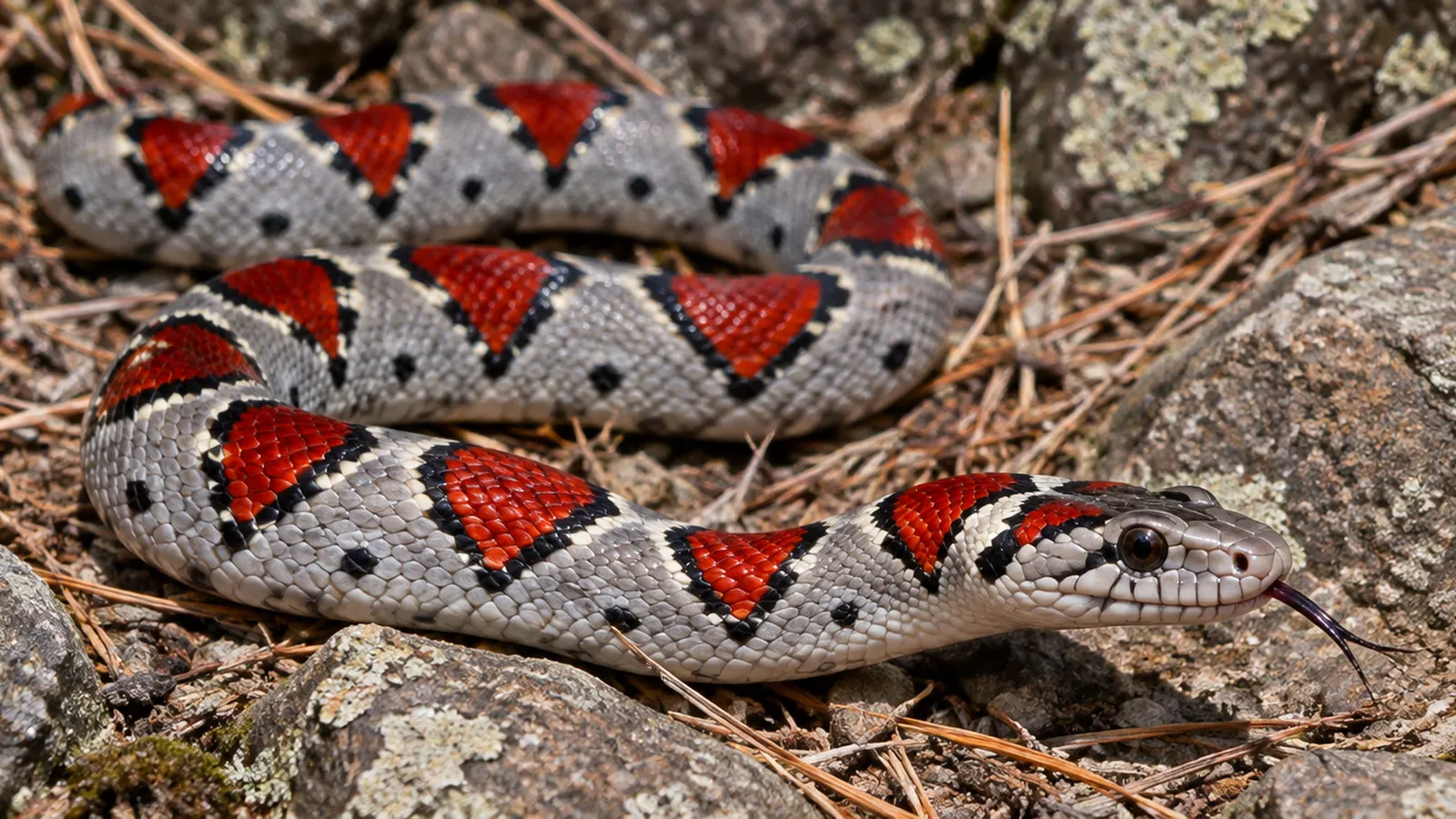
About Mexican kingsnakes
"Mexican kingsnake" is a name used for a small group of closely related kingsnakes from the mountains and high deserts of northern and central Mexico. The three most commonly kept are the Durango mountain kingsnake (Lampropeltis mexicana greeri, now often listed as L. greeri), the San Luis Potosí kingsnake (Lampropeltis mexicana mexicana), often nicknamed the "Mex Mex", and the variable kingsnake (Lampropeltis mexicana thayeri).
They're typically light grey or silver with red or orange saddles edged in black, though the variable kingsnake earns its name: it comes in a remarkable range of colour phases, from grey with red saddles (the "Leonis" phase) to near-solid black, tricolour and patternless forms. Different phases can even hatch from the same clutch of eggs, which makes them a fun species to breed.
What makes Mexican kingsnakes such good pets is their size and temperament. They usually reach only 60–90 cm (2–3 ft), with some Durangos approaching 100 cm, making them smaller than most corn snakes and kingsnakes. They're very docile, and many breeders say they've kept them for years without ever being bitten. Babies take pinky mice readily, and adults are great rodent feeders.
Housing
Mexican kingsnakes don't need a large enclosure. A baby can be kept in a small tub or enclosure of around 11 litres, and an adult does well in something around 60×30×30 cm (24×12×12 in). A useful rule is to make the enclosure at least three-quarters as long as the snake. If you'd like a naturalistic display, a 90×45×45 cm (36×18×18 in) enclosure gives more room for décor.
Like all kingsnakes, they're excellent escape artists and will spend nights testing every gap, so make sure the enclosure is fully secure with a locking lid or door. Provide a hide at each end so the snake can thermoregulate without feeling exposed, and a water bowl. Always house kingsnakes on their own: they eat other snakes in the wild and can and do eat cage mates.
Substrate
Aspen shavings, reptile bark or dust-free wood shavings are all good choices. They're attractive, easy to spot-clean and let the snake burrow. Newspaper or paper towel works well for babies and for keepers with many snakes. Avoid pine and cedar.
Heating
A heat mat under one end of the enclosure is the easiest option. Aim for a warm side of around 28–30°C (82–86°F) and a cool side of 21–24°C (70–75°F). At night the temperature can drop a few degrees. Always connect the heat mat to a thermostat to avoid hot spots and fire risk.
Lighting
A natural day and night cycle is all they need. Low-output UVB is optional but beneficial.
Humidity
Mexican kingsnakes come from fairly dry highland habitats, so average room humidity of 30–50% is fine. Provide a humid hide with damp moss when the snake is going into shed to help it shed cleanly.
Feeding
Hatchlings can be fed a pinky mouse every 5–7 days, juveniles a fuzzy or hopper mouse every 7 days, and adults a small adult mouse every 10–14 days. Prey should be no wider than the snake's body. See how to thaw frozen rodents.
Kingsnakes have a strong feeding response and can be enthusiastic eaters, so use tongs and don't overfeed. A slightly lean kingsnake is healthier than a heavy one.
Handling
Mexican kingsnakes are among the most handleable small snakes. Babies can be a little flighty and may musk at first, but they quickly calm down. Support the body and let the snake move through your hands. Wait 48 hours after feeding.
Sexing
Males have longer tails that stay thicker past the vent before tapering. Females have shorter tails that narrow quickly. Hatchlings can be popped and adults probed by an experienced keeper.
Breeding
Mexican kingsnakes can breed from as young as two years old if well conditioned. Breeding is triggered by a brumation period of around two months in winter, with feeding stopped about two weeks beforehand and temperatures kept at around 14–18°C (57–64°F). After warming back up and a few weeks of regular feeding, the female is introduced to the male.
Females lay around 5–10 eggs about two months after mating. Durango kingsnakes are known for taking their time between their pre-lay shed and laying, sometimes more than two weeks, so don't panic and assume egg binding too quickly. Eggs hatch after around 60–70 days at 27–28°C (81–82°F).
Common health problems
Mexican kingsnakes are hardy. Most problems are stuck sheds from low humidity during shed, obesity from overfeeding and regurgitation from handling too soon after a meal. A healthy kingsnake has clear eyes, clean sheds, a firm body and a good appetite.
FAQ
What is a Mexican kingsnake? A group of small kingsnakes from northern Mexico, including Durango, San Luis Potosí and variable kingsnakes.
Good for beginners? Yes.
Can they live together? No, always alone.