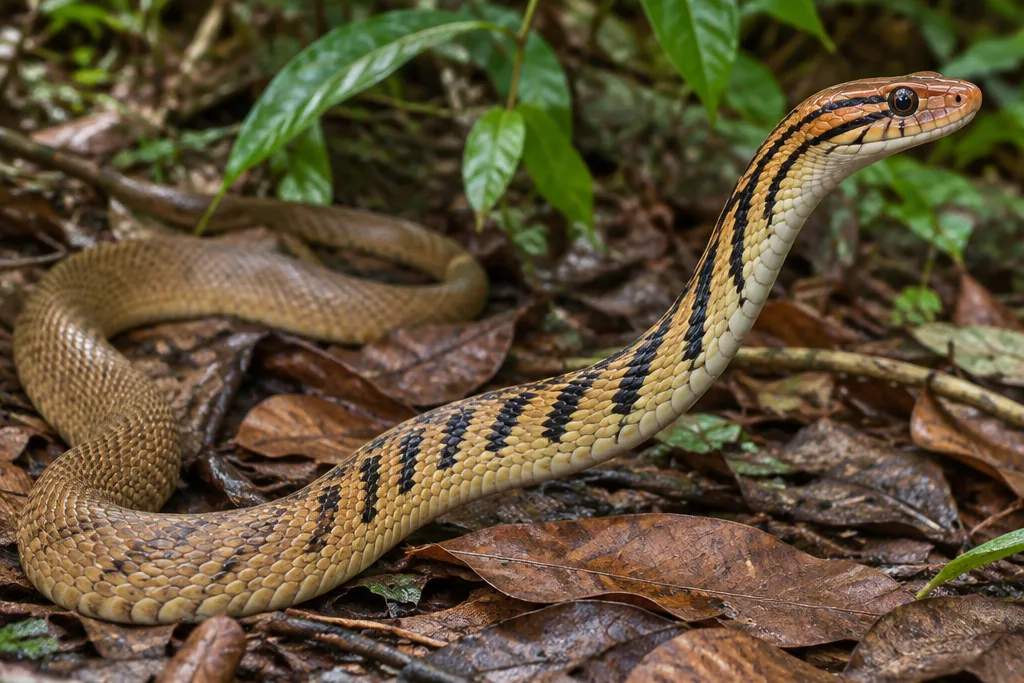
About the radiated rat snake
The radiated rat snake (Coelognathus radiatus), also called the copperhead rat snake or copper-headed trinket snake, has a huge range across South and Southeast Asia, from north-east India, Nepal and Bangladesh through Myanmar, Thailand, Indochina and southern China to Malaysia and Indonesia. It lives in forest edges, grassland, farmland and around villages, where it hunts rodents, birds and lizards. It is non-venomous.
It gets its name from the three thin black lines that radiate backwards from each eye. The head is usually coppery, and the body is tan, olive or golden-brown with bold black stripes and bars on the front third that fade towards the tail. Adults commonly reach 1.5–2.1 m (5–7 ft) but stay fairly slim. Captive breeders also produce albino and other morphs.
The species is famous for its defensive display. When threatened, a radiated rat snake raises the front of its body in an S-shape, flattens and inflates its neck to flash the bright skin between its scales, gapes and strikes. It may also vibrate its tail, musk and defecate, and some individuals even play dead. Many animals for sale are cheap wild-caught imports, and these are usually the most nervous and the most likely to carry parasites. Captive-bred snakes are a much better start.
Housing
An adult needs an enclosure of at least 180×60×60 cm (6×2×2 ft), and a little extra height is welcome because these snakes climb well. They're active and fast, so a big enclosure lets them move and lets you create a proper temperature gradient. Hatchlings feel more secure in a small tub or enclosure of about 60×30×30 cm (2×1×1 ft) at first, moving up in size as they grow.
Radiated rat snakes are strong escape artists, so use a secure, lockable enclosure. Provide a snug hide at each end, sturdy branches for climbing, plenty of cover from artificial or live plants and a heavy water bowl. Lots of cover helps a nervous snake feel safe and reduces defensive behaviour.
Substrate
Use a substrate that holds some moisture without staying wet, such as a coconut fibre and cypress mulch mix, a soil-based bioactive mix or a blend of these. Aspen works for drier setups but needs a humid hide alongside it. Avoid pine and cedar shavings, which release harmful oils. Spot-clean waste quickly, as these snakes produce a lot of it.
Heating
Give a warm basking area of about 30–32°C (86–90°F) at one end and a cool side of about 24–26°C (75–79°F). Night temperatures can drop to around 22–24°C (72–75°F). A halogen bulb or deep heat projector on a dimming thermostat works well and creates a natural day-night cycle. Guard the heat source so the snake can't touch it while climbing.
Lighting
UVB isn't strictly required for snakes that eat whole prey, but low-level UVB (a 5–7% T5 tube over part of the enclosure) is beneficial and recommended by many modern keepers. Run the lights for about 12 hours a day.
Humidity
Keep humidity at around 50–70%. A large water bowl, a moisture-holding substrate and light misting usually maintain this. Provide a humid hide with damp sphagnum moss, especially when the snake is about to shed. Shedding problems are common in imports kept too dry.
Feeding
Captive-bred radiated rat snakes usually take frozen-thawed rodents readily and have strong feeding responses. Offer prey about as wide as the widest part of the snake's body, warmed to body temperature and offered from long tongs.
| Age | Prey | How often |
|---|---|---|
| Hatchling | Pinky mouse | Every 5–7 days |
| Juvenile | Fuzzy to adult mouse | Every 7–10 days |
| Adult | Adult mice, weaner or small rats | Every 10–14 days |
Wild-caught snakes sometimes refuse rodents at first. Scenting the prey with a lizard or bird, or feeding at dusk, often helps. They can also eat quickly and strike hard at food, so use long tongs and don't hand-feed. Watch the body condition and avoid overfeeding.
Handling and temperament
Expect defensive behaviour, especially from young snakes and imports. Use a snake hook to gently lift the snake out of its hide area first; this teaches it that the hook means handling, not food. Move slowly and confidently, keep sessions short and support the body. Many captive-bred individuals calm down considerably with regular, gentle handling, but some stay jumpy for life. If a snake inflates and strikes, give it a moment and try again later. Never handle it just after it has eaten.
Sexing
Males have longer, thicker tails that taper more gradually after the vent. Females have shorter tails that narrow quickly. Probing by an experienced keeper or vet is the most reliable method.
Breeding
Radiated rat snakes are bred in captivity in small numbers. Adults are usually given a slight winter cool-down before breeding. Females lay clutches of around 5–12 eggs, which are incubated at about 27–29°C (81–84°F) and typically hatch after two to three months. Hatchlings usually take pinky mice after their first shed.
Common health problems
Imports often carry internal parasites and mites, so quarantine new snakes and get a vet faecal test. Other common issues are retained shed from low humidity, mouth injuries from striking the glass and obesity from overfeeding. A healthy radiated rat snake is alert, flicks its tongue constantly, has clear eyes and sheds in one piece.
FAQ
Are radiated rat snakes venomous? No. They're non-venomous constrictors. Their defensive display, with an inflated neck and open mouth, looks dramatic, but a bite is only like that of any other rat snake.
Are radiated rat snakes aggressive? They're defensive rather than aggressive. Many will strike, musk and inflate their necks when disturbed, especially young snakes and wild-caught imports. Captive-bred snakes often calm down with patient handling.
How big do radiated rat snakes get? Most adults reach 1.5–2.1 m (5–7 ft) but stay fairly slim. They need at least a 6×2×2 ft enclosure.