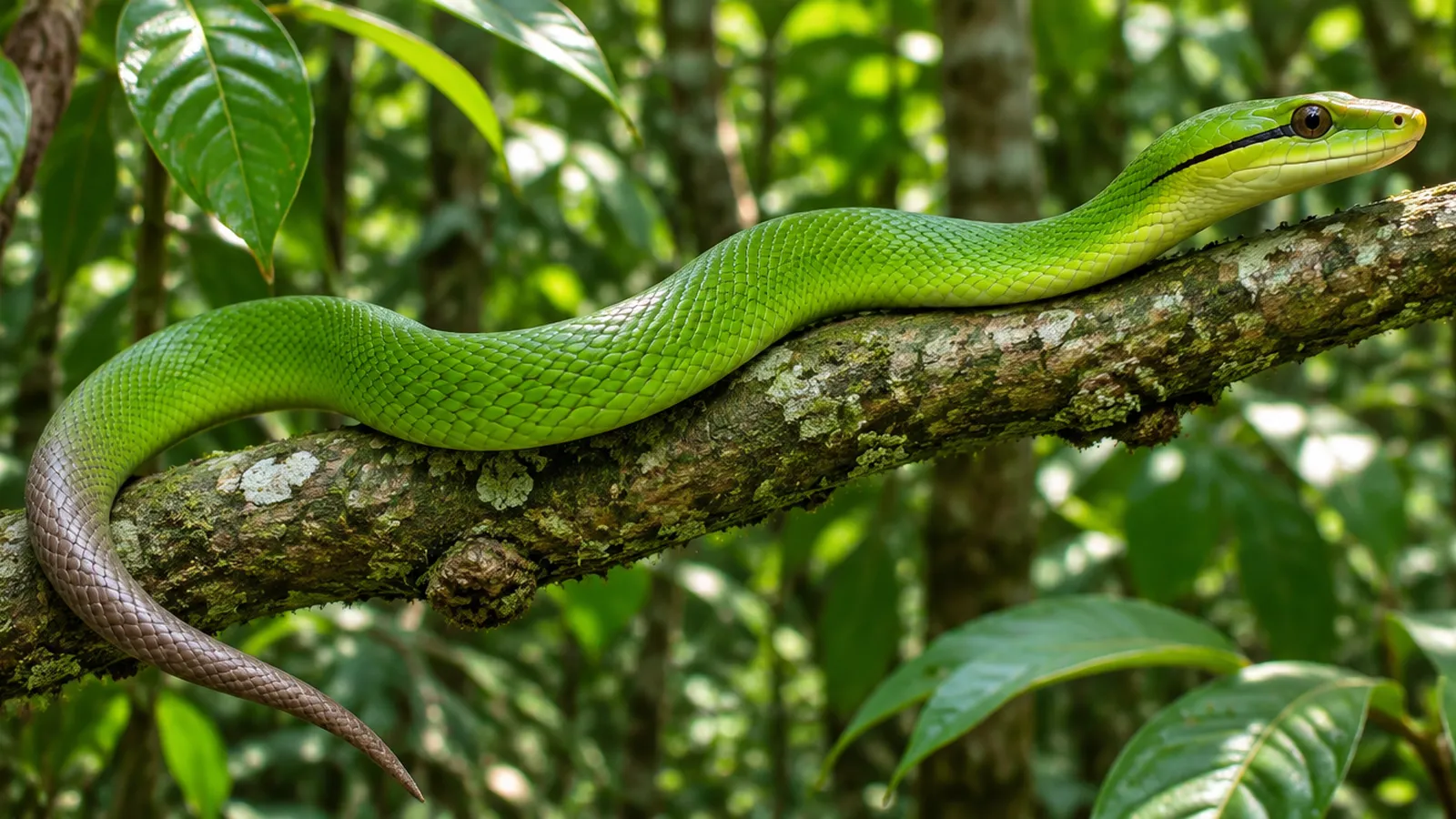
About the red-tailed green rat snake
The red-tailed green rat snake (Gonyosoma oxycephalum) lives in the rainforests, mangroves and forest edges of Southeast Asia, from Thailand and Malaysia through Indonesia and the Philippines. Its body is a brilliant leaf green, often with a pale blue or yellow head, and despite the name the tail is more often grey, brown or orange than true red. A few rare colour forms are blue, yellow or grey all over.
At 1.5–1.8 m (5–6 ft) it is the largest of the rat snakes, but it is slender and spends nearly its whole life in trees. These are alert, fast-moving snakes that rely on their eyesight, and many are defensive. A threatened red-tail inflates its throat, gapes its mouth and strikes, sometimes repeatedly. That makes them wonderful display animals rather than pets for regular handling. Many animals in the trade are still wild-caught, stressed and carrying parasites, so it's well worth paying more for captive-bred stock and having any new snake checked by a vet.
Housing
Height is the most important thing for this species. A hatchling can start in a tall enclosure of around 45×45×60 cm (18×18×24 in). An adult needs at least 120×60×120 cm (48×24×48 in), and an enclosure 150 cm (60 in) tall or more is even better.
Fill the space with horizontal and diagonal branches at different heights, cork bark tubes and plenty of foliage. Live or artificial plants give the snake cover, which is vital for a nervous species; a red-tail that can't hide will stay stressed and may refuse food. Elevated hides near the top of the enclosure are often used more than ones on the floor.
Substrate
Choose a substrate that holds some moisture without staying wet, such as coco husk, cypress mulch, reptile bark or a bioactive soil mix. A good substrate is the first step to good respiratory health in this species: soggy, stagnant bedding is a common cause of infections.
Heating
Because red-tails live in the branches, the heat should come from above. Aim for 29–30°C (84–86°F) around the upper branches and 24–27°C (76–80°F) lower down. At night a drop of 1–3°C is fine. A radiant heat panel or guarded heat lamp on a thermostat works well; heat mats under the enclosure do very little for an arboreal snake.
Lighting
Red-tails are active by day, so a 12-hour light cycle helps them keep a natural routine. Low-output UVB is beneficial and supports any live plants in the enclosure.
Humidity
Keep humidity at around 60–80%, misting once or twice a day. A water bowl should always be available, but many red-tails also drink droplets from leaves after misting. Good ventilation is just as important as humidity: warm, wet, stagnant air is a recipe for respiratory problems. See our guide on how to raise humidity in a terrarium.
Feeding
Red-tails eat a range of small animals in the wild, including birds, lizards and rodents, but most adapt to frozen-thawed mice quite quickly, even many that weren't captive-bred. Hatchlings can be fed pinky or fuzzy mice every 5–7 days, juveniles a hopper mouse every 7 days, and adults an adult mouse every 7–10 days.
Offer food with long tongs at branch height. Many red-tails won't come down to the floor to eat, and some prefer to take their meal from a ledge. Our guide on how to thaw frozen rodents explains how to prepare prey properly.
Handling
Treat this as a look-but-don't-touch snake. Use a hook for maintenance, move slowly around the enclosure and expect defensive displays. A few individuals do calm down with time, but many never enjoy being handled, and repeated handling can stress them enough to stop feeding.
Sexing
Males usually have longer, thicker tails than females, with a slower taper after the vent. Probing by an experienced keeper or vet is the most reliable way to confirm the sex.
Breeding
Red-tails don't need a full winter cooling period, but a slight night-time drop of about 1–3°C during the cooler months has proven helpful for triggering breeding. Feed females more often (around every 5 days) in the lead-up to the breeding season to build up their condition. Females lay a small clutch of eggs, usually 5–12, which hatch after around 90–110 days of incubation.
Common health problems
Most issues come from stress, poor ventilation or parasites in wild-caught animals. Watch for wheezing, bubbles at the mouth, weight loss, regurgitation or loose, smelly droppings, all of which need a vet. A healthy red-tail has vivid colour, clean sheds, climbs actively and has a good feeding response.
FAQ
Are they good pets? Great display snakes, but usually defensive.
Do they need a tall enclosure? Yes, at least as tall as it is wide.
How often should I feed one? Adults every 7–10 days.