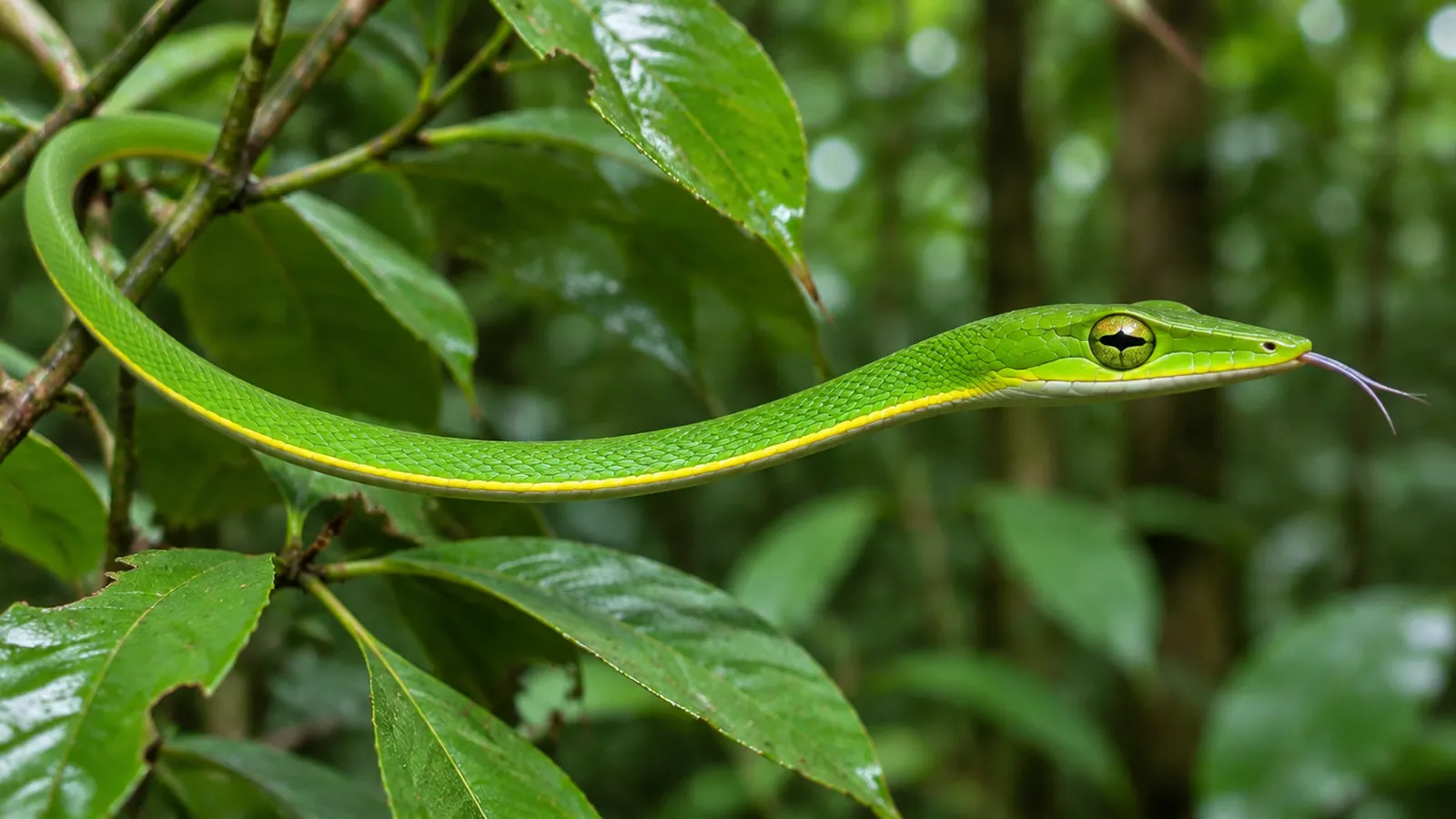
About the Asian vine snake
Asian vine snakes belong to the genus Ahaetulla, a small group of tree-dwelling colubrids also called Asian whip snakes. The species most often kept is the green vine snake (Ahaetulla prasina), found across Southeast Asia, including Cambodia, Indonesia, Singapore, Thailand, Vietnam and western Malaysia. They live in humid lowland forest, woodland, swamps and jungle, and are often found near farmland and villages that border good habitat.
They're among the most remarkable-looking snakes in the world: extremely slender, bright green (some are brown or yellowish), with a long, pointed snout and large eyes with horizontal, keyhole-shaped pupils that give them excellent forward vision for hunting. When they sense danger, they freeze, and if there's a breeze they sway back and forth with the foliage to blend in. For reasons that still aren't fully understood, they sometimes stay completely still with their tongue extended for minutes at a time.
Asian vine snakes are mildly venomous. They are opisthoglyphous, or rear-fanged, meaning they have enlarged teeth at the back of the upper jaw. Unlike the hollow fangs of front-fanged snakes, these teeth are grooved, and venom flows down the grooves into prey as the snake chews. Bites to people usually cause pain and swelling, but reactions can vary. Combined with their delicate build and sometimes difficult feeding, this makes them a species for experienced keepers. Check local laws before buying, as some places regulate rear-fanged snakes.
Housing
Vine snakes are arboreal and need a tall enclosure. A single adult should have at least 90×45×90 cm (36×18×36 in), and taller is better. Fill it with plenty of thin branches at different heights and lots of live or artificial foliage for cover. Provide a hide on the ground and another near the top of the enclosure. A large water bowl is also needed, as they drink and sometimes soak.
Substrate
A moisture-holding substrate such as a peat moss and sphagnum moss mix, coco husk or a bioactive soil mix helps maintain high humidity.
Heating
Provide a vertical temperature gradient, with the air near the top of the enclosure at around 29–32°C (84–90°F) and the cooler lower regions at 24–26°C (75–79°F). An arboreal hot spot of about 34°C (93°F) near the top can be created with a heat panel or heat mat attached to the outside top or back of the enclosure. Always use a thermostat.
Lighting
Vine snakes are active by day and rely on their excellent eyesight, so a regular 12-hour light cycle is important. Low-output UVB is beneficial and supports live plants.
Humidity
Misting is an important part of their care. It provides drinking water, as many vine snakes drink droplets from leaves, and helps keep humidity at around 80–90%. Brief periods of lower humidity are tolerated, but make sure the enclosure is well ventilated so it doesn't become stagnant. See how to raise humidity in a terrarium.
Feeding
In the wild, Asian vine snakes eat mainly lizards, and occasionally small birds, frogs and mammals. In captivity they are commonly fed small lizards such as anoles or house geckos and live fish such as guppies or other livebearers offered in a shallow dish. Feed adults every 5–7 days.
You can try offering small rodents, but while some vine snakes accept pinky or fuzzy mice, many never will. Moving prey is more enticing, as vine snakes are visual hunters that respond to movement. If you do switch a snake to mice, scenting a pinky with lizard can help. Always buy feeder animals from a clean, reliable source to avoid parasites. See snake not eating for more tips.
Handling
Keep handling to a minimum. Vine snakes are delicate and easily stressed, and they can bite. Use a snake hook for maintenance and avoid touching the snake directly. If you are bitten, wash the area well and seek medical advice if swelling or symptoms develop.
Sexing
Males usually have longer tails with a thicker base and a more gradual taper. Females are often larger overall. Probing by an experienced keeper confirms the sex.
Breeding
Unusually for colubrids, Ahaetulla prasina gives birth to live young. Litters of around 4–20 babies are typical. Neonates are tiny and usually need small lizards or fish to start feeding.
Common health problems
Wild-caught vine snakes often carry parasites and arrive stressed and dehydrated, so captive-bred animals are much easier to keep. Low humidity causes stuck sheds and dehydration; poor ventilation causes respiratory infections. A healthy vine snake is bright, alert, climbs actively and feeds regularly.
FAQ
Are they venomous? Mildly; they are rear-fanged.
What do they eat? Mostly lizards and fish; some accept mice.
Why does it hold its tongue out? A defensive freeze behaviour.