About the striped house snake
The striped house snake (Boaedon lineatus) is found across much of East and Central Africa, including Tanzania, and is a close relative of the brown or Cape house snake (Boaedon capensis) found further south. House snakes get their name from their habit of living around towns and villages, where they hunt the rodents and lizards that gather near homes.
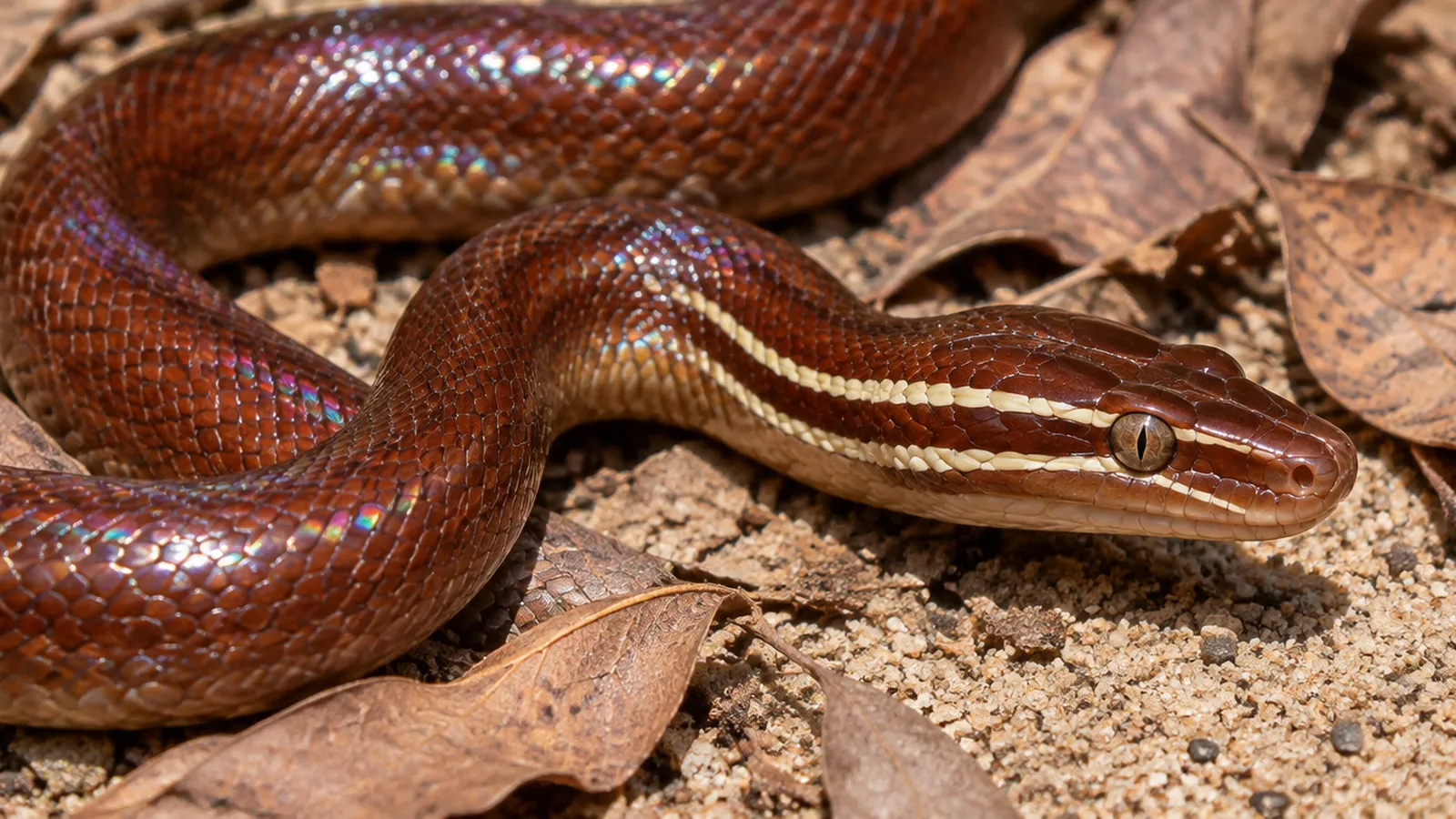
Striped house snakes are usually reddish brown to dark brown, with two pale cream stripes running along each side of the head, from the snout through the eye. Their smooth scales have a beautiful iridescent sheen that really shows up in natural or UVB light. Their base colour can vary from dark brown to reddish brown, even within a single clutch.
House snakes have grown in popularity in recent years, both locally in Africa and internationally, because they reach a decent size, feed eagerly on rodents and breed readily in captivity. Like other house snakes, they're strongly dimorphic: females can easily reach 100 cm (3.3 ft), while males rarely exceed 60 cm (2 ft).
Housing
An adult female needs an enclosure of at least 80×30×30 cm (32×12×12 in), and 90×45×45 cm (36×18×18 in) is better. Males can be kept in slightly smaller enclosures. House snakes are good escape artists, so use a secure, lockable lid. Provide two hides at opposite ends so the snake can thermoregulate, and place a water dish at the cool end.
House snakes have a strong feeding response, and while some keepers house them together, it's safest to keep them individually and always feed them separately.
Substrate
Aspen shavings, wood shavings or paper towel all work well. House snakes are fast metabolisers and messy, so choose a substrate that's easy and cheap to replace often.
Heating
Provide a hot spot of around 28–30°C (82–86°F) with a cool end of 22–25°C (72–77°F). A heat mat under one end, controlled by a thermostat, is ideal.
Lighting
A natural day and night cycle is enough. A UVB light is optional, but it really brings out the iridescent sheen on their scales.
Humidity
Moderate humidity of 40–60% is fine, with a humid hide when the snake is in shed.
Feeding
House snakes are excellent feeders. Feed hatchlings a pinky mouse every 5–7 days, juveniles a fuzzy or hopper mouse every 7 days, and adults an appropriately sized mouse every 7–10 days. Females need larger prey than males. Use tongs, as their feeding response is strong. See how to thaw frozen rodents.
Handling
Babies can be nippy, but most striped house snakes calm down quickly with regular, gentle handling. Wait 48 hours after feeding.
Sexing
Adult females are much larger than males. Males also have longer tails relative to their body length, which is visible even in hatchlings. Popping or probing confirms the sex.
Breeding
Striped house snakes breed readily without a winter cooling period, although a mild cooling period can help regulate egg laying. If you keep a pair, watch the female closely: they have been known to lay up to six clutches a year, which is a heavy strain on her body. Separate them after breeding and give the female rest periods. Clutches are relatively small, usually 6–10 eggs.
House snakes are notorious for laying their eggs in water dishes, so give a gravid female a laying box filled with damp moss.
Common health problems
Overbreeding is the biggest risk for females, along with obesity from overfeeding. Stuck sheds point to low humidity. A healthy striped house snake has an iridescent sheen, clean sheds and a firm body.
FAQ
Good for beginners? Yes.
Striped vs brown house snake? Close relatives with the same care.
Why did it lay eggs in the water bowl? It's common; provide a damp moss laying box.