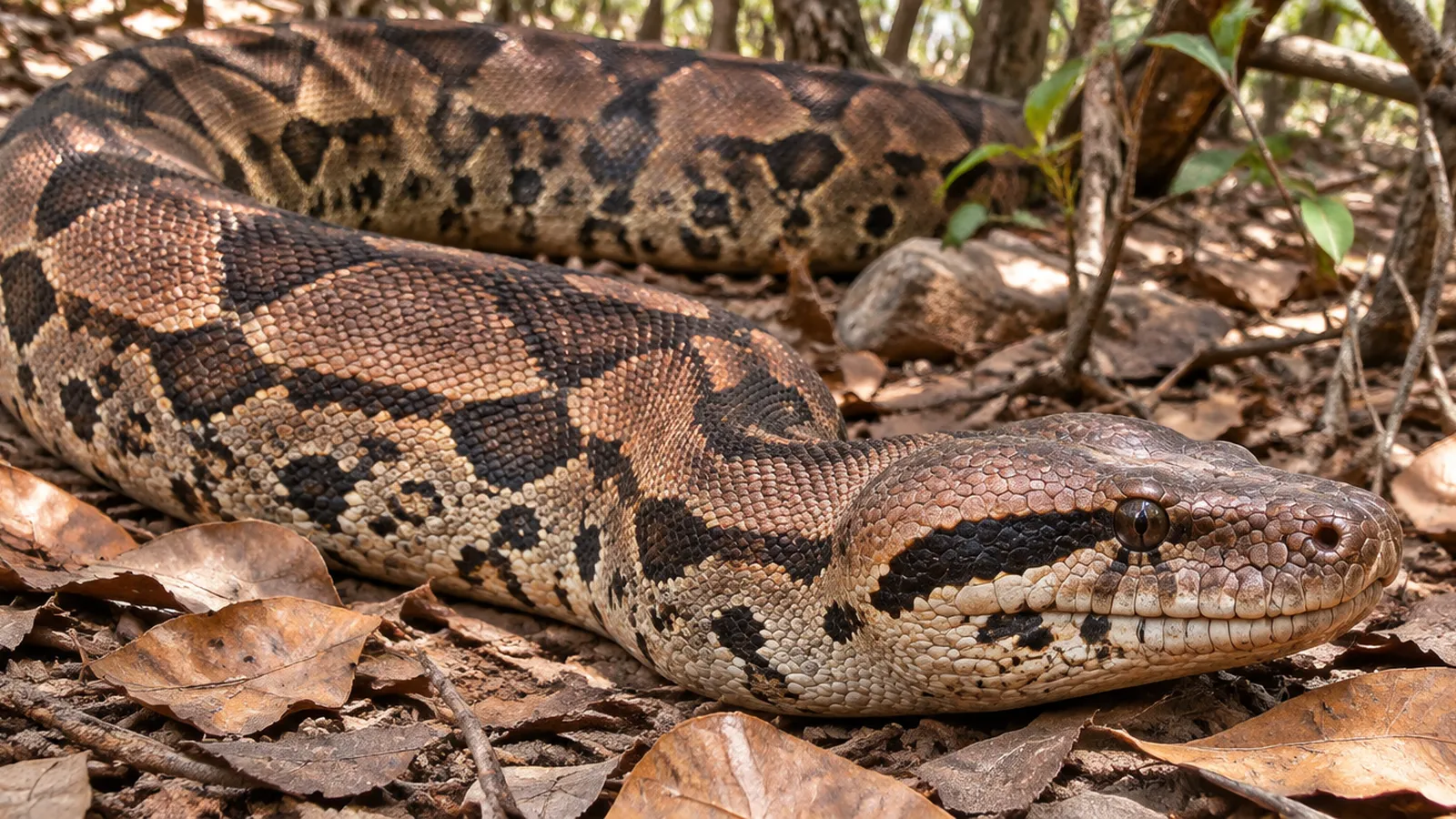
About the Dumeril's boa
The Dumeril's boa (Acrantophis dumerili) is a ground-dwelling boa from the dry forests and scrubland of southern and south-western Madagascar. It's a heavy-bodied snake with a beautifully detailed pattern of brown, tan, grey and black, often with a coppery or pinkish sheen. Babies are especially pretty, often tinged with pink, orange and crimson, and are among the most attractive young of any boa species.
What really sets the Dumeril's boa apart is its temperament. They are typically docile, slow-moving and predictable, and they readily feed on rats. That combination makes them one of the best choices for someone looking for their first larger snake. Their only real demand is space, because adults are heavy and need a large enclosure.
Dumeril's boas are protected internationally (CITES Appendix I, EU Annex A), so make sure you buy captive-bred animals that come with the correct paperwork for your country.
Housing
Babies can be kept in a 20–30 gallon enclosure, moving to around 120×60×60 cm (48×24×24 in) as juveniles. An adult needs at least 180×60×60 cm (72×24×24 in), and a large female will appreciate 180×90×60 cm (72×36×24 in).
As a ground-dweller, a Dumeril's boa uses floor space far more than height. Provide a large hide at each end of the enclosure so the snake can choose its temperature and still feel secure, and a sturdy water bowl that can't be tipped over. A few pieces of cork bark or a log give it something to push against and explore.
Substrate
Cypress mulch, coco husk or a soil and bark mix 5–10 cm (2–4 in) deep all hold humidity well. Aspen shavings can be used too, but they go mouldy if they get wet, so you'll need to manage humidity with a humid hide instead.
Heating
Dumeril's boas come from a warm climate and need a proper hot spot. Aim for 32–35°C (90–95°F) at the hot spot, with an ambient temperature of 26–28°C (78–82°F) across the rest of the enclosure. At night it can drop to about 24°C (75°F).
A hot spot that's too cool, below around 29°C (85°F), increases the chance of the snake developing an upper respiratory infection. Use a heat lamp or radiant heat panel controlled by a thermostat, and check temperatures where the snake actually sits.
Lighting
UVB isn't essential, but a low-output UVB tube and a regular 12-hour day are a good addition.
Water
Dumeril's boas drink a lot of water, so it must always be fresh and topped up. They're also notorious for defecating in their water bowls. The best way to reduce this is to use a bowl that's just big enough to drink from, rather than one they can climb into. Check it every day and clean it immediately whenever it's been soiled.
Humidity
Although they come from a drier part of Madagascar than many boas, they still do best with moderate humidity of around 50–70%, a little higher when they go into shed. A humid hide filled with damp sphagnum moss helps them shed in one piece.
Feeding
Dumeril's boas are enthusiastic feeders and take mice and rats with equal enthusiasm. Babies can be fed a hopper mouse or rat pup every 7–10 days, juveniles a weaned rat every 10–14 days, and adults a medium rat every 3–4 weeks. Neonates often feed better if the first meals are offered at night.
The biggest risk is overfeeding. These snakes will eat almost whenever food is offered, and an obese Dumeril's boa is prone to health problems. Keep prey about as wide as the thickest part of the body and space meals out as the snake matures. See how to thaw frozen rodents.
Handling
Dumeril's boas are among the most tolerant snakes to handle. Support the heavy body with both hands and let the snake move slowly through your hands. Avoid handling for 48 hours after a meal.
Sexing
Females grow noticeably larger and heavier than males. Males have longer, thicker tails and larger pelvic spurs. Probing by an experienced keeper or vet will confirm the sex.
Breeding
Dumeril's boas mature slowly and are usually bred from around 3–5 years old. A cooling period in the cooler months, with night-time temperatures dropping to around 21–24°C (70–75°F) for several weeks, helps trigger breeding. Like all boas, females give birth to live young, usually 6–8 months after mating. Litters are small, typically 6–15 large babies.
Common health problems
Overfeeding and obesity are the most common issues. A hot spot that's too cool can lead to respiratory infections, shown by wheezing or bubbles at the mouth, which need a vet. Dirty water bowls can spread bacteria, so keep them clean. A healthy Dumeril's boa has a firm, rounded body with no visible spine or fat rolls, clean sheds and a calm temperament.
FAQ
Are Dumeril's boas good for beginners? Yes, if you have room for an adult enclosure.
How big do they get? 1.5–2 m.
Why does it poop in its water bowl? It's common; use a smaller bowl and clean promptly.