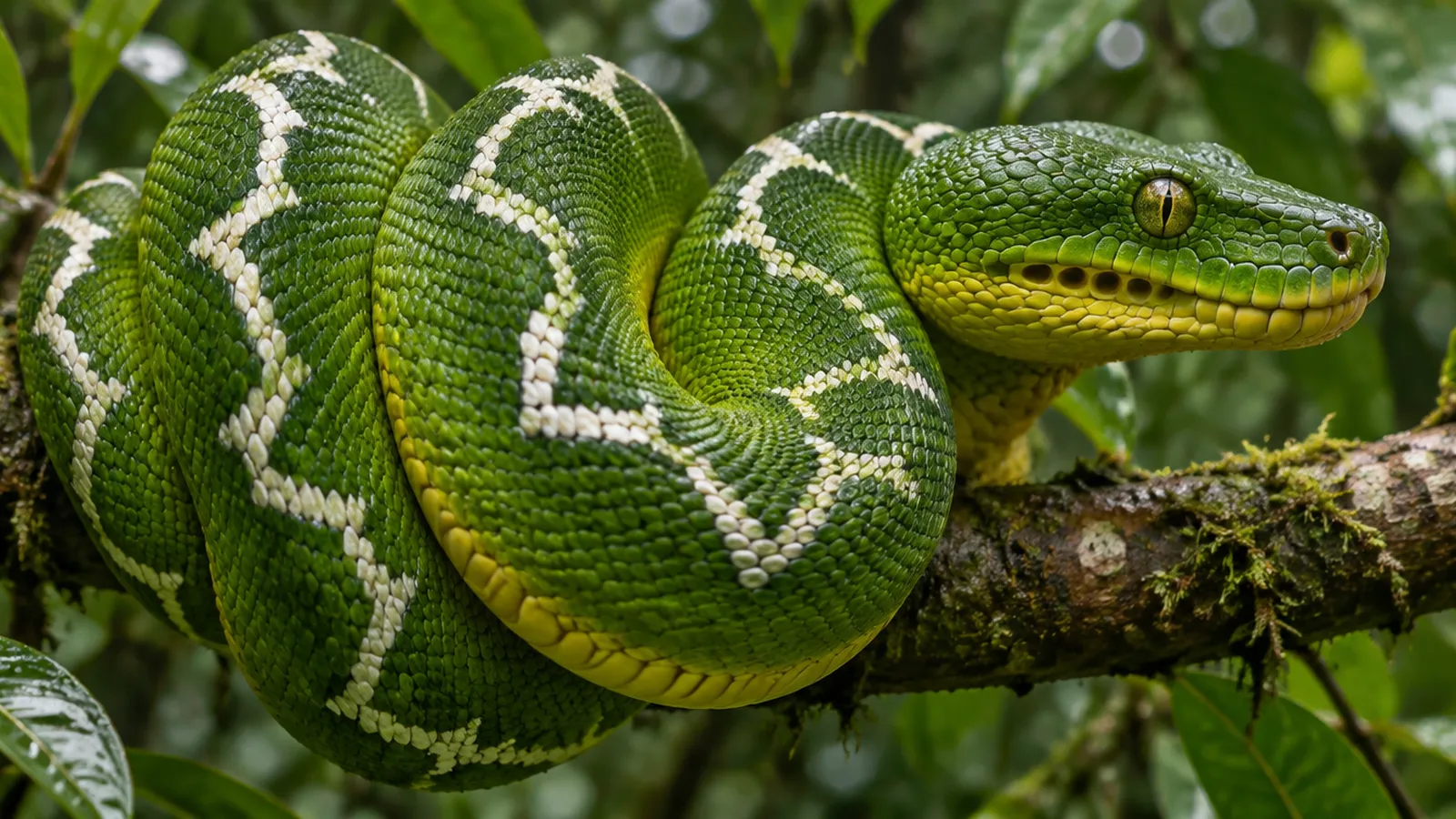
About the emerald tree boa
The emerald tree boa (Corallus caninus) and its close relative Corallus batesii live in the rainforests of the Amazon basin and the Guiana Shield of northern South America. Adults are a vivid emerald green with white markings along the back, and can grow to around 2 m (6.5 ft). Babies are born a striking red, orange or brick colour and change to green within their first year.
There are two main types in the hobby. Animals from the Amazon basin (now usually called C. batesii) are often larger, more strikingly patterned and calmer by nature, which has made them the more popular choice. Those from the Guianas (C. caninus) are usually a little smaller and can be more defensive.
At first glance an emerald tree boa looks almost identical to a green tree python, and both coil over branches in the same way. But they're not closely related, they come from opposite sides of the world, and their care is different. Emeralds are kept cooler, need consistently high humidity and are much more sensitive to overfeeding. They have earned a reputation as one of the more demanding snakes in the hobby and are best left to experienced keepers. They can live for 15–20 years.
Housing
A single adult needs an enclosure of at least 90×60×90 cm (36×24×36 in), and 120×60×120 cm (48×24×48 in) is better. Juveniles can start in something around 45×45×45 cm (18×18×18 in).
Whatever you build or buy, it needs to cope with daily misting and constant high humidity. Many keepers start out thinking a glass enclosure will do, but glass is a poor insulator: it loses heat quickly and makes temperatures swing up and down, which emeralds don't tolerate well. PVC or sealed wooden enclosures are a much better choice. Fit several horizontal perches about as thick as the snake's body, at different heights, and add plenty of foliage for cover.
Substrate
Cypress mulch, coco husk or a bioactive soil mix all hold humidity well. The snake will rarely use the floor, so the substrate's job is mainly to keep the air moist and be easy to spot-clean.
Heating
Getting temperature and humidity in balance is the key to keeping emeralds healthy. Daytime temperatures should sit between 26–29°C (78–84°F), with a basking perch of no more than 30°C (86°F). At night, temperatures can drop to 20–25°C (68–77°F).
Emeralds are kept cooler than most boas because their natural habitat is shaded forest and they digest their food slowly. If the enclosure is too warm, they often regurgitate their meals. A radiant heat panel on a thermostat gives safe, even heat without the burn risk of a bulb.
Lighting
A regular 12-hour day and night cycle is ideal. Low-output UVB is fine as long as there's plenty of shade for the snake to retreat to.
Humidity
Humidity needs to stay in the range of 70–85%. Mist the enclosure once or twice a day, spraying the walls, branches and substrate, and then lightly misting the snake itself; emeralds drink the droplets that collect on their coils. Some keepers also use very large water bowls to help keep the air moist.
Don't overdo it, though. Prolonged humidity of 90% or more with poor ventilation can be harmful, leading to respiratory infections and skin problems. Allow the enclosure to dry slightly between mistings.
Feeding
Feeding is where most emerald keepers go wrong. Neonates can be fed a pinky or fuzzy mouse every 7–10 days, juveniles a hopper mouse every 10–14 days, and adults an adult mouse or rat pup only every 3–4 weeks.
Keep meals small, no wider than the snake's body, and offer them at night with long tongs held near the perch. Large or frequent meals are the most common cause of regurgitation in this species, so resist the temptation to feed more just because the snake strikes eagerly. See how to thaw frozen rodents.
Handling
Keep handling to a minimum. Use a hook, and unwrap the snake from its perch tail-first rather than pulling it off. Avoid handling at night, when the snake is in hunting mode, and never handle after a meal. Emeralds have long front teeth, and a bite can be painful.
Sexing
Males generally have longer tails with a gradual taper and larger spurs, while females are heavier with shorter tails. Probing is the most reliable way to confirm the sex.
Breeding
Emeralds usually breed at around 4 years old. A cooler period with night-time drops to around 20°C (68°F) for several weeks, combined with heavier misting, helps trigger breeding. Like all boas, females give birth to live young, usually 6–7 months after a successful pairing. Litters are often small, around 5–15 babies.
Common health problems
Most problems trace back to temperature, humidity or feeding. Too warm, too cool, too dry or too much food can all lead to regurgitation. Constantly saturated, stagnant air causes respiratory infections. Because emeralds move so little, they're also prone to constipation, so keep track of when your snake last passed waste; see constipation in reptiles. A healthy emerald sits in a relaxed coil by day, takes a hunting posture at night, sheds cleanly and holds a steady weight.
FAQ
Emerald tree boa vs green tree python? Different species; emeralds are South American, live-bearing and need cooler conditions.
Why does it regurgitate? Usually temperature, humidity or meal size.
What temperature does it need? 26–29°C by day, perch up to 30°C.