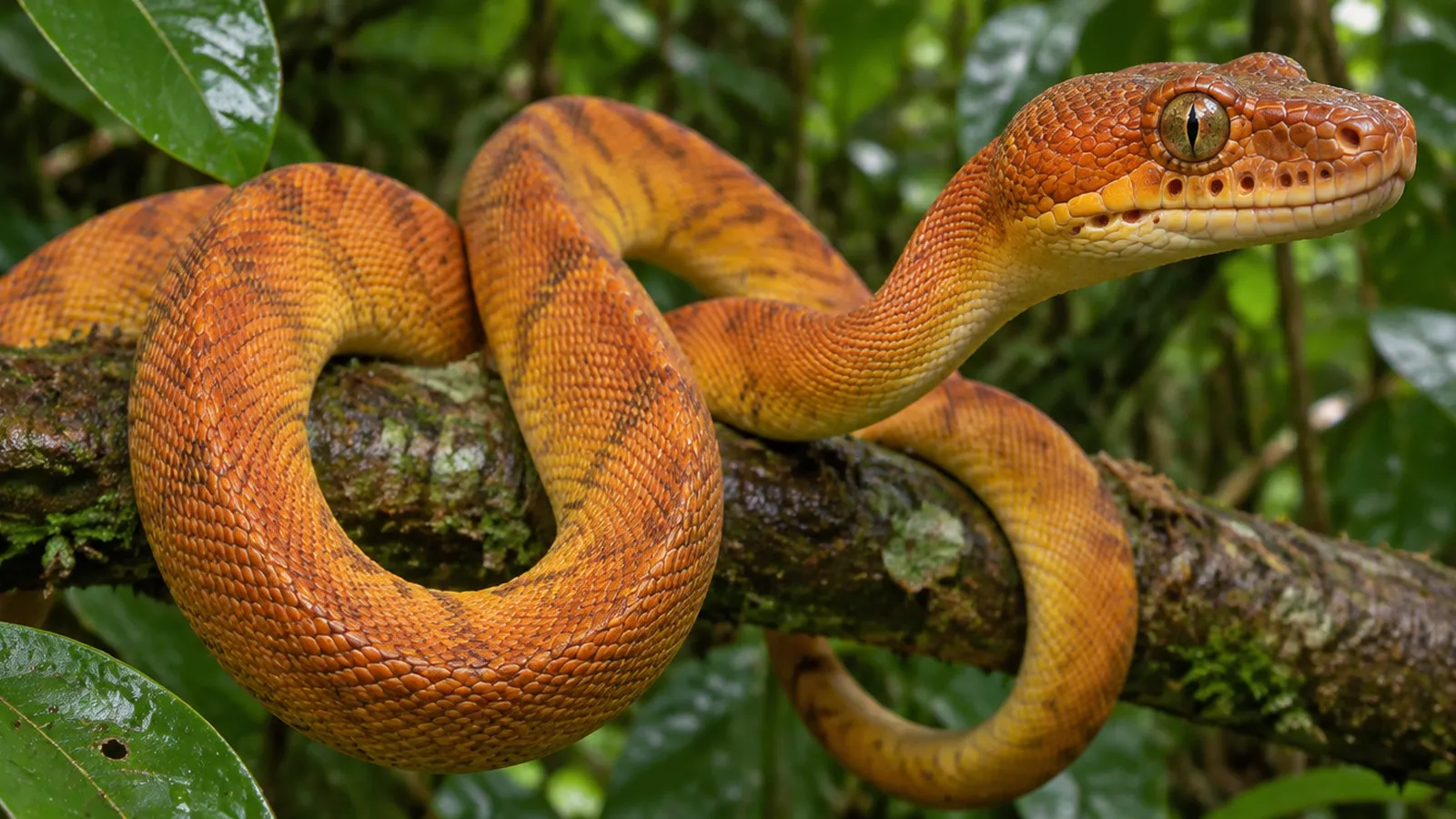
About the Amazon tree boa
The Amazon tree boa (Corallus hortulana) is found across the Amazon basin in northern South America. Few snakes come in such a wide range of colours: individuals can be grey, brown, olive, yellow, orange or red, with or without bold patterns, and even siblings from the same litter can look completely different. For years the brightly coloured animals were wrongly sold as "Cook's tree boas", but the Cook's tree boa (C. cookii) is actually a separate species from the Caribbean.
These are slender, nocturnal snakes with a big head, large eyes and long front teeth for catching birds and bats. They spend the day coiled on a branch and come alive at night. Once settled, Amazon tree boas are hardy and long-lived, and they don't always stay high up: many spend a surprising amount of time resting on the floor or on broad shelves. They do have a well-earned reputation for biting, so they suit keepers who are happy to watch rather than handle.
Housing
Juveniles can be kept in a small arboreal enclosure of around 45×45×60 cm (18×18×24 in). An adult needs at least 90×45×90 cm (36×18×36 in), and 120×60×120 cm (48×24×48 in) is better.
Arrange several horizontal perches about as thick as the snake's body at different heights, with at least one positioned below the heat source. Add plenty of foliage so the snake can hide. Because many Amazon tree boas spend time low down, include a floor-level hide or a wide shelf as well. PVC or wooden enclosures hold heat and humidity much better than glass.
Substrate
Coco husk, cypress mulch or a bioactive soil mix all hold humidity well. Since the snake rarely sits on the floor, the main job of the substrate is to keep the air humid and be easy to spot-clean.
Heating
Amazon tree boas like it warm but not hot. Aim for a daytime ambient temperature of about 27–28°C (80–82°F), with a basking perch of 30–32°C (86–90°F). Never let the basking spot go above 32°C (90°F). At night, a drop to about 24–26°C (75–78°F) is fine. Juveniles are best kept at a steady 27°C (80°F) for their first couple of years to keep their metabolism and growth on track.
Temperature is critical with tree boas. Too hot and they regurgitate their meals; too cool and they quickly develop respiratory infections. A radiant heat panel on a thermostat is the best choice because it gives gentle, even heat with no risk of the snake burning itself on a bulb.
Lighting
A regular 12-hour day and night cycle keeps them in a normal routine. Low-output UVB is beneficial as long as the snake can move into shade.
Humidity
Humidity is almost as important as temperature. Keep it at 70–80%, never letting it drop much below 70%, and raise it to 80–90% during shed. Mist the enclosure daily with a spray bottle or automatic mister, and let surfaces dry a little in between. If humidity is wrong you'll usually see regurgitation or shedding problems first. See how to raise humidity in a terrarium for tips.
Feeding
Neonates can be offered a pinky mouse every 7 days, juveniles a fuzzy or hopper mouse every 7–10 days, and adults an adult mouse every 14–21 days. Tree boas have slow metabolisms and become obese easily, so keep meals small and spaced out.
Offer prey at night with long tongs, dangled close to the snake's perch. Most will strike from the branch rather than come down to the floor. Make sure prey is fully thawed and warmed right through; see how to thaw frozen rodents.
Handling
Use a snake hook to lift the snake gently off its perch, and give it a moment to settle before taking it in hand. Avoid handling at night, when they're in hunting mode, and back off if the snake pulls its neck into a tight S-shape, which means it's ready to strike.
Sexing
Males tend to have longer tails with a gradual taper and larger pelvic spurs, while females are usually bulkier with shorter tails. Probing confirms the sex.
Breeding
Amazon tree boas usually breed at 3–4 years old. Night-time drops to about 20°C (68°F) along with heavy misting help stimulate breeding activity. Like all boas, females give birth to live young, typically 6–8 months after mating, with litters of around 5–15 babies.
Common health problems
Overheating causes regurgitation, overfeeding causes obesity, and low humidity causes bad sheds. Low-activity tree boas can also become constipated; see constipation in reptiles. See a vet for wheezing, mouth bubbles or repeated regurgitation. A healthy tree boa rests in a relaxed coil by day, is active at night, sheds cleanly and holds a steady weight.
FAQ
Do Amazon tree boas bite? Many do; use a hook.
What humidity do they need? 70–80%.
How often should I feed one? Adults every 2–3 weeks.