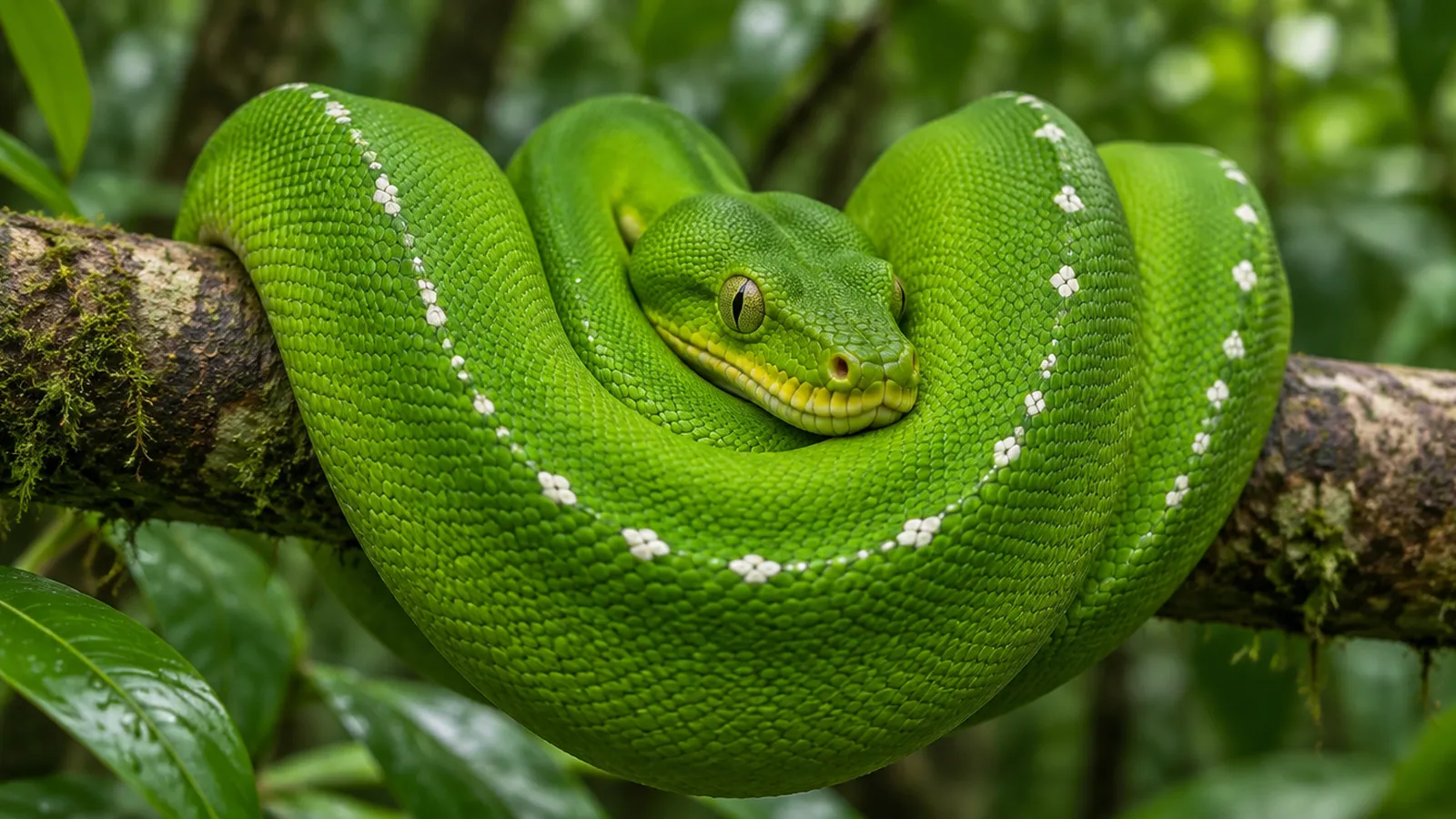
About the green tree python
The green tree python (Morelia viridis), often just called a "chondro" after its old scientific name, comes from the rainforests of New Guinea, the surrounding islands and the Cape York Peninsula of northern Australia. It spends almost its entire life in the trees, resting by day in a distinctive saddle-shaped coil draped over a branch, with its head tucked in the middle.
One of the most remarkable things about the species is its colour change. Babies hatch bright yellow, brick red or occasionally brown, and change to green as they mature, usually somewhere between 6 and 18 months old. For some it happens gradually over weeks; others seem to change almost overnight. Adults are typically leaf green with white or yellow flecks along the spine, and different localities (Aru, Biak, Sorong, Jayapura and others) have their own looks.
Green tree pythons have a reputation as difficult snakes, but when their enclosure is set up properly they are hardy and long-lived. They are not handling snakes, though, and they suit keepers who want a striking display animal and are prepared to manage temperature and humidity carefully.
Housing
The right enclosure makes a real difference with chondros. A snake that feels comfortable in its surroundings has a better feeding response and generally grows faster. Hatchlings do well in a small enclosure of around 30×30×30 cm (12×12×12 in), moving to about 60×45×45 cm (24×18×18 in) as juveniles. For an adult, 90×45×60 cm (36×18×24 in) is ample, and many keepers use a 60 cm cube or a vertical enclosure instead. As long as the snake has at least 60 cm in each direction, the exact shape doesn't matter much.
Don't jump straight to a huge enclosure for a young snake. Too much space can make a small chondro nervous, while too little makes it hard to create a proper temperature and humidity gradient. Size up as the snake grows.
PVC and wooden enclosures hold heat and humidity much better than glass, and they need to cope with years of misting. Fit horizontal perches about as thick as the snake's body at different heights, with at least one below the heat source, and add foliage for cover. Aquariums can be used for juveniles, but they need a proper secure lid rather than the original fish tank cover.
Substrate
Since chondros rarely come down to the floor, the substrate matters more for how it handles moisture than for the snake itself. Coco husk and cypress mulch hold humidity well, while paper towel is easy to clean and lets you keep an eye on droppings.
Heating
Green tree pythons need only a slight temperature gradient. Aim for a hot end of 30–32°C (86–90°F) and a cool end of about 24–26°C (75–79°F), with the overall air temperature around 28–30°C (82–86°F). A small drop of a couple of degrees at night is fine but not necessary.
A radiant heat panel on a proportional thermostat is the best setup, giving gentle, even heat from above. Unguarded heat bulbs are a real risk, because a resting chondro will happily sit right next to one and burn itself.
Lighting
A 12-hour day and night cycle keeps your snake in a natural routine. Low-output UVB is beneficial and helps any live plants in the enclosure.
Humidity
Rather than keeping humidity high all the time, follow a daily cycle: let it fall to around 50–60% during the day and mist in the evening so it climbs to 80–90% overnight. This mirrors the wild, where nights and early mornings are damp and days dry out.
Constant wet air with poor airflow is one of the main causes of respiratory infections in chondros, while an enclosure that's too dry leads to stuck sheds and dehydration. Many green tree pythons drink droplets that collect on their coils after misting, so mist even if there's a water bowl available.
Feeding
Hatchlings can be fed a pinky mouse every 5–7 days, juveniles a fuzzy or hopper mouse every 7–10 days, and adults an adult mouse or small rat every 14–21 days. Offer prey in the evening with long tongs, held near the snake's perch; most will strike from their branch.
Adult chondros have slow metabolisms and gain weight easily, which can lead to obesity and regurgitation. Keep meals modest and well spaced once the snake is fully grown. See how to thaw frozen rodents for preparing prey.
Handling
Keep handling to a minimum. Use a hook to lift the snake, or gently unwrap it from its perch starting at the tail. Never pull a coiled chondro off a branch; its grip is strong and you can injure its spine. Some individuals are calm, others bite readily, so treat every snake with respect.
Sexing
Males usually have longer tails with a gradual taper after the vent and more visible pelvic spurs. Females tend to be heavier-bodied. Probing by an experienced keeper or vet will confirm the sex.
Breeding
Females are usually ready to breed at around 3–4 years old once they've reached a good weight. Breeding is normally triggered by a night-time cooling period of a few degrees over several weeks. Females lay a clutch of around 10–25 eggs and often coil around them. Most keepers incubate the eggs artificially at around 31°C (88°F) for roughly 50 days.
Common health problems
The most common problems are respiratory infections from constantly wet, stagnant air, stuck sheds from low humidity, obesity and regurgitation from overfeeding, and burns from unguarded heat sources. Because chondros move so little, constipation can also be an issue; see constipation in reptiles. A healthy chondro sits in a tight, relaxed coil by day, takes a hunting posture at night, sheds cleanly and holds a steady weight.
FAQ
Why is my baby green tree python yellow? They change to green between about 6 and 18 months.
Can they be handled? Occasionally and briefly; use a hook.
How do you manage humidity? Drier by day (50–60%), misted to 80–90% at night.